

Key Takeaways
- Tailgating dramatically compresses the time available to perceive, react, and brake before a collision.
- Rear-end crashes are among the most common collision types reported on US highways.
- The three-second following-distance rule is a minimum baseline, not an ideal target.
- Adverse weather, fatigue, and distraction all make safe following distance even more critical.
- Tailgating is both a physics problem and a behavioral one - stress and impatience are major drivers.
Tailgating
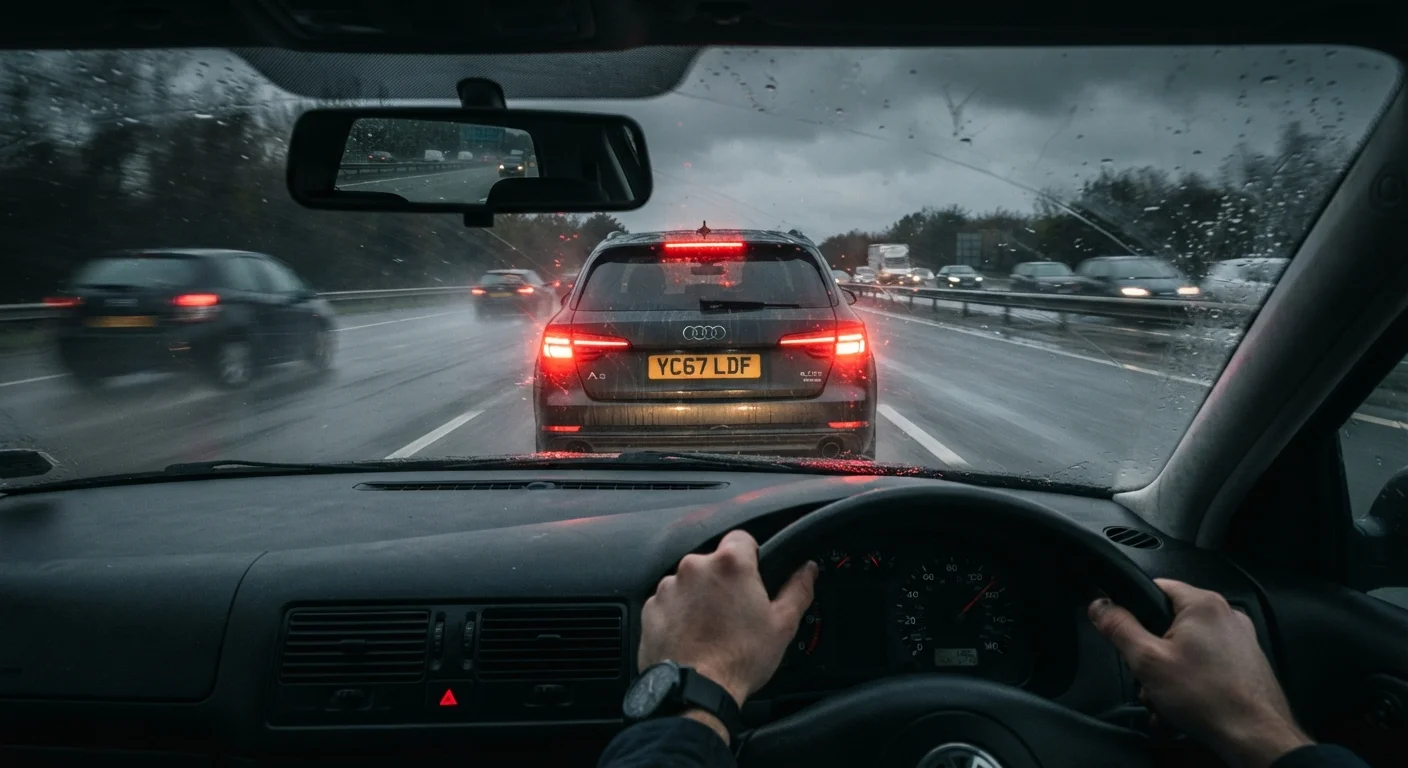
Tailgating is the practice of following another vehicle so closely that you would be unable to stop safely if that vehicle braked suddenly. It reduces your reaction window to near zero and is one of the most common causes of rear-end collisions on US roads. Most drivers who tailgate underestimate how little time and space they actually have.
At 60 mph, a vehicle travels approximately 88 feet per second. Human perception-reaction time alone - typically 1.5 seconds - means a car covers roughly 132 feet before braking even begins.
The Physics That Make Tailgating So Lethal
Speed and distance combine in ways most drivers don't intuitively grasp. At 60 mph, you're covering 88 feet every single second. By the time you notice brake lights ahead, process the information, move your foot to the brake pedal, and generate meaningful stopping force, a typical passenger vehicle has already traveled well over 100 feet - and that's before accounting for the braking distance itself.
When a following vehicle is only one or two car lengths behind, that math has no good outcome. The lead vehicle doesn't need to brake hard. Even a moderate slowdown can trigger a collision when the gap is too small. Wet pavement, worn tires, or a slightly slower reaction time - any one of these factors shifts the arithmetic further against the tailgating driver.
~29%
Share of all US crashes that are rear-end collisions
According to the National Highway Traffic Safety Administration (NHTSA), rear-end crashes consistently represent one of the largest categories of traffic collisions in the United States.
1.5 sec
Average human perception-reaction time
Traffic safety research identifies approximately 1.5 seconds as a typical perception-reaction interval - the time from noticing a hazard to beginning to apply the brakes.
88 ft/sec
Distance traveled at 60 mph per second
This figure illustrates why even a one-second delay in response can mean the difference between stopping safely and a collision at highway speeds.
This is why engineers and safety researchers treat following distance not as a courtesy, but as a physical buffer that literally determines whether a crash occurs. Unlike other driving behaviors where skill can compensate for risk, tailgating eliminates the margin that skill depends on.
Why Drivers Underestimate the Risk
If tailgating is so demonstrably dangerous, why do so many drivers do it? The answer involves both psychology and perception. Research in traffic behavior consistently finds that drivers overestimate their own reaction speed and underestimate how fast they're actually traveling. The brain is poor at judging closing distances at highway speeds - what feels like a safe gap often is not.
There's also a behavioral dimension. Tailgating frequently functions as a social signal - an attempt to pressure the car ahead to accelerate or change lanes. This is a hallmark of aggressive driving, and it's closely connected to the emotional state of the driver. Stress, running late, or frustration with slow-moving traffic can all push otherwise careful drivers into risky following behavior.
“Most drivers believe they are above average in skill and reaction time. That overconfidence is precisely what makes close following so dangerous - people drive to their imagined abilities, not their actual ones.”
— Traffic Safety Researcher, Transportation safety academic, paraphrasing findings from driver behavior literature
Understanding these psychological triggers is part of what defensive driving addresses. Rather than reacting emotionally to traffic, a defensive driver actively manages space and speed as a deliberate safety strategy.
Compounding Factors That Amplify the Danger
Tailgating doesn't occur in isolation. Several common conditions make it significantly more hazardous than it already is:
- Distraction: A glance at a phone or dashboard display adds critical fractions of a second to reaction time - fractions that matter enormously at close following distances.
- Fatigue: Drowsy drivers have measurably slower reaction times. The combination of driver fatigue and insufficient following distance is particularly dangerous on long highway stretches.
- Adverse weather: Rain, ice, and snow can more than double stopping distances. A gap that would have been marginal on dry pavement becomes wholly inadequate in wet conditions.
- Multiple-vehicle chain reactions: In congested traffic, tailgating by several consecutive drivers creates a chain reaction risk. One hard stop near the front can ripple backward as a multi-car pileup before the last driver ever sees a brake light.
Aggressive driving behaviors - including tailgating - often travel together. For context on related patterns, the distinction between aggressive driving and road rage is worth understanding, as the two are legally and behaviorally distinct.
Use a Fixed Marker for the Three-Second Count
Choose a stationary object on the roadside - a sign, overpass, or tree. When the car ahead passes it, count 'one-thousand-one, one-thousand-two, one-thousand-three.' You should not reach the same marker before you finish counting. In rain or low visibility, add at least one more second to your count.
Building the Habit of Safe Following Distance
The three-second rule is a practical starting point: pick a fixed roadside marker, and when the vehicle ahead passes it, count three seconds before you reach the same point. If you arrive sooner, you're following too closely. In adverse conditions or at higher speeds, extend that to four or five seconds.
The deeper habit, though, is one of spatial awareness - routinely checking the gap ahead, adjusting speed proactively rather than reactively, and resisting the impulse to close distance when a vehicle ahead is moving slower than you'd like. Merging and lane changes are often a safer outlet when you need to increase speed - though those maneuvers carry their own risks that deserve attention.
Ultimately, a safe following distance isn't just about protecting yourself. It's about giving the drivers behind you enough information and time to respond if you brake - making the entire road environment safer for everyone sharing it.
This article is for general informational and educational purposes. Always follow local traffic laws and consult appropriate authorities for jurisdiction-specific regulations.