

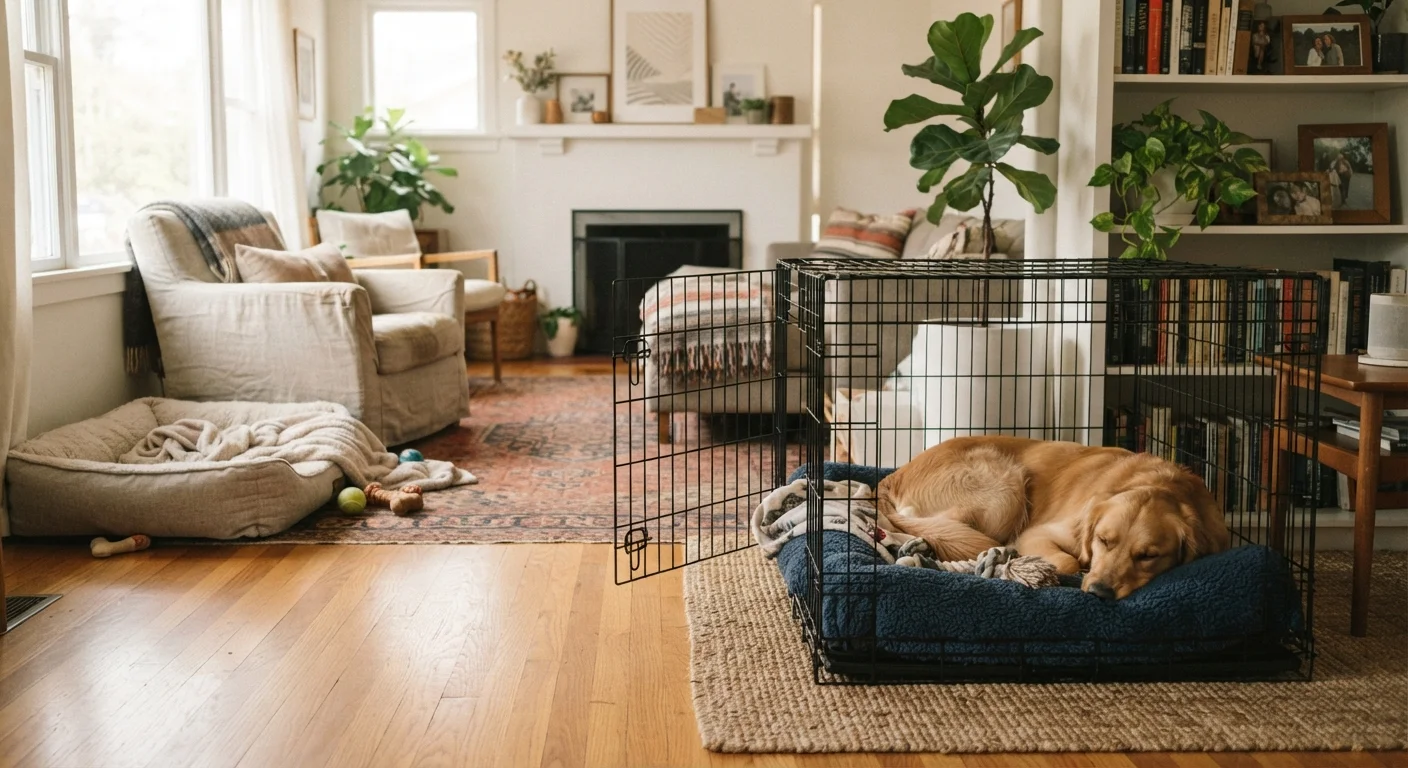
Key Takeaways
- Crate training supports housebreaking and gives dogs a secure, predictable retreat.
- Free roaming suits dogs with solid manners, but requires a dog-proofed environment.
- Neither method is universally better - age, temperament, and training history matter most.
- A crate should never feel like punishment; positive association is essential.
- Many owners use a hybrid approach, expanding freedom as the dog earns trust.
- Always consult your veterinarian if anxiety or destructive behavior is a concern.
Option A
Crate Training
The structured, den-like approach to containment and routine.
Best for: Puppies, newly adopted dogs, and dogs still building reliable house manners.
Option B
Free Roaming
The hands-off, trust-based approach that gives dogs full household access.
Best for: Adult dogs with established training, calm temperaments, and a proven track record at home.
If you're raising a puppy or welcoming a newly adopted dog
Crate Training
Puppies and new arrivals need structure to learn boundaries and build housebreaking habits. A crate provides a safe, manageable space while trust is being established.
If your adult dog is reliably house-trained and calm when left alone
Free Roaming
A dog with proven self-control and no destructive history can thrive with open access, which supports comfort and independence.
If your dog shows signs of separation anxiety
Crate Training
A familiar, enclosed space can reduce anxiety triggers for some dogs, though severe cases should be evaluated by a veterinarian or certified behaviorist.
If your dog is a senior with mobility challenges
Free Roaming
Older dogs often benefit from open access to water, resting spots, and movement without confinement. See our room-by-room comfort checklist for setup tips.
If you're unsure where your dog falls on the readiness spectrum
Crate Training
Starting with structure and gradually expanding freedom is safer than giving full access too early and walking back privileges after a problem occurs.
What Each Approach Actually Involves
Crate training means teaching your dog to spend time in a designated enclosure - typically a wire, plastic, or fabric crate - during unsupervised hours, overnight, or when you're away. Done well, it mimics the natural denning instinct many dogs have, giving them a quiet, bounded space that's entirely their own. The crate is never used as punishment; instead, it's introduced gradually with positive reinforcement until the dog enters willingly.
Free roaming means your dog has unsupervised access to part or all of your home. This could mean a single dog-proofed room, the full house, or anything in between. It works best when a dog has already demonstrated reliable behavior - no destructive chewing, no accidents indoors, and the ability to settle calmly when alone.
If you're still in the early days of dog ownership, our guide on what no one tells you before bringing a dog home covers how confinement decisions fit into the bigger picture of those first weeks.
| Criterion | Crate Training | Free Roaming |
|---|---|---|
| Best starting point for | Puppies and newly adopted dogs | Adult dogs with proven house manners |
| Housebreaking support | Strong - limits accident opportunities | Relies on prior house-training |
| Risk of destructive behavior | Low while crated | Higher if readiness is misjudged |
| Dog comfort and autonomy | Limited during crate time | High - dog chooses rest spots freely |
| Suitable for anxious dogs | Sometimes - depends on the dog | Often better for mild anxiety |
| Setup requirement | Crate, bedding, positive introduction | Thorough dog-proofing of home |
| Owner supervision needed | Low when crated correctly | High until trust is established |
The Real Trade-Offs of Each Method
Crate training's biggest advantage is control - specifically, the ability to prevent accidents, destructive behavior, and safety hazards while your dog is still learning the rules of the home. It also supports housebreaking by leveraging a dog's natural reluctance to soil their sleeping area. The downside is that improper use - crating for too many hours, introducing the crate harshly, or using it punitively - can create negative associations and increase stress.
How Long Is Too Long in a Crate?
General veterinary guidance suggests adult dogs should not be crated for more than four to six hours at a stretch during the day. Puppies under six months need bathroom breaks every two to three hours at minimum. Overnight crating is generally acceptable once a dog is comfortable, but crating for the majority of a dog's waking hours is not a substitute for exercise, enrichment, and social interaction. If your schedule makes long crating unavoidable, a dog walker or midday check-in is worth considering.
Free roaming's appeal is simplicity and comfort. Dogs with full access can move freely, choose their own rest spots, and avoid the frustration of confinement. The real risk is miscalculating readiness. Chewed baseboards, kitchen counter surfing, and indoor accidents are the most common signs a dog wasn't ready for that level of freedom - and those behaviors are harder to undo once they become habits.
Many owners land on a middle path: crating during the night or when away, and supervising with gradually expanding household access during the day. This hybrid approach is widely recommended by trainers and aligns with how dogs naturally build trust and self-regulation skills over time.
How to Know Which Setup Fits Your Dog
Age is the most reliable starting point. Puppies almost universally benefit from crate training - their bladder control is limited, their curiosity is relentless, and their understanding of household rules is zero. The puppy socialization window is also a time when structured, safe experiences matter most, and a crate supports that structure.
~4-6 hrs
Maximum recommended daily crate time for adult dogs
Veterinary behaviorists generally advise against confining adult dogs for longer periods without a break for exercise and interaction.
2-3 hrs
Maximum crate interval for young puppies
Puppies under six months have limited bladder capacity and typically need to eliminate every two to three hours, including overnight.
~70%
Of dog owners who use crates report faster housebreaking
Owner surveys conducted by veterinary and training organizations consistently show crate use correlates with shorter housebreaking timelines, though individual results vary.
Temperament matters just as much as age. A naturally anxious dog may find confinement distressing, while a dog prone to destructive behavior may not be safe with free access until training is solid. Observe how your dog behaves when mildly frustrated or left briefly alone - that's one of the clearest indicators of readiness.
Home setup plays a role too. A small apartment with few hazards is different from a large home with a kitchen trash can, staircases, or off-limits rooms. Dog-proofing any space your dog will access freely is non-negotiable, regardless of how well-trained they are. If you share your home with a senior dog, the room-by-room comfort checklist is worth reviewing before settling on a free-roaming arrangement.
This article is for general informational purposes only and is not a substitute for advice from a qualified veterinarian or certified animal behaviorist. If your dog shows persistent anxiety, destructive behavior, or other concerns, please consult a professional.