

Key Takeaways
- Several common repairs carry serious injury or vehicle-damage risks that home mechanics often underestimate.
- Professional shops have specialized tools, lifts, and diagnostic equipment that are impractical to replicate at home.
- Knowing when to hand a job to a mechanic can prevent costly mistakes and keep your vehicle safe.
- Safety-critical systems - brakes, suspension, airbags - should almost always be serviced by a qualified technician.
- A clear maintenance log helps mechanics diagnose problems faster and confirms work was done correctly.
When the Driveway Isn't the Right Workplace
Changing an air filter or topping off windshield washer fluid are well within the reach of any motivated car owner. But plenty of maintenance tasks that look manageable on video tutorials involve hidden risks - compressed systems, high-voltage components, or precise torque specifications - where a mistake can endanger you or make the vehicle unsafe to drive.
This list focuses on jobs where a qualified mechanic's training, equipment, and controlled environment genuinely change the outcome. If you're weighing which tasks to tackle yourself, our DIY vs. shop guide covers the broader trade-offs. For the jobs below, the professional route is the safer call.
A Note on Vehicle Lifts and Jack Safety
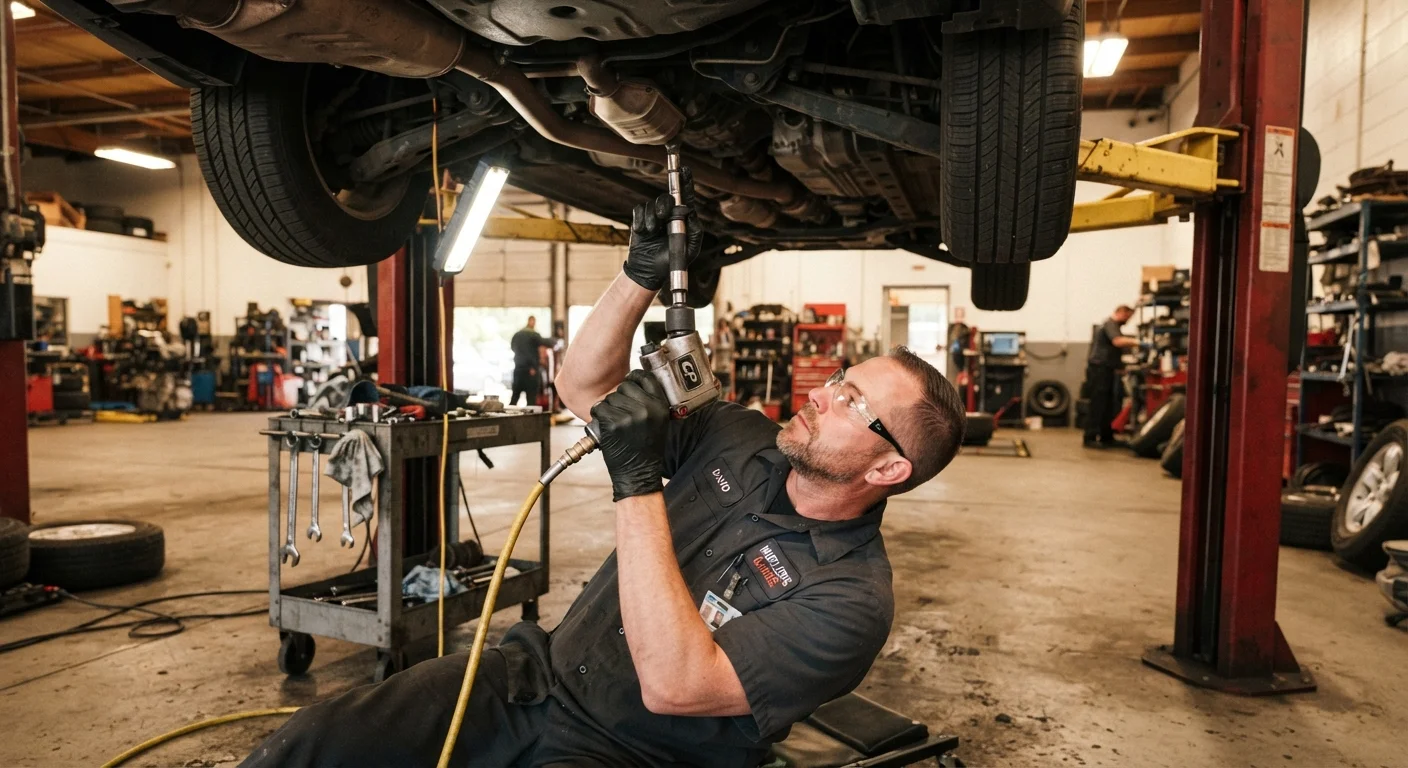
Many of the tasks below become more dangerous without a proper hydraulic lift. Floor jacks and jack stands can support a vehicle safely for routine work, but they have real limitations - they can slip, shift, or fail under a heavy load if used on uneven surfaces or if the vehicle's jack points aren't used correctly. A professional shop's lift provides full undercarriage access and stable, elevated support that a home garage typically cannot match.
Jobs Best Left to a Professional
Brake System Repairs Beyond Pad Replacement
Swapping brake pads is a task many experienced home mechanics handle safely. But the moment a job moves into brake lines, master cylinders, ABS (antilock braking system) modules, or caliper rebuilds, the risk profile changes dramatically. Brake hydraulics operate under high pressure, and any air introduced into the lines or a connection that isn't fully sealed can cause brake fade or sudden failure - neither of which announces itself until you need to stop quickly.
Shops use dedicated brake bleeding equipment and can pressure-test the system before the vehicle leaves the bay. At home, improvised bleeding methods often leave residual air. Given that brakes are the most safety-critical system on your vehicle, professional service for anything beyond a straightforward pad swap is strongly advisable.
A brake line with residual air can fail exactly when you need to stop hardest.
Suspension and Steering Component Replacement
Control arms, ball joints, tie rod ends, and struts require precise torque values and, in many cases, a front-end alignment immediately after installation. Without an alignment rack - equipment that costs tens of thousands of dollars - you cannot confirm the wheels are pointed correctly. Driving on a misaligned suspension accelerates tire wear, compromises handling, and can make a vehicle pull unpredictably at highway speeds.
There's also a physical risk: coil springs store enormous energy. Compressing them without a proper spring compressor tool is one of the most commonly cited causes of serious workshop injuries among home mechanics. A shop that performs this work routinely has the correct tools and knows exactly how much force is involved.
An improperly compressed coil spring can release with enough force to cause serious injury.
Airbag and Supplemental Restraint System Work
Any repair that requires removing a steering wheel, dashboard trim, or seat components risks disturbing airbag wiring or the airbag module itself. Supplemental restraint systems (SRS) can deploy unexpectedly - even with the battery disconnected - because of residual charge stored in capacitors. Accidental deployment during a repair can cause severe injury and will destroy the airbag unit, adding significant cost to whatever job prompted the work in the first place.
Diagnosing and servicing airbag systems also requires manufacturer-specific scan tools to read fault codes accurately. Generic code readers often cannot interface with SRS modules reliably. This is a clear case where specialist equipment and training are prerequisites, not optional extras.
Airbag capacitors retain enough charge to trigger deployment even after disconnecting the battery.
Transmission Fluid Flush and Internal Repairs
A simple drain-and-fill of transmission fluid is manageable for mechanically inclined owners on some vehicles. A full flush - which exchanges nearly all fluid including that held in the torque converter - is another matter. Done incorrectly on a high-mileage transmission, a full flush can dislodge debris that had been harmlessly suspended, circulating it through narrow passages and valves.
Internal transmission repairs require a clean, controlled environment, specialized rebuild tools, and detailed knowledge of band adjustments and clutch pack clearances that vary by transmission type. Errors here are expensive: a transmission replacement is one of the costliest repairs on any vehicle. Skipping or botching this service can turn a routine fluid interval into a full rebuild bill.
A botched transmission flush on a worn unit can accelerate the very damage you were trying to prevent.
Fuel System Work
The fuel system - injectors, fuel pump, fuel lines, and the tank itself - handles flammable liquid under pressure. Even a small fuel leak near an ignition source creates a fire risk. On most modern vehicles, releasing fuel system pressure requires a specific procedure and, in many cases, a scan tool to command the pump off safely before opening any line.
Fuel pump replacement typically means working in or near the fuel tank, which may require dropping the tank entirely - a job that demands a vehicle lift and proper support equipment. Home mechanics working on jack stands face genuine risk if a tank shifts or falls. The combination of flammable fuel, confined space, and awkward positioning makes this one of the cleaner cases for deferring to a shop.
Fuel system work combines flammable materials, high pressure, and confined spaces - a risk combination that demands professional handling.
Timing Belt or Timing Chain Service
On interference engines - where the pistons and valves share overlapping space in the cylinder - a timing belt or chain that breaks or slips can cause the valves and pistons to collide. The result is typically catastrophic internal engine damage. Replacement requires precise timing of the crankshaft and camshaft(s) using alignment tools specific to each engine family.
The job is also labor-intensive: accessing the timing components on many vehicles means removing the front engine accessories, sometimes the radiator, and frequently the harmonic balancer. A misaligned reinstall - even by a single tooth on the timing sprocket - can cause rough running, misfires, or immediate engine damage at startup. Consulting your manufacturer's maintenance schedule will confirm the recommended service interval for your specific engine.
On an interference engine, a timing belt installed one tooth off can destroy the engine at first startup.
Get a Second Opinion on Complex Estimates
If a shop quotes you for any of these higher-stakes repairs, it's entirely reasonable to seek a second estimate from another licensed facility. Reputable shops expect this for major work. Ask both shops to explain what specific components they're replacing and why - the quality of that explanation tells you a great deal about the technician's competence.
Making the Most of Every Shop Visit
Recognizing the limits of at-home repair is only half the equation. When you do bring your vehicle in, arrive prepared: describe symptoms specifically (sounds, smells, when they occur), ask for a written estimate before work begins, and request that worn parts be shown or returned to you. If your vehicle has higher mileage, keeping aging systems well-maintained becomes especially important - deferred repairs compound faster on older vehicles.
Keeping a simple maintenance log also pays dividends: it helps mechanics spot patterns quickly, confirms that safety-critical work was completed, and supports your vehicle's resale value. The goal isn't to avoid DIY entirely - it's to match each task to the right skill level and environment.
This article is for general informational purposes. For repairs involving safety-critical systems, always consult a qualified, licensed automotive technician.