

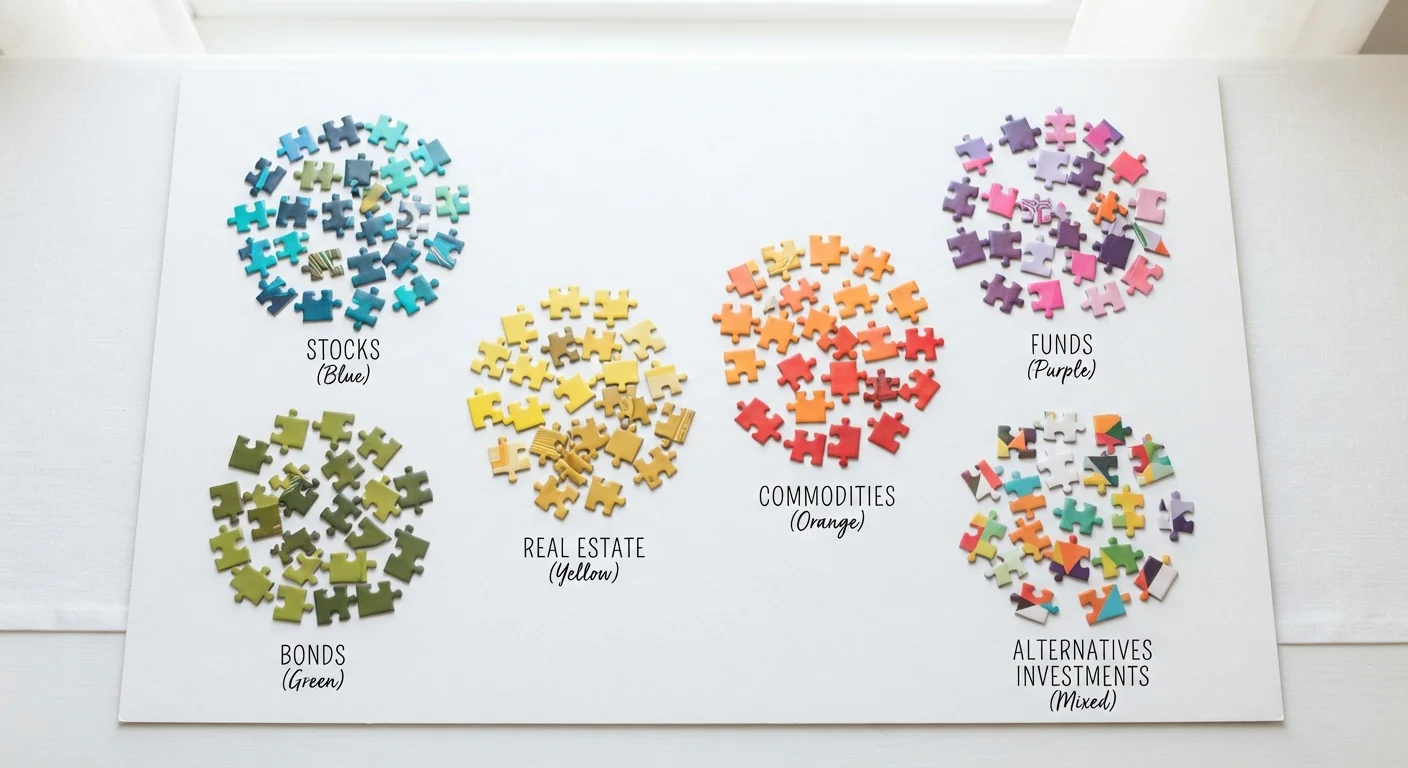
Key Takeaways
- Diversification means spreading investments across asset classes, not just owning many stocks.
- Owning 20 stocks in the same sector does not meaningfully reduce your risk.
- Low-cost index funds make broad diversification accessible to everyday investors.
- Rebalancing periodically keeps your portfolio aligned with your original risk goals.
- Over-diversification can dilute returns without proportionally reducing risk.
What Diversification Actually Means
Many investors think diversification simply means owning a lot of different investments. In reality, it means owning investments that don't all move in the same direction at the same time. If every holding in your portfolio rises and falls together, you haven't reduced your risk - you've just multiplied it.
Genuine diversification works by combining assets with low or negative correlation - a measure of how closely two investments move in relation to each other. When stocks fall, for example, high-quality bonds have historically sometimes held steady or risen, softening the overall impact on a portfolio. That cushioning effect is the whole point.
If you're newer to investing fundamentals, see our beginner's guide to investing for a solid foundation before building a diversified strategy.
Correlation: The Key Concept Behind Diversification
Correlation is measured on a scale from -1 to +1. Investments with a correlation near +1 tend to move together; those near -1 tend to move in opposite directions. The closer to zero (or negative), the more diversification benefit you gain by combining them. You don't need to calculate this yourself - it's the principle behind why mixing stocks, bonds, and other asset classes matters more than simply owning many individual stocks.
The Most Common Diversification Mistakes
The most frequent error is what financial educators sometimes call diworsification - accumulating so many similar investments that you add complexity without reducing risk. Owning 15 large-cap U.S. tech stocks is not diversification. It's concentration with extra steps.
Another mistake is ignoring asset class diversity entirely. A portfolio of only stocks - even across many sectors - is still fully exposed to equity market downturns. True diversification typically involves spreading money across asset classes such as equities, fixed income (bonds), cash equivalents, and potentially real assets like real estate investment trusts (REITs).
It's also worth noting that geographic concentration is a risk. U.S. stocks have performed well historically, but global economic cycles don't always align. International exposure - both developed and emerging markets - adds another dimension of diversification.
~500
Securities in a typical S&P 500 index fund
A single broad index fund can hold hundreds of individual company stocks, providing instant diversification across the U.S. large-cap market without selecting individual securities.
60/40
Classic stock-bond diversification ratio
The 60% stocks / 40% bonds portfolio allocation has long been a benchmark for balanced diversification, though appropriate ratios vary by individual risk tolerance and time horizon.
Practical Ways to Diversify Without Overcomplicating It
The good news is that genuine diversification doesn't require actively managing dozens of positions. Index funds and exchange-traded funds (ETFs) that track broad market benchmarks - such as a total U.S. stock market fund, an international stock fund, and a bond fund - can deliver meaningful diversification in just a few holdings.
Spread investments across multiple asset classes, not just multiple stocks.
Stocks, bonds, cash, and real assets respond differently to economic conditions. Holding only one asset class leaves you fully exposed to that market's downturns, no matter how many individual positions you hold.
Include geographic diversification by adding international exposure.
U.S. and international markets don't always move in sync. Adding exposure to developed and emerging markets abroad can reduce the impact of a domestic market slump on your overall portfolio.
Use low-cost index funds to achieve broad diversification efficiently.
Actively selecting dozens of individual securities to diversify is time-consuming and introduces the risk of poor choices. A single index fund can hold hundreds or thousands of securities, instantly spreading risk at low cost.
Avoid concentrating in any single sector, industry, or theme.
Sector-specific downturns - such as a technology correction or an energy price collapse - can devastate a portfolio concentrated in that area, even if it looks diversified on the surface.
Rebalance your portfolio at least once a year to maintain your target allocation.
Portfolio drift caused by uneven market gains can silently push you into a riskier or more conservative position than you intended. Regular rebalancing keeps your risk level aligned with your goals and timeline.
This kind of simple, low-cost approach is consistent with advice widely endorsed by financial educators and regulators. As the U.S. Securities and Exchange Commission notes in its public investor guides, diversification is one of the most important ways investors can manage investment risk. It doesn't eliminate risk, but it helps ensure that no single loss is catastrophic.
For those who invest regularly, pairing diversification with dollar-cost averaging can further reduce the impact of short-term market swings by spreading purchases over time rather than investing a lump sum at once.
Maintaining Your Diversification Over Time
Diversification isn't a one-time setup - it requires periodic attention. As markets move, some assets grow faster than others, gradually shifting your portfolio away from your original allocation. This is called portfolio drift, and left unchecked, it can quietly increase your risk exposure.
Rebalancing - periodically selling assets that have grown beyond their target allocation and buying those that have shrunk - restores your intended risk level. Many financial educators suggest reviewing your allocation at least annually or after major market moves.
One important caveat: rebalancing within tax-advantaged accounts (like a 401(k) or IRA) typically has no immediate tax consequences. Rebalancing in a taxable brokerage account may trigger capital gains taxes, so it's worth discussing the timing and method with a qualified financial adviser. This article is general financial education - not personalized investment advice. Your specific situation may differ, and consulting a licensed financial professional is always a sound step before making significant portfolio changes.
For more on clearing up misconceptions that might hold you back, explore common investing myths debunked.
This article is for general informational and educational purposes only and does not constitute personalized financial, investment, or tax advice. Consult a qualified financial professional before making investment decisions based on your individual circumstances.