

Key Takeaways
- Green, black, white, and oolong teas all come from the same plant species, Camellia sinensis.
- The degree of oxidation during processing is the primary factor that distinguishes one tea type from another.
- Black tea is fully oxidized; green and white teas are minimally processed; oolong falls in between.
- Caffeine content varies by variety and brew time, but no tea is caffeine-free unless explicitly labeled herbal.
- Water temperature and steeping time significantly affect flavor - each tea type has its own ideal brew conditions.
Start here
One Plant, Four Teas
Core concept
What Oxidation Actually Does
Apply it
Breaking Down Each Variety
Go deeper
Caffeine, Antioxidants, and What's in the Cup
Put it to use
How to Brew Each Type Correctly
One Plant, Four Teas
Walk down the tea aisle and you'll find dozens of varieties with very different names, colors, and flavor descriptions. But four of them - green, black, white, and oolong - all begin as leaves from a single plant species: Camellia sinensis. What separates them isn't where they grow or what they absorb from the soil, though those factors do influence flavor. The defining variable is what happens to the leaf after it's picked.
Processing transforms the same raw material into strikingly different beverages. Understanding how is the key to understanding tea - just as understanding brewing method explains why the same coffee bean tastes so different as espresso versus drip. See our guide to espresso and drip coffee for a parallel comparison.
Oxidation
A chemical reaction where tea leaf enzymes interact with oxygen after picking, darkening the leaf and transforming its flavor compounds. It's the central process that differentiates tea types.
Camellia sinensis
The plant species from which all true teas - green, black, white, and oolong - are made. Different cultivars and growing regions produce different flavor profiles.
Catechins
A group of naturally occurring antioxidant compounds found in tea leaves, particularly abundant in green tea. They belong to a larger family of plant chemicals called polyphenols.
Kill-green
A heat-application step used in green (and some white) tea production that stops oxidation by deactivating the enzymes in the leaf. It preserves the green color and fresh flavor.
Theaflavins
Antioxidant compounds that form during the full oxidation of black tea. They contribute to the tea's characteristic amber color and some of its flavor complexity.
What Oxidation Actually Does
The single most important process in tea production is oxidation. After leaves are picked, they begin to wilt. If producers then crush or roll the leaves, they break open the cell walls, exposing enzymes to oxygen. Those enzymes react with oxygen and start a chemical transformation - similar to how a cut apple turns brown.
The longer and more completely oxidation is allowed to proceed, the darker the leaf becomes and the more dramatically its flavor compounds change. Grassy, vegetal notes give way to floral ones, then to malty, earthy, and robust flavors. Producers control this by applying heat - a step called kill-green in green tea or firing in black - which stops oxidation by deactivating the enzymes.
A Quick Way to Remember the Spectrum
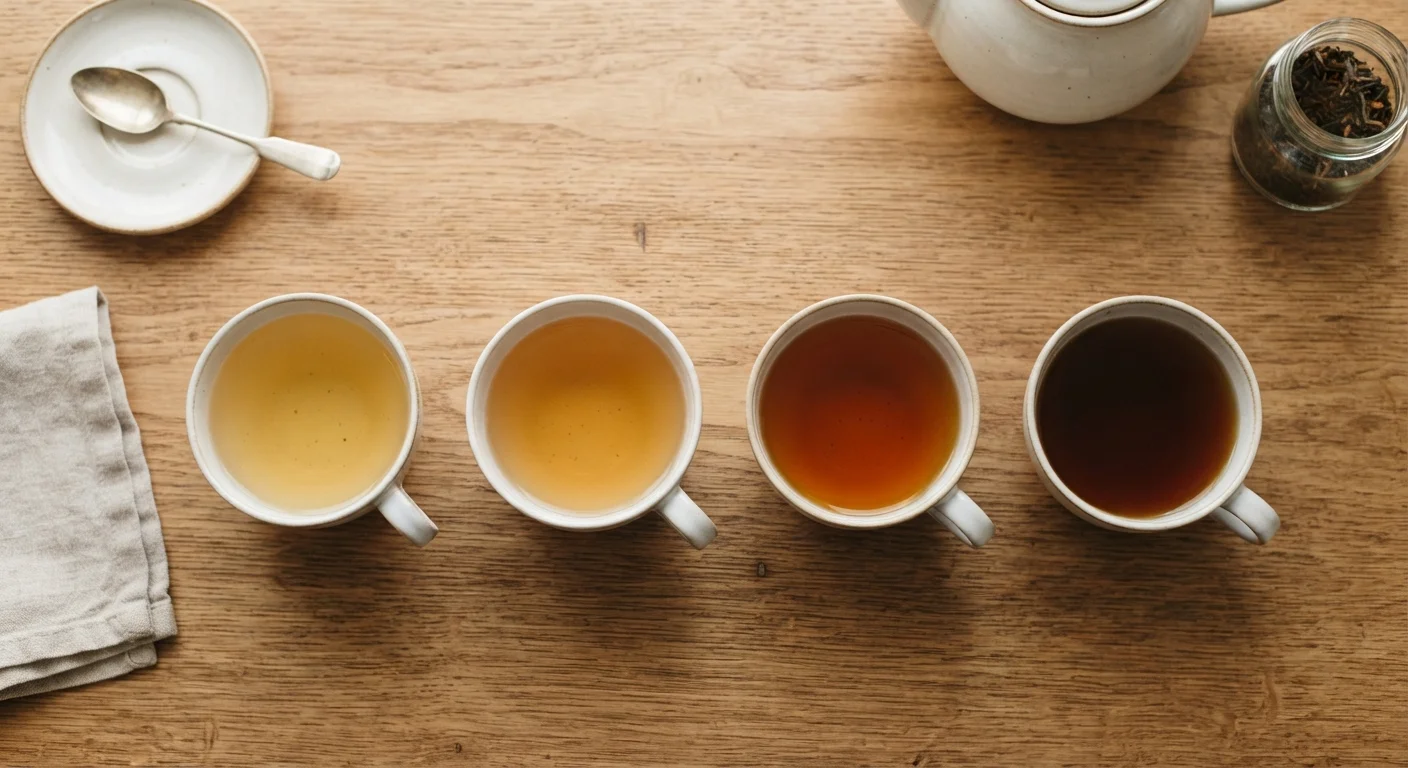
Think of tea processing as a dial from zero to full oxidation. White tea sits near zero, green tea just above it, oolong somewhere in the middle, and black tea at the far end. The further along the dial, the darker the leaf, the deeper the brew color, and the bolder the flavor.
Breaking Down Each Variety
Here's how each of the four major tea types is produced and what that means for your cup:
- White tea is the least processed. Young leaves and buds are picked and simply dried - very little rolling, no deliberate oxidation. The result is a pale, lightly colored brew with a gentle, subtly sweet flavor.
- Green tea is harvested and then quickly heated - either steamed (common in Japanese styles) or pan-fired (common in Chinese styles) - to stop any oxidation. The leaf stays green, and the flavor stays fresh, grassy, or vegetal depending on origin and method.
- Oolong tea occupies a wide middle ground. Leaves are deliberately allowed to oxidize partially - anywhere from about 15% to 85% - before being stopped. This range produces an enormous variety of flavors: some oolongs are light and floral, others are deep and roasted.
- Black tea undergoes full oxidation. Leaves are withered, rolled, fully oxidized, and then dried. The leaf turns dark, and the brew is deep amber to brown with bold, malty, sometimes astringent flavors.
Caffeine, Antioxidants, and What's in the Cup
All four types contain caffeine, though amounts vary. Black tea is typically highest, followed by oolong, green, and white - though steep time, water temperature, and how much leaf you use affect the final amount in any given cup. No true tea is caffeine-free.
Tea also contains compounds called catechins and polyphenols - plant-based antioxidants that have been studied for their potential health effects. Green tea is particularly high in a catechin called EGCG (epigallocatechin gallate). Black tea has fewer catechins but contains theaflavins and thearubigins, which form during oxidation and contribute both color and their own antioxidant properties.
Research on tea and health is ongoing, and while some associations look promising, it's worth approaching specific health claims cautiously. What's established is that tea is a low-calorie beverage with a well-documented history as part of varied diets around the world. For a parallel look at what's in another popular beverage, see our breakdown of what's actually in coffee.
Tea Research Is Still Evolving
Many studies on tea and health are observational, meaning they note associations rather than proving direct cause and effect. Factors like diet, lifestyle, and tea preparation methods differ across studies, making it difficult to draw firm conclusions. Treat specific health claims about tea with appropriate skepticism, and consult a qualified healthcare professional for guidance relevant to your own health.
How to Brew Each Type Correctly
Using the right water temperature and steeping time makes a real difference in flavor - especially for green and white teas, which can turn bitter if brewed too hot or too long.
| Tea Type | Water Temperature | Steep Time |
|---|---|---|
| White | 160-185°F (70-85°C) | 2-5 minutes |
| Green | 160-180°F (70-80°C) | 1-3 minutes |
| Oolong | 185-205°F (85-96°C) | 2-5 minutes |
| Black | 200-212°F (93-100°C) | 3-5 minutes |
These are general starting points. Loose-leaf teas from specific regions may have their own recommended parameters - always a good idea to check guidance from the producer when available. Experimenting within these ranges is the most reliable way to find what suits your taste.
Avoid Boiling Water for Delicate Teas
Pouring boiling water (212°F/100°C) over green or white tea leaves can scorch them, releasing harsh, bitter tannins that overwhelm the tea's natural flavors. Let boiling water cool for two to three minutes, or use a temperature-controlled kettle to stay within the recommended range.