

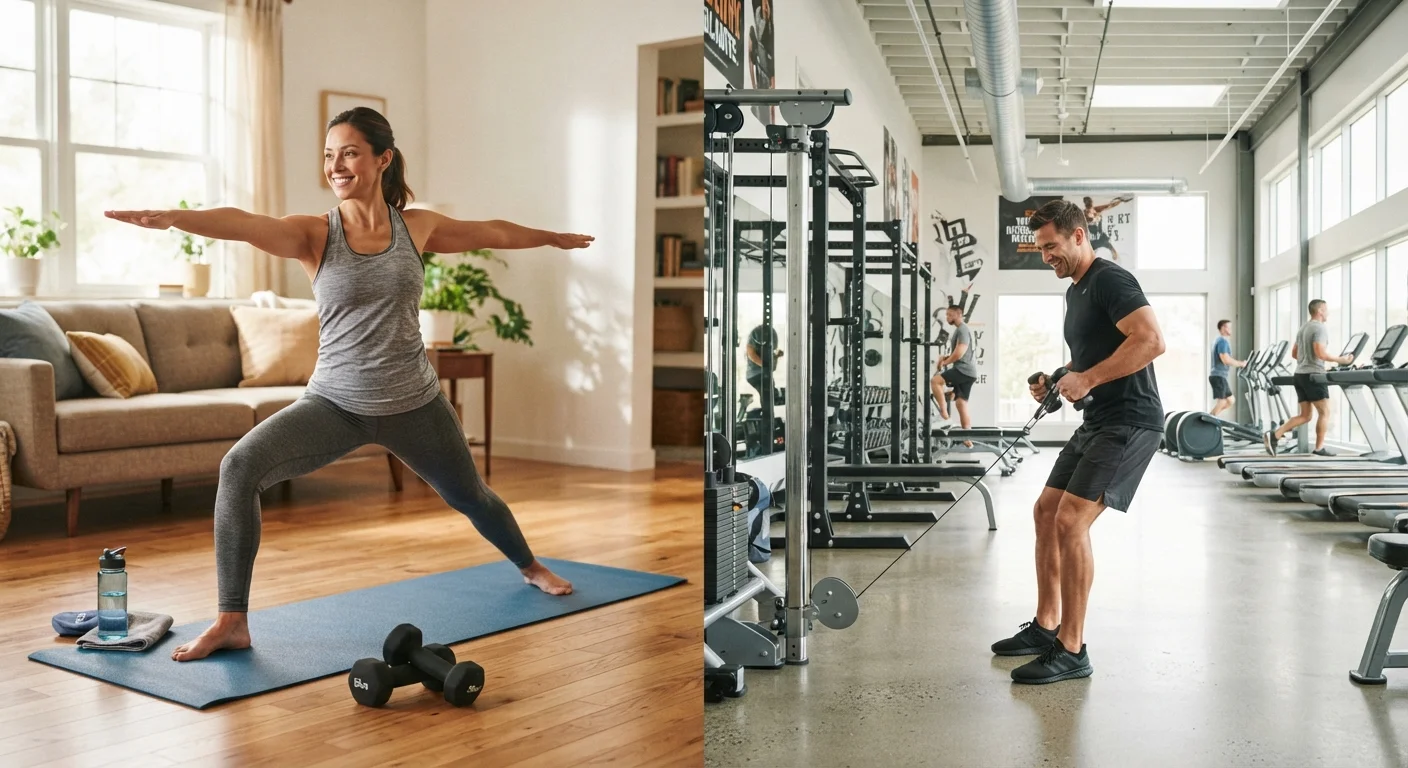
Key Takeaways
- Home workouts eliminate commute time and cost, making consistency easier for busy schedules.
- Gyms offer equipment variety and professional guidance that can accelerate certain fitness goals.
- Neither setting is inherently superior - adherence and effort matter more than location.
- A hybrid approach works well for many people, combining both environments strategically.
No commute saves significant time each session
Eliminating travel to and from a gym can reclaim 30-60 minutes per workout, making it easier to maintain frequency for people with demanding schedules.
Lower ongoing financial cost
Once basic equipment is purchased, home training carries no monthly fees. Over one to two years, this often represents meaningful savings compared to gym memberships.
Available on your schedule, any time
Home workouts aren't subject to facility hours, holiday closures, or peak-time crowding - reducing the logistical friction that disrupts consistency.
Private and low-pressure environment
Training at home removes the social anxiety that deters some people from the gym, particularly beginners or those returning after a long break.
Flexible equipment options at various price points
Resistance bands, adjustable dumbbells, and bodyweight progressions can support a wide range of fitness goals without requiring a large dedicated space.
Limited equipment constrains certain training goals
Heavy compound lifting, cable-based exercises, and sport-specific conditioning machines are difficult or expensive to replicate at home, which can become a ceiling for advanced goals.
Distractions and lack of structure can undermine consistency
Home environments come with competing demands - family, chores, screens - that a gym's dedicated space naturally filters out.
No access to professional guidance on-site
Gyms typically offer personal trainers, group classes, and staff who can correct form or adjust programming - resources not available in most home setups.
Social motivation and accountability are absent
For people who thrive on group energy or workout partners, training alone at home removes a significant source of motivation that helps many people maintain long-term habits.
Our Verdict
Home workouts and gym training each deliver real fitness results when approached consistently. The gap between them narrows considerably once you account for how often you'll actually show up. Your schedule, budget, goals, and the social or solitary nature you prefer in exercise are the variables that matter most.
Home training suits those with tight schedules, budget constraints, or a preference for privacy; gym training suits those who benefit from structured environments, diverse equipment, or social motivation.
What Actually Determines Your Results
The debate between training at home and going to a gym often focuses on equipment and facilities - but exercise science consistently points to a more fundamental factor: adherence. The setting that gets you moving regularly, week after week, is the one that produces results. That said, understanding the concrete trade-offs between the two environments helps you build a setup you'll actually stick with.
Before weighing the pros and cons below, it's worth reading through what to think through before starting a new workout program - a practical checklist covering health history, scheduling, and equipment that applies regardless of where you train.
#1
Barrier to exercise cited by US adults
Lack of time is consistently ranked as the leading reason American adults do not meet physical activity guidelines, according to CDC survey data.
~23%
US adults meeting aerobic and muscle-strengthening guidelines
The CDC reports that only about 1 in 4 U.S. adults meet both the aerobic and muscle-strengthening components of federal physical activity guidelines.
The Case for Home Workouts
Training at home removes several of the most common barriers to exercise: travel time, membership fees, and the social self-consciousness that keeps many people from ever setting foot in a gym.
No commute saves significant time each session
Eliminating travel to and from a gym can reclaim 30-60 minutes per workout, making it easier to maintain frequency for people with demanding schedules.
Lower ongoing financial cost
Once basic equipment is purchased, home training carries no monthly fees. Over one to two years, this often represents meaningful savings compared to gym memberships.
Available on your schedule, any time
Home workouts aren't subject to facility hours, holiday closures, or peak-time crowding - reducing the logistical friction that disrupts consistency.
Private and low-pressure environment
Training at home removes the social anxiety that deters some people from the gym, particularly beginners or those returning after a long break.
Flexible equipment options at various price points
Resistance bands, adjustable dumbbells, and bodyweight progressions can support a wide range of fitness goals without requiring a large dedicated space.
Research on exercise behavior consistently identifies convenience as one of the strongest predictors of long-term adherence. When the friction of getting to a workout drops, the likelihood of completing it rises. Bodyweight training, resistance bands, and a modest set of dumbbells can cover a wide range of fitness goals - from building foundational strength to improving cardiovascular capacity. For those returning to fitness after a long break, the lower-pressure environment of home can also make the early weeks feel less daunting.
The Case for Gym Training
A well-equipped gym offers resources that are genuinely difficult to replicate at home without significant cost - and for certain goals, those resources matter.
Limited equipment constrains certain training goals
Heavy compound lifting, cable-based exercises, and sport-specific conditioning machines are difficult or expensive to replicate at home, which can become a ceiling for advanced goals.
Distractions and lack of structure can undermine consistency
Home environments come with competing demands - family, chores, screens - that a gym's dedicated space naturally filters out.
No access to professional guidance on-site
Gyms typically offer personal trainers, group classes, and staff who can correct form or adjust programming - resources not available in most home setups.
Social motivation and accountability are absent
For people who thrive on group energy or workout partners, training alone at home removes a significant source of motivation that helps many people maintain long-term habits.
Progressive overload - the principle of gradually increasing training stress to drive adaptation - is easier to apply when you have a full range of weights, cable machines, and specialty equipment at hand. If your goals include building significant muscle or improving sport-specific performance, a gym environment typically gives you more tools to do that systematically. Access to fitness professionals and group classes can also provide structure that self-directed home training lacks.
Form and Injury Risk in Any Setting
Access to equipment doesn't automatically translate to safe or effective training. Poor movement mechanics in a gym can cause injury just as readily as at home. If you're new to strength training or returning after time off, working with a certified trainer for even a few sessions - regardless of setting - can establish safer movement patterns. Always consult a healthcare professional if you have any existing injuries or conditions before beginning a new program.
Practical Considerations Before You Decide
A few honest questions can clarify which direction makes more sense for your life right now - keeping in mind that the answer may change over time.
- Budget: Gym memberships vary widely in cost. Home setups require upfront equipment investment but have no ongoing fees. Neither is universally cheaper over time.
- Schedule: A 30-minute home session may be more feasible on a demanding workday than a 90-minute round trip to a gym. Time constraints are real, not excuses.
- Goals: Bodyweight and minimal equipment training can build real strength and endurance. But if powerlifting or sport-specific conditioning is the aim, equipment access becomes more relevant.
- Motivation style: Some people are energized by gym environments; others find them distracting or anxiety-inducing. Neither response is wrong.
It's also worth remembering that formal workouts aren't the only way movement contributes to health. Non-exercise activity thermogenesis (NEAT) - the movement you accumulate throughout your day - plays a surprisingly large role in overall health, regardless of where your structured exercise happens.
For many people, a hybrid model works well: consistent home sessions during the week supplemented by gym visits when time and goals call for it. What matters most is building a sustainable reason to keep moving rather than optimizing the setting before you've built the habit.
This article is for general informational and educational purposes only and is not a substitute for personalized guidance from a qualified fitness or healthcare professional. Consult a professional before starting or significantly changing your exercise routine, particularly if you have any existing health conditions.