

Key Takeaways
- Communities use language, dress, humor, and rituals to signal who is truly 'in.'
- These boundary markers serve real social functions but can also exclude unintentionally - or very intentionally.
- Recognizing these signals helps newcomers navigate groups and helps insiders reflect on their own community dynamics.
- Both online and offline communities rely on the same core mechanisms to define membership.
- Belonging feels good; exclusion can sting - understanding the machinery behind both matters.
The Invisible Architecture of Belonging
Walk into any tight-knit group - a neighborhood watch meeting, a gaming Discord server, a CrossFit gym, a neighborhood book club - and within minutes you'll notice it: a shared shorthand that flows easily between regulars but lands awkwardly for newcomers. That shorthand isn't accidental. It's the product of a community actively, if often unconsciously, defining its edges.
Sociologists call these mechanisms boundary markers - the symbolic and behavioral cues that separate members from non-members. They exist in every human group, from ancient tribes to today's online fandoms. Understanding them isn't just an academic exercise; it's a genuinely useful lens for navigating social life. Whether you're trying to find your footing in a new group or reflect honestly on a community you already belong to, these patterns are worth knowing. See how they compare to the broader forces that determine what makes a community stick together.
Specialized Language and Slang
Every community develops its own vocabulary. Skaters talk about tricks by specific names. Medical professionals use clinical shorthand. Online communities coin new terms at a dizzying pace - think of the layered meanings baked into phrases that circulate on Reddit or TikTok. This linguistic drift isn't random; it's functional.
Shared language compresses complex ideas into fast signals and tells others: I've put in the time to learn how we talk here. It's one of the most reliable markers of authentic membership. By extension, getting the terminology wrong - or using last season's slang - can quietly flag you as an outsider. Memes carry this same function, encoding in-group values and references that insiders recognize instantly and outsiders often miss entirely.
Getting the terminology wrong can quietly flag you as an outsider, even before you say much else.
Dress Codes - Written and Unwritten
Sometimes the signal is literal: a uniform, a logo, a team jersey. More often it's subtler - the right brand of sneakers, a particular style of flannel, a lanyard from the right conference. Dress functions as a fast visual shortcut for community affiliation, communicating identity before a single word is spoken.
Subcultures in particular lean heavily on aesthetic codes. What started as functional workwear for skaters, or thrift-store finds for early hip-hop fans, became powerful in-group markers. Notably, when these codes go mainstream, long-time members often feel something is lost - because the signal has been diluted. When subcultures go mainstream, this aesthetic erosion is one of the first casualties.
Dress functions as a visual shortcut for community affiliation, communicating identity before a word is spoken.
Inside Jokes and Shared References
Shared humor is powerful social glue - and a surprisingly effective filter. An inside joke rewards those who were there for the original context and gently reminds everyone else that they weren't. References to a community's founding moment, a legendary argument, or a running bit that dates back years all function as membership tests.
In online spaces, this often manifests as meme fluency. Knowing which meme format is ironic-retro versus sincerely used, or being able to trace a reference back to its original context, signals depth of engagement. Every online forum has unwritten rules around this - and missing them can mark someone as a newcomer more clearly than anything they say directly.
An inside joke rewards those who were there and gently reminds everyone else that they weren't.
Rituals and Initiation Norms
Groups formalize belonging through rituals - some elaborate, most mundane. A subreddit might require new members to post a specific type of introduction. A hobbyist group might expect newcomers to lurk before speaking. A sports fanbase may have chants that regulars know by heart. These rituals serve a real purpose: they create a shared experience that marks the transition from outsider to member.
Even informal rituals carry weight. The expectation that you bring something to a potluck, show up early to help set up, or simply know the order at a regular gathering are all low-key tests of commitment. Communities like fandoms make this particularly visible - fandoms have distinct hierarchies and rituals that newcomers must learn to navigate carefully.
Rituals - even mundane ones - mark the transition from outsider to member in almost every community.
Knowledge Tests (Formal and Informal)
"Do you even know who started this subreddit?" "You said you're a fan - name five albums." Knowledge gatekeeping is one of the blunter community signals, but it's extremely common. Demonstrating depth of knowledge - about a band's early catalog, a sport's historical stats, a neighborhood's history - signals genuine investment rather than surface-level interest.
This can be earnest and welcoming (sharing knowledge to bring someone in) or hostile (deploying trivia as a weapon to exclude). The same mechanism powers very different community cultures. Online communities in particular can tip quickly toward the gatekeeping end, making it worth reading about how online belonging differs from place-based community - the norms around knowledge and status often diverge significantly.
Knowledge gatekeeping can be welcoming or hostile - the same mechanism powers very different community cultures.
Behavioral Norms and Unspoken Rules
Perhaps the most pervasive signals are the ones that are never explicitly stated. How loud is too loud? Who speaks first in a meeting? Is it okay to disagree openly, or does harmony require nodding along? These unwritten behavioral norms are absorbed gradually by members and remain invisible until someone violates them.
Communities enforce these norms through subtle social correction - a well-timed silence, a redirect in conversation, a private message. Being unaware of them isn't a moral failure, but it can lead to repeated missteps that mark someone as not-quite-fitting-in. Real communities, unlike audiences, have these behavioral expectations precisely because members actually interact with and influence each other.
Unwritten behavioral norms remain invisible until someone breaks them - and the correction is rarely direct.
Belonging Is a Two-Sided Coin
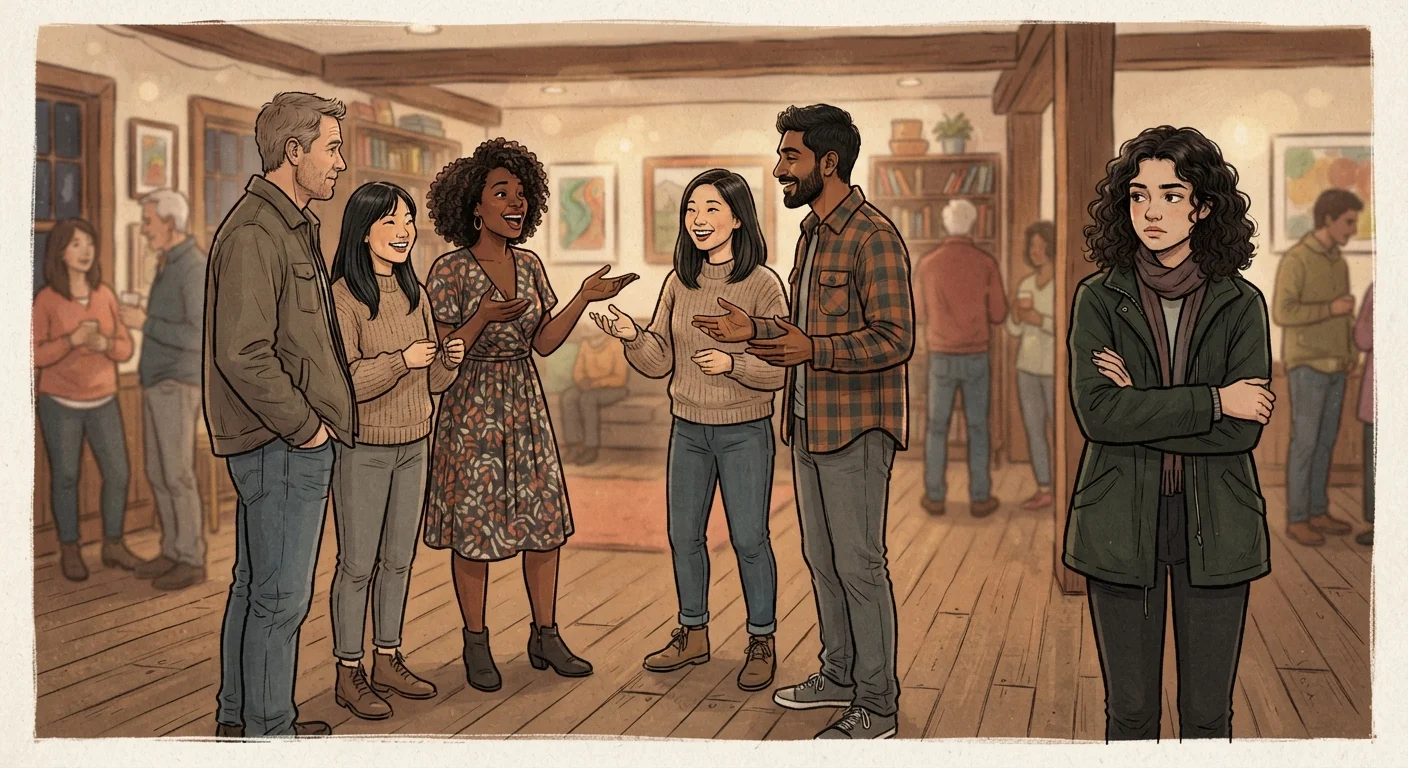
None of these signals are inherently malicious - in fact, most emerge organically as communities develop shared history and identity. The same dress code that makes a subculture feel cohesive can feel alienating to someone who didn't grow up with it. The same inside joke that bonds ten-year members can quietly humiliate a newcomer who doesn't get the reference.
If You're New to a Group
Observe before you assert. Most community signals reveal themselves if you spend time listening before trying to demonstrate you belong. Pay attention to language, humor, and what topics seem off-limits. Genuine curiosity - asking questions rather than performing knowledge - tends to open more doors than trying to prove insider status too quickly.
That tension is worth sitting with. Boundaries protect something real - shared values, safety, cultural continuity. But when they harden into walls, communities stop growing and start gatekeeping. If you're navigating a new group, our piece on building a sense of belonging in a new place or group offers grounded, research-backed strategies. And if you're an established member of any community, it's worth asking: are your group's signals welcoming a wider circle, or quietly narrowing it? The answer usually reveals a lot about what that community actually values - and who it's really for.