

Key Takeaways
- A maintenance log creates a verifiable service history that can raise a vehicle's resale value.
- Documented records help mechanics diagnose recurring problems faster, potentially lowering repair costs.
- Logs make it easier to track upcoming service intervals and catch overdue maintenance before it causes damage.
- The main drawback is consistency - a log only helps if you actually update it after every service.
- Digital apps and cloud storage make log-keeping far easier than a paper glove-box notebook.
Strengthens resale value with verifiable service history
Documented maintenance gives buyers confidence that the vehicle has been cared for, which typically translates to a higher sale price and a faster transaction compared to undocumented vehicles.
Helps mechanics diagnose problems faster
A complete record of past repairs and fluid changes lets a technician identify patterns or gaps quickly, reducing the diagnostic labor you pay for.
Keeps upcoming service intervals on your radar
Logging the last oil change or brake inspection makes it straightforward to calculate when the next one is due, so you're not relying on memory or a sticker that faded two winters ago.
Supports warranty and recall claims
Proof of regular maintenance can be essential when disputing a warranty denial or demonstrating that a recall-related issue wasn't caused by neglect.
Reveals recurring problems you might otherwise miss
Seeing that your coolant has been topped off three times in 18 months signals a slow leak that isolated service visits might not connect.
Only useful if updated consistently after every service
Gaps in the log can be as damaging as no log at all - a buyer or mechanic may assume missing periods mean missing maintenance, not just missing paperwork.
Takes time to reconstruct for older vehicles
Starting a log on a car you've owned for several years requires digging through old receipts, invoices, and records that may be incomplete or lost entirely.
Paper logs can be lost or damaged
A notebook kept in the glove box is vulnerable to spills, theft, or simply getting thrown away during a car clean-out - making digital backups important.
Our Verdict
For the vast majority of drivers, keeping a maintenance log is a low-effort habit that pays real dividends - in resale value, faster diagnostics, and peace of mind. The only meaningful downside is the discipline required to keep it current, and modern apps have largely solved that friction.
Any driver who plans to sell their vehicle eventually, keep it past 100,000 miles, or simply wants to stay ahead of service needs rather than react to warning lights.
What a Maintenance Log Actually Is
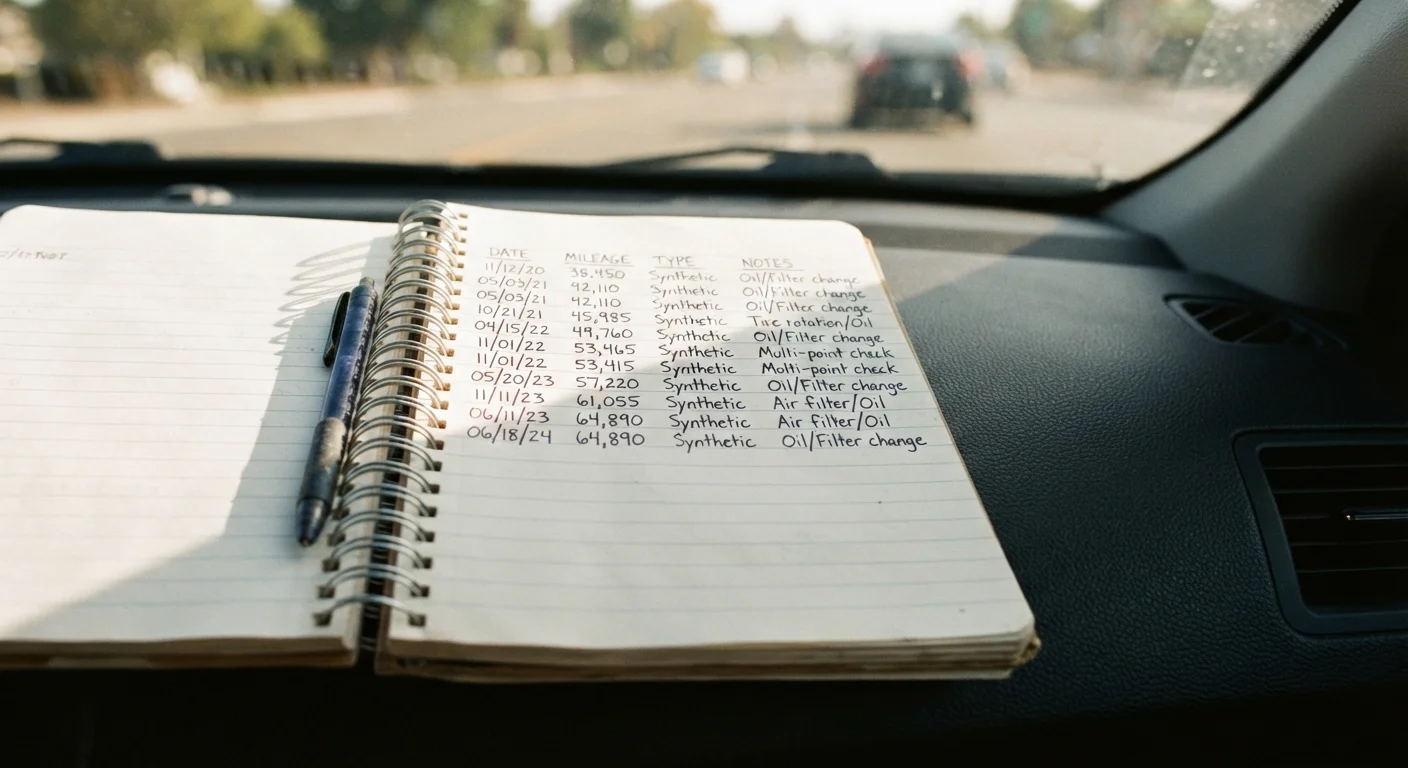
A maintenance log is a running record of every service, repair, and inspection performed on your vehicle. At its most basic, it captures the date, the mileage at the time of service, what was done, and who did it - whether that's a dealership, an independent shop, or yourself in the driveway.
Formats range from a dedicated section in your owner's manual to a simple spreadsheet, a notes app on your phone, or one of several purpose-built apps that send you service reminders automatically. The medium matters far less than the habit. See your car's maintenance schedule explained for a breakdown of which service milestones are worth tracking from day one.
The Real Advantages of Keeping Records
A well-maintained log does several things that benefit you directly, not just some hypothetical future buyer.
Strengthens resale value with verifiable service history
Documented maintenance gives buyers confidence that the vehicle has been cared for, which typically translates to a higher sale price and a faster transaction compared to undocumented vehicles.
Helps mechanics diagnose problems faster
A complete record of past repairs and fluid changes lets a technician identify patterns or gaps quickly, reducing the diagnostic labor you pay for.
Keeps upcoming service intervals on your radar
Logging the last oil change or brake inspection makes it straightforward to calculate when the next one is due, so you're not relying on memory or a sticker that faded two winters ago.
Supports warranty and recall claims
Proof of regular maintenance can be essential when disputing a warranty denial or demonstrating that a recall-related issue wasn't caused by neglect.
Reveals recurring problems you might otherwise miss
Seeing that your coolant has been topped off three times in 18 months signals a slow leak that isolated service visits might not connect.
Up to $1,000+
Potential resale premium with documented service history
Industry observers and used-car market analysts consistently note that verifiable maintenance records can meaningfully increase private-sale and trade-in prices, particularly on higher-mileage vehicles.
~15 min
Average time saved per diagnostic visit
Mechanics report that a complete service history allows them to narrow down potential causes more quickly, reducing billable diagnostic time for the vehicle owner.
When you bring a car to a new mechanic with a complete service history, they can spot patterns - such as a recurring coolant top-up that suggests a slow leak - that would otherwise require expensive diagnostic time to uncover. That efficiency saves you money on labor. For high-mileage vehicles in particular, a log becomes invaluable; keeping a high-mileage car on the road is far more manageable when you know exactly what's been replaced and what's coming due.
Resale value is another concrete benefit. Private buyers and dealers alike place a premium on verifiable service history because it reduces their risk. A car sold with receipts and a complete log consistently commands a stronger price than an identical vehicle with no documentation.
The Honest Drawbacks
No habit is without friction, and a maintenance log is no exception.
Only useful if updated consistently after every service
Gaps in the log can be as damaging as no log at all - a buyer or mechanic may assume missing periods mean missing maintenance, not just missing paperwork.
Takes time to reconstruct for older vehicles
Starting a log on a car you've owned for several years requires digging through old receipts, invoices, and records that may be incomplete or lost entirely.
Paper logs can be lost or damaged
A notebook kept in the glove box is vulnerable to spills, theft, or simply getting thrown away during a car clean-out - making digital backups important.
Digital Logs Solve Most Paper Problems
Several free and low-cost apps - available on both major mobile platforms - let you log service entries, store photos of receipts, and set mileage-based reminders for upcoming maintenance. Cloud sync means your records are accessible even if you switch phones or share the vehicle with another driver. If a paper log feels like too much friction, a digital alternative removes most of the barriers to consistency.
The most significant challenge is consistency. A log that covers the first two years and then goes blank tells a buyer almost nothing useful - and may actually raise suspicion. Life gets busy, and unless you build log-updating into your post-service routine, entries get missed.
There's also a time cost up front if you're starting a log on a car you've owned for years. Reconstructing service history from old receipts, shop invoices, and credit card statements is tedious, though it's worth attempting for any vehicle you plan to sell or keep long-term.
Practical Tips for Starting and Sustaining a Log
The easiest way to build the habit is to tie log entry to an existing routine. The moment you get back in the car after a service appointment - before you drive away - record the date, mileage, and work performed. It takes under two minutes.
If you handle at-home maintenance tasks yourself, photograph the odometer alongside any receipts for parts. That timestamped photo doubles as a backup record. Store digital logs in cloud-based storage so they survive a phone change or a lost notebook.
Whether you plan to drive your current vehicle for decades or trade it in within a few years, a log pays off either way. If you're weighing those options more broadly, keeping a car long-term vs. replacing it often walks through the financial trade-offs in detail. Either path is easier with complete records in hand.