

Key Takeaways
- Teen drivers face significantly elevated crash risk with each additional peer passenger in the vehicle.
- Even adult drivers experience measurable distraction from in-car conversations and passenger behavior.
- The social pressure to appear calm or competent in front of passengers can override safe decision-making.
- Young children as passengers also increase crash risk - primarily through distraction rather than peer pressure.
- Most graduated licensing laws restrict passenger numbers for new drivers precisely because of this research.
- Simple awareness of the passenger effect is a meaningful first step toward safer driving habits.
Passenger Effect on Driver Risk
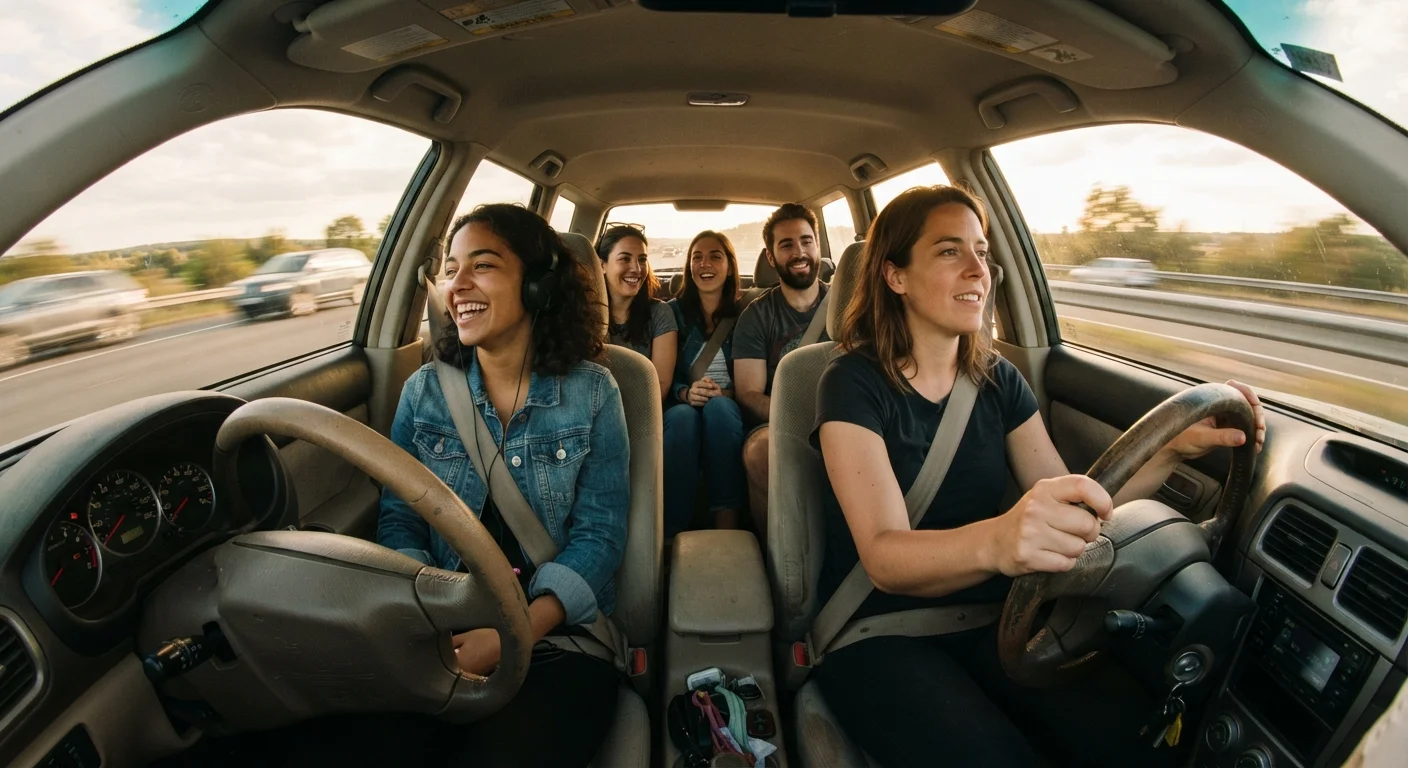
The 'passenger effect' refers to the measurable change in a driver's crash risk, attention, and decision-making that occurs when other people are present in the vehicle. Research consistently shows that passengers - particularly peers of teen drivers - can increase distraction, encourage risk-taking, and reduce the driver's ability to focus on the road. The effect varies significantly by the age of the driver, the number of passengers, and the social dynamics between them.
Traffic safety researchers distinguish between 'social facilitation' (performance improvement with an audience) and 'social distraction' (performance degradation from competing social demands). In driving, the distraction effect almost always dominates, especially among novice drivers.
Why Passengers Change the Driving Environment
Most drivers think about distraction in terms of smartphones or GPS screens. But a conversation happening inches from your ear - or a passenger reacting loudly to something outside the car - creates a cognitive demand that competes directly with the task of driving. The vehicle's interior is a social space, and human beings are wired to respond to the social cues happening within it.
This isn't a matter of willpower or attention discipline. Traffic safety research consistently shows that the presence of passengers shifts driver behavior in several measurable ways: response times slow, following distances shorten, and speed choices become less conservative. Drivers also spend more time glancing away from the road when interacting with passengers, even briefly.
Understanding the passenger effect matters because it's one of the most underestimated crash risk factors across all age groups - but it hits novice drivers the hardest. Teen drivers and the graduated license system exist in part because lawmakers recognized this evidence decades ago.
2-3×
Increased crash risk for teen drivers with 2+ peer passengers
Research cited by the Insurance Institute for Highway Safety (IIHS) shows teen driver crash rates climb substantially with multiple peer passengers compared to driving alone.
~8 min
Time parents spent distracted by children per 16-min trip
A study by Monash University Accident Research Centre found that child passengers distracted drivers for a substantial portion of observed trips, often through caretaking behaviors.
44 states
U.S. states with passenger restrictions in GDL programs
The majority of U.S. states include passenger caps as part of their graduated driver licensing laws, reflecting the broad policy consensus around passenger-related crash risk.
The Teen Driver Data: A Clear and Striking Pattern
Among teen drivers, the passenger effect is not subtle. Research from the Insurance Institute for Highway Safety (IIHS) and the AAA Foundation for Traffic Safety has documented a consistent pattern: crash rates climb with each peer passenger added to the vehicle. A teen driver carrying two or more teenage peers faces a crash risk substantially higher than when driving alone - some studies place the increase at two to three times the baseline rate.
The mechanism isn't simply distraction in the conventional sense. Social dynamics play a central role. Teens are more likely to speed, accept shorter following distances, or run yellow lights when peers are watching. The desire to project confidence or avoid embarrassment can override rational risk assessment - even among teens who intellectually understand safe driving practices.
“Peer passengers appear to create a social environment in which risky driving behavior is normalized or even encouraged - the crash risk associated with teen passengers is one of the most consistently replicated findings in traffic safety research.”
— AAA Foundation for Traffic Safety, U.S. traffic safety research organization
This is a meaningful distinction: the problem isn't that teen drivers are reckless by nature. It's that the social environment of the car actively works against careful decision-making in ways that are difficult to counteract in the moment. Awareness helps, but the most effective interventions tend to be structural - like the passenger caps built into graduated licensing programs.
Adult Drivers Are Not Immune
The passenger effect is most dramatic for new drivers, but experienced adults are not exempt. Cognitive distraction from in-vehicle conversation has been measured in adult drivers across numerous simulator and naturalistic driving studies. The difference is that experienced drivers have more developed hazard-perception skills and a larger repertoire of automatic responses - meaning the deficit is smaller, but still present.
Notably, the nature of the passenger matters. A calm, attentive adult passenger who monitors road conditions can sometimes act as a supplemental observer, occasionally reducing risk. But a loud, emotionally charged, or physically distracting passenger - regardless of age - degrades driver performance. This is why aggressive driving and emotional arousal and passenger dynamics can compound each other in dangerous ways.
Establish a No-Interruption Rule for Demanding Roads
Before navigating a complex interchange, merging onto a busy highway, or driving in heavy rain, it's reasonable to ask passengers to pause conversation briefly. Framing this as a safety habit rather than a complaint makes it easier for everyone to accept. Even experienced drivers benefit from reducing social demands during the highest-complexity moments of a trip.
Young children in the back seat represent a specific category of passenger risk. Unlike peer-pressure dynamics, the distraction here stems from caretaking instincts: parents attending to a fussing child, retrieving dropped items, or turning to check on a sleeping infant. The distraction is brief but repeated - and brief intervals of inattention are precisely when crashes occur.
Practical Habits That Reduce Passenger-Related Risk
Structural rules - like graduated licensing passenger restrictions - are among the most effective interventions, but most drivers will spend years operating outside those frameworks. Building conscious habits around passenger dynamics is the next best layer of protection.
- Set expectations before departure. A simple, direct statement that you need to focus while driving - especially in unfamiliar areas or poor conditions - is more effective than trying to manage conversation mid-route.
- Delay difficult conversations. Emotionally charged discussions elevate cognitive load in ways similar to active distraction. If a conversation becomes intense, it's appropriate to pause until you can stop safely.
- Recognize when passenger noise is escalating. Volume, sudden movement, and laughter all briefly redirect attention. Awareness of this pattern helps drivers proactively create mental boundaries.
- Treat passenger-heavy trips like higher-risk conditions. Just as night driving demands extra margin, so does a car full of passengers. Increase following distance and reduce speed slightly as a compensating buffer.
For parents of teen drivers specifically, having direct conversations about the passenger effect - grounded in evidence rather than general caution - tends to land more effectively than broad warnings. Teens respond better to 'here's why' than to 'just because.'