

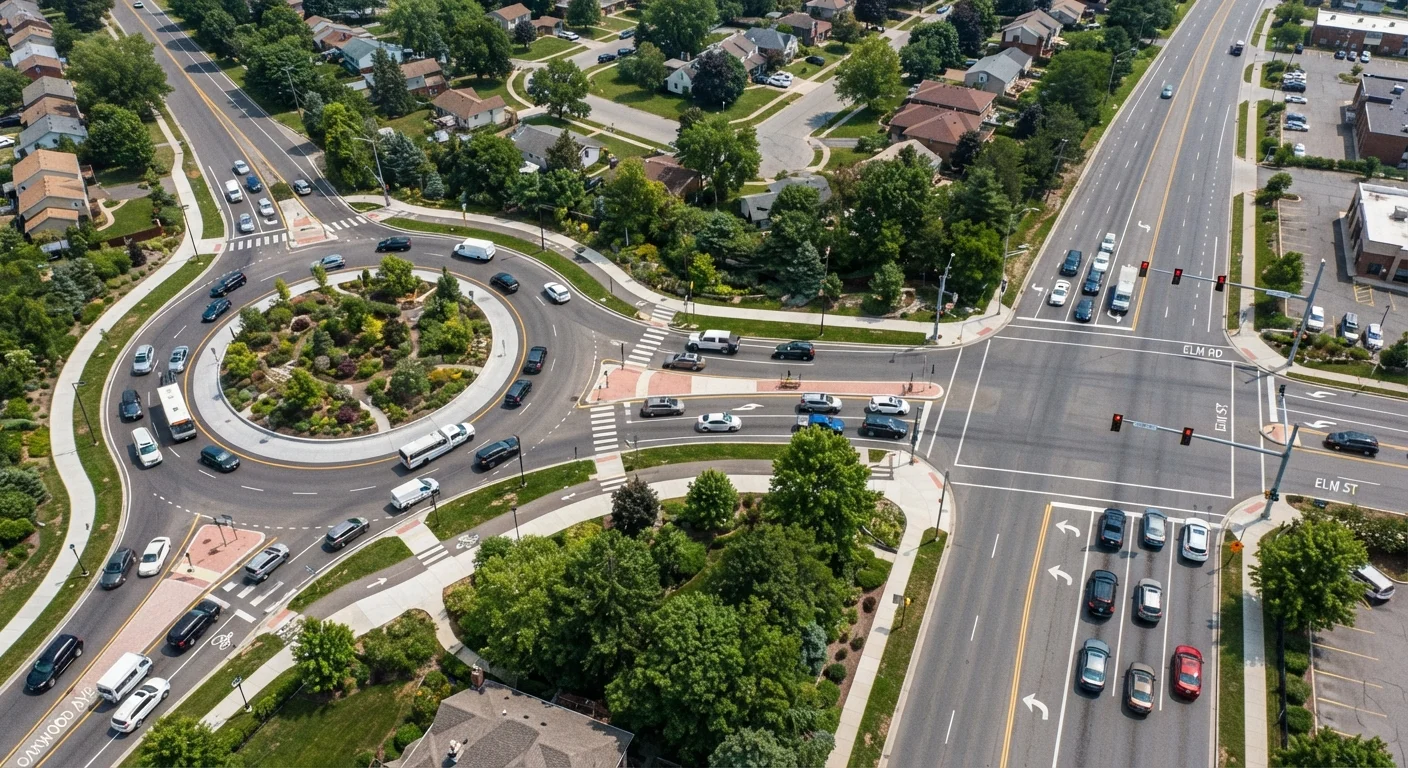
Key Takeaways
- Roundabouts eliminate the high-speed right-angle crashes most associated with fatal intersection collisions.
- Federal Highway Administration research indicates roundabouts reduce injury crashes by roughly 75% compared to signalized intersections.
- Traditional intersections handle high-volume, complex traffic patterns better than single-lane roundabouts.
- Drivers unfamiliar with roundabouts have a short learning curve, but error rates drop quickly with experience.
- Neither design is universally superior - the best choice depends on traffic volume, speed, and local geography.
Our Verdict
Roundabouts consistently outperform traditional intersections on the most critical safety metrics, particularly in reducing fatal and serious-injury crashes. However, traditional signalized intersections remain better suited to high-volume corridors, complex multi-road junctions, and locations where pedestrian crossing demands are high. The safest roads use each design where it fits best.
| Best for | Recommended |
|---|---|
| Drivers prioritizing reduced crash severity risk | Roundabouts |
| High-volume urban corridors with complex pedestrian traffic | Traditional Signalized Intersections |
| Rural or suburban roads where traffic signals would be excessive | Roundabouts |
| Multi-road junctions with more than four approaches | Traditional Signalized Intersections |
How Each Intersection Type Works
A traditional intersection - whether stop-sign controlled or signal-controlled - assigns right-of-way through a fixed, externally managed system. Drivers stop, wait for a green light or a gap in cross-traffic, then proceed through at whatever speed they choose. Conflict points (places where vehicle paths cross) are numerous and involve perpendicular approaches.
A roundabout replaces that stop-and-go sequence with a continuous circular flow. Entering vehicles yield to traffic already circulating inside the loop, then merge when a gap appears. Because all vehicles travel in the same direction around a central island, perpendicular crossings - the kind most likely to produce T-bone crashes - are eliminated by design. Speeds inside a roundabout are naturally limited by the geometry, typically 15-25 mph.
Understanding this structural difference is the foundation for comparing their safety and efficiency profiles. For a broader look at how road type shapes driving risk, see our guide to highway vs. city driving risks.
Safety: What the Research Shows
The safety case for roundabouts is well-documented. The Federal Highway Administration (FHWA) has compiled multiple studies showing that converting a traditional intersection to a roundabout typically produces:
- A reduction in fatal crashes of roughly 90%
- A reduction in injury crashes of approximately 75%
- A reduction in all crashes of around 35-40%
The mechanism is straightforward: roundabouts convert high-speed, right-angle collisions into low-speed, sideswipe-angle contacts. A T-bone crash at 45 mph is significantly more lethal than a sideswipe at 20 mph. The physics favor the circular design. That said, roundabouts do present higher rates of property-damage-only crashes - minor fender-benders from merging errors - compared with signalized intersections. The trade-off is fewer life-altering crashes in exchange for more minor ones.
Pedestrian outcomes are more nuanced. Roundabouts require pedestrians to cross one direction of traffic at a time, with a refuge island in the middle - a design that many safety researchers consider safer than crossing all lanes at once. However, the continuous vehicle movement can be disorienting for visually impaired pedestrians, and this remains an active area of accessibility research and engineering improvement.
~90%
Reduction in fatal crashes
Federal Highway Administration research on intersections converted from traditional signals to roundabouts.
~75%
Reduction in injury crashes
FHWA multi-study compilation comparing roundabout and signalized intersection injury outcomes.
35-40%
Reduction in total crashes
Overall crash frequency decline documented in FHWA roundabout conversion studies.
Traffic Flow and Efficiency
Roundabouts eliminate the idle time of red-light cycles. Vehicles that arrive during a gap in circulating traffic never stop at all, which reduces fuel consumption and emissions. For low-to-moderate traffic volumes, roundabouts demonstrably reduce average delay per vehicle.
At very high traffic volumes, however, the yield-to-circulating-traffic rule can cause entry queues to back up significantly. A signalized intersection with properly timed phases can process more vehicles per hour at a busy urban corridor than a single-lane roundabout. Multi-lane roundabouts partially address this but introduce greater driver complexity - choosing the correct lane before entry becomes critical, and incorrect lane selection is a common source of the minor crashes mentioned above. See our article on merging and lane-change errors for more on how lane selection decisions contribute to incidents.
| Roundabouts | Traditional Signalized Intersections | |
|---|---|---|
| Fatal crash risk | ~90% lower (vs. signals) | Higher - perpendicular high-speed conflicts |
| Injury crash risk | ~75% lower (vs. signals) | Higher |
| Minor/property-damage crashes | Slightly higher | Lower |
| Traffic flow at low-moderate volume | Better - no idle red-light time | Worse - fixed signal cycles cause delay |
| Traffic flow at high volume | Can queue at entry | Managed throughput via signal timing |
| Pedestrian accessibility | Good; some challenges for visually impaired | Strong dedicated crossing phases |
| Land area required | More | Less |
| Driver learning curve | Short but real | Minimal - widely familiar |
Driver Behavior and the Learning Curve
Most driving errors at roundabouts stem from unfamiliarity, not inherent difficulty. Studies tracking crash rates at newly installed roundabouts consistently show a spike in minor crashes immediately after conversion, followed by a meaningful decline within one to two years as local drivers adapt. This pattern suggests the learning curve is real but short.
Key habits for roundabout safety include: signaling when exiting (not entering), yielding to circulating traffic rather than stopping unless necessary, and choosing the correct lane for multi-lane roundabouts before reaching the entry point. Applying the same defensive driving mindset used in any complex traffic situation - scanning ahead, anticipating others' movements, maintaining appropriate speed - transfers directly.
Navigating a Roundabout Correctly
Yield to vehicles already inside the roundabout - do not stop unless traffic requires it. Choose your exit lane before you enter a multi-lane roundabout, and signal right as you approach your exit. Keep your speed low and steady; the geometry is designed to guide you through safely if you don't fight it.
When Traditional Intersections Make More Sense
Roundabouts are not a universal solution. Several conditions favor retaining or installing traditional signal-controlled intersections:
- Very high traffic volume on one or more approaches, where signal timing can actively manage throughput
- Five or more road approaches, which a circular layout cannot accommodate efficiently
- High pedestrian and cyclist volumes requiring dedicated, clearly signaled crossing phases
- Limited right-of-way - roundabouts require more land area than a standard intersection
- Emergency vehicle corridors, where signal preemption systems allow fire and EMS vehicles to clear traffic rapidly
Traffic engineers assess these factors site by site. The choice is not ideological but operational - the goal in every case is to move people through safely and efficiently.