

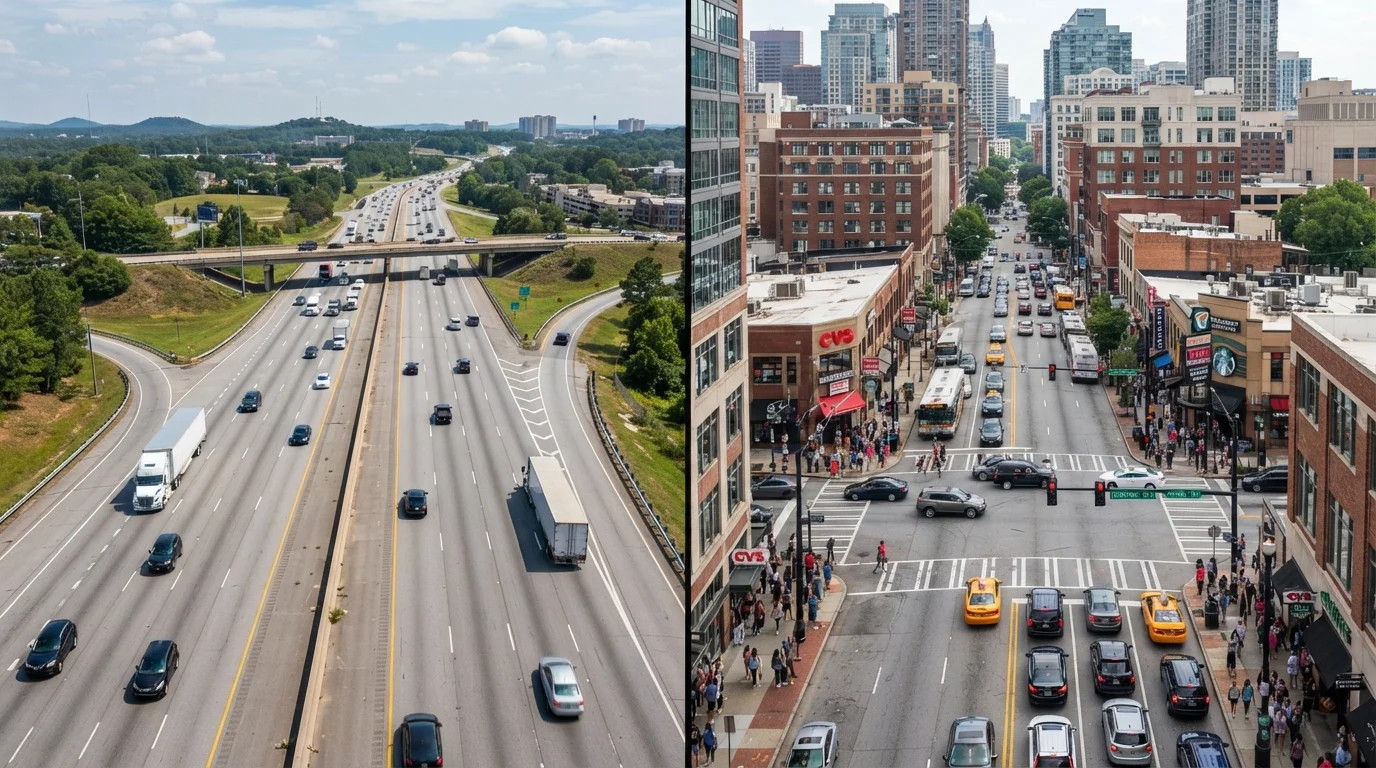
Key Takeaways
- Highway driving's primary risks include high-speed collisions, tailgating, and driver fatigue over long distances.
- City driving presents more frequent hazard interactions - pedestrians, cyclists, intersections, and unpredictable stops.
- Fatal crash rates per mile driven are higher on rural and interstate roads than in urban settings.
- Distraction is dangerous in both environments but has faster consequences at highway speeds.
- Adapting your following distance, speed management, and attention strategy is essential for each road type.
- New drivers benefit from mastering each environment separately before tackling complex mixed-route trips.
Option A
Highway Driving
High-speed, lower-interaction travel with distinct fatigue and attention risks.
Best for: Covering long distances efficiently, though it demands sustained attention and safe following distances at speed.
Option B
City Driving
Slow-speed, high-complexity navigation through dense traffic and pedestrians.
Best for: Short-distance urban travel, though it requires constant hazard scanning and quick decision-making.
If you're a new driver building foundational skills
City Driving (first)
Urban environments train hazard awareness and decision-making at lower speeds, building habits that transfer to all road types.
If fatigue and sustained attention are your primary concern
Highway Driving
Highway monotony is a well-documented fatigue risk; understanding this environment's unique demands helps you plan rest stops and manage alertness proactively.
If you frequently drive in dense urban areas
City Driving
Pedestrian, cyclist, and intersection hazards dominate urban risk - targeted awareness practices make a measurable safety difference.
If you take regular long-distance road trips
Highway Driving
Lane discipline, merge safety, and fatigue management are the skills that matter most on high-speed, long-haul routes.
The Core Difference: Speed, Complexity, and Hazard Type
At first glance, highway driving seems simpler - fewer intersections, no pedestrians, consistent lane markings. City driving looks more chaotic. But the risk profiles of each environment are more nuanced than that surface impression suggests.
Highway driving concentrates danger into high-consequence moments: a lapse in following distance at 70 mph, a sudden lane change by another driver, or fatigue that causes attention to drift. The NHTSA consistently reports that crashes on rural roads and interstates, while less frequent per trip, tend to result in more severe injuries and fatalities because of the speeds involved.
City driving, by contrast, multiplies the number of hazard interactions per mile. Pedestrians step off curbs, cyclists merge unexpectedly, signal timing changes rapidly, and drivers make abrupt stops. Urban crashes are more frequent but more often result in lower-severity outcomes - though serious injuries and fatalities do occur, particularly involving vulnerable road users.
For new drivers, this means each environment warrants its own preparation. The complete roadmap for new drivers addresses how to build skills progressively across both settings.
| Criterion | Highway Driving | City Driving |
|---|---|---|
| Typical speed | 55-80 mph | 15-45 mph |
| Primary crash type | High-speed rear-end, run-off-road | Intersection, rear-end, pedestrian |
| Hazard frequency | Lower per mile | Higher per mile |
| Crash severity | Higher (speed-related) | Generally lower, but variable |
| Key attention demand | Sustained focus, fatigue management | Rapid hazard scanning, decisions |
| Following distance | 3-4+ seconds minimum | 2-3 seconds, more stops |
| Pedestrian/cyclist risk | Rare | Frequent and significant |
| Fatigue risk | High (monotony-driven) | Lower, but stress-related |
Highway Hazards: Speed, Following Distance, and Fatigue
The most underestimated highway risk is following distance. At 65 mph, a vehicle travels roughly 95 feet per second. The standard three-second following rule - watching a fixed point and counting from when the vehicle ahead passes it to when you do - is a minimum, not a target. Many safety guidelines recommend four seconds or more in heavy traffic or adverse conditions.
Driver fatigue is a serious highway-specific concern. Monotonous road environments reduce cognitive stimulation, accelerating the onset of drowsiness even in well-rested drivers. Research published by the AAA Foundation for Traffic Safety has linked drowsy driving to a substantial share of serious crashes. Planning regular stops on long trips - approximately every two hours - is a widely recommended countermeasure.
Merging and lane changes at speed are another key risk area. Blind spot checks, proper mirror use, and signaling well in advance of a lane change are habits that become especially consequential at highway speeds. Wet or foggy conditions further compress reaction time, making following distance even more critical.
~50%
Of US traffic fatalities on rural roads
NHTSA data consistently shows rural and highway roads account for roughly half of traffic fatalities despite carrying less total traffic volume than urban roads.
3 sec+
Minimum safe following distance at highway speed
Most driving safety guidelines recommend at least a three-second gap at highway speeds, increasing to four or more seconds in poor conditions.
2 hrs
Recommended maximum continuous highway driving before a rest stop
AAA Foundation for Traffic Safety and other safety organizations suggest stopping every two hours on long highway trips to counter fatigue-related impairment.
City Hazards: Intersections, Pedestrians, and Decision Density
Urban driving demands what researchers sometimes call attentional bandwidth - the ability to process multiple competing hazards simultaneously. Signalized intersections alone account for a disproportionate share of urban crashes. Drivers must monitor cross traffic, pedestrian signals, cyclists in bike lanes, and vehicles turning from adjacent lanes, all at once.
Pedestrian risk is concentrated in city environments. Children, older adults, and people with mobility challenges may move unpredictably or cross outside marked crosswalks. Scanning well ahead of the vehicle - not just the car immediately in front - is a foundational urban driving skill.
The stop-and-go rhythm of city traffic also creates rear-end collision risk. Smooth, progressive braking (rather than sudden stops) helps the driver behind you anticipate your deceleration. City driving also correlates with higher rates of distracted driving events, since the stimulus-rich environment can tempt drivers to engage with phones or navigation screens. The risk of aggressive behavior is also elevated in congested urban settings - understanding the line between frustration and dangerous driving is worth reviewing in the context of road rage and aggressive driving.
Intersections - including the increasingly common roundabout - present their own decision requirements. The roundabouts vs. traditional intersections comparison explains how yield rules and traffic flow differ between formats.
Intersection Design Affects Urban Risk
Not all urban intersections carry the same risk profile. Research from the Insurance Institute for Highway Safety (IIHS) indicates that roundabouts are associated with significantly fewer serious injury crashes than traditional signalized intersections. Understanding the yield rules and entry conventions of different intersection types is part of competent city driving. Local road design varies widely, so familiarity with your specific area's intersection types is worthwhile.
Adapting Your Habits for Each Environment
Skilled drivers don't apply one-size-fits-all habits - they adjust their behavior to match the road environment. On the highway, that means setting cruise control to maintain a legal, consistent speed, increasing following distance, scheduling deliberate rest stops, and resisting the urge to use a phone even hands-free when concentration is needed for merges or construction zones.
In the city, it means keeping eyes scanning 12-15 seconds ahead rather than fixating on the vehicle directly in front, covering the brake pedal (hovering a foot over it) when approaching intersections or driveways, and being predictable to other road users through clear signaling and steady speeds.
Night driving adds complexity to both environments - reduced visibility changes hazard detection timing on highways and in cities alike. And when passengers are present, their effect on driver focus is worth understanding: the research on driving with passengers reveals how social dynamics influence risk in ways many drivers underestimate.
Ultimately, the safest drivers are those who recognize which environment they're entering, anticipate its specific risks, and adjust accordingly - rather than carrying the same habits from one road type to another.