

| Most commonly used budget rule | 50/30/20 (needs / wants / savings-debt) (Widely referenced in personal finance education) |
| Recommended emergency fund size | 3-6 months of essential expenses (General guidance from financial educators; individual needs vary) |
| Zero-based budget starting point | Income minus all allocations = $0 |
| Fixed vs. variable expenses | Fixed stay constant; variable fluctuate each month |
| Discretionary vs. non-discretionary | Discretionary = wants; non-discretionary = needs |
Why Budgeting Vocabulary Matters
You don't need a finance degree to manage money well - but you do need a shared language. When a budgeting app asks for your net income, or an article recommends building a sinking fund, knowing exactly what those terms mean is what turns advice into action.
This reference covers the core vocabulary of personal budgeting: what each term means, why it matters, and how it connects to your everyday financial decisions. Bookmark it and return whenever an unfamiliar phrase slows you down.
This Is General Financial Education
The terms and concepts here are provided for informational purposes only and do not constitute personalized financial advice. Everyone's financial situation is different. For guidance specific to your circumstances, consult a licensed financial professional.
Income Terms: What You're Working With
Every budget starts with a clear-eyed look at income - specifically, the money you actually have available to spend and save.
| Most commonly used budget rule | 50/30/20 (needs / wants / savings-debt) (Widely referenced in personal finance education) |
| Recommended emergency fund size | 3-6 months of essential expenses (General guidance from financial educators; individual needs vary) |
| Zero-based budget starting point | Income minus all allocations = $0 |
| Fixed vs. variable expenses | Fixed stay constant; variable fluctuate each month |
| Discretionary vs. non-discretionary | Discretionary = wants; non-discretionary = needs |
Gross income is your total pay before deductions. Net income - sometimes called take-home pay - is what remains after federal and state taxes, Social Security, Medicare, and any pre-tax benefit contributions (like a 401(k) or health insurance premium) are withheld. Always build your budget around net income, not gross. Using gross figures is one of the most common reasons budgets come up short before the month ends.
If you have irregular income - freelance work, tips, or seasonal employment - track your lowest monthly net earnings over the past year and use that conservative baseline for budgeting. Anything above it becomes a surplus to allocate intentionally. For deeper saving and debt vocabulary, see our saving and debt glossary.
Spending Terms: Knowing Where the Money Goes
Expenses fall into two broad categories that every budget should distinguish between.
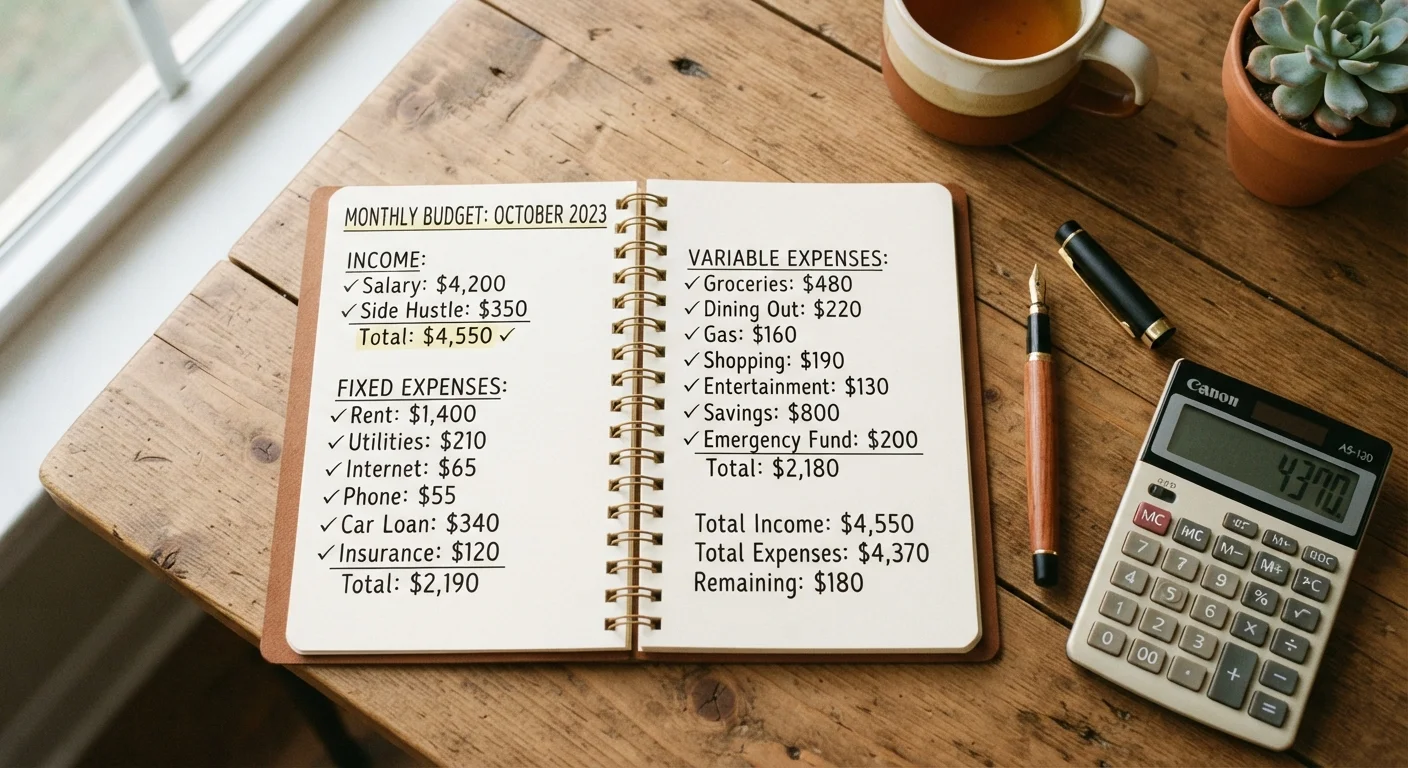
Fixed expenses are predictable and constant - rent, mortgage payments, car loans, insurance premiums. Because they don't change, they're the easiest to plan for and should be the first line items you enter when building a budget.
Variable expenses shift each month. Groceries, gas, utilities, and dining out are all variable. These categories need regular monitoring because small, frequent purchases can quietly compound into significant overspending.
Within variable expenses, discretionary spending refers specifically to wants - streaming services, gym memberships you may not use, clothing beyond necessity, and leisure activities. Discretionary spending isn't inherently bad; the goal is to make it conscious and intentional rather than accidental. Tracking it for even one month often reveals patterns that surprise people.
~1 in 3
Americans who report having a written budget
Multiple consumer surveys suggest that fewer than half of U.S. adults maintain a formal, written budget plan.
56%
U.S. adults unable to cover a $1,000 emergency from savings
According to Bankrate's annual Emergency Savings Report, a majority of Americans could not comfortably absorb a four-figure unexpected expense.
Key Budgeting Concepts and Methods
Beyond income and expenses, a handful of structural concepts shape how most budgets are organized.
Net Income
The amount of money you actually take home after taxes, Social Security, Medicare, and any other payroll deductions are subtracted from your gross pay. This is the number your budget should be built around.
Gross Income
Your total earnings before any deductions are taken out. Gross income is what employers advertise in job listings, but it is not what lands in your bank account.
Fixed Expenses
Costs that stay the same amount each billing cycle, such as rent, a car loan payment, or a fixed-rate mortgage. These are the easiest to plan for because the amount does not change.
Variable Expenses
Costs that fluctuate month to month, such as groceries, gas, utilities, and dining out. Variable expenses require regular tracking to keep them from quietly expanding your spending.
Discretionary Spending
Money spent on wants rather than needs - entertainment, subscriptions, hobbies, and non-essential shopping. Discretionary spending is usually the first area examined when looking to cut back.
Cash Flow
The movement of money in and out of your household over a given period. Positive cash flow means you earn more than you spend; negative cash flow means you are spending more than you earn.
Sinking Fund
A savings account or earmarked pool of money built up over time to cover a predictable future expense - such as a car repair, holiday gifts, or annual insurance premium - without disrupting your regular budget.
Zero-Based Budget
A budgeting method where every dollar of income is assigned a specific purpose until your income minus all allocations equals zero. It does not mean spending everything; saving and investing count as allocations.
Emergency Fund
A reserve of liquid savings set aside exclusively for unexpected financial shocks, such as job loss or a medical bill. Financial educators commonly suggest aiming for three to six months of essential expenses, though the right amount varies by situation.
Budget Surplus
The amount left over after all expenses and savings contributions are subtracted from income. A surplus gives you options - paying down debt faster, investing, or building your emergency fund.
Budget Deficit
When total spending exceeds total income for a given period. A recurring deficit typically requires either reducing expenses or increasing income - or both.
Pay Yourself First
A savings strategy where you direct a set amount toward savings or investments at the start of each pay period, before spending on anything else. This treats saving as a non-negotiable expense rather than an afterthought.
Cash flow is the clearest diagnostic tool in personal finance. If your household runs a monthly cash flow deficit consistently, that's a signal to examine both spending and income - not just one side of the equation. For strategies on addressing that gap, the Saving & Debt hub offers practical frameworks.
The zero-based budget is one of the most disciplined methods available. By assigning every dollar a job - whether that's rent, groceries, a sinking fund, or an investment contribution - you eliminate the ambiguity that leads to end-of-month shortfalls.
Sinking funds deserve special attention because they prevent irregular but predictable expenses from derailing an otherwise solid budget. Annual car registration, holiday spending, and home maintenance all qualify. Learn how to put them to work in our article Sinking Funds: The Budget Tool Most People Skip. And once your budget is consistently generating a surplus, Investing Essentials is a natural next step.
This article is for general informational purposes only and does not constitute personalized financial, tax, or legal advice. Consult a qualified financial professional for guidance tailored to your situation.