

Key Takeaways
- Active investing aims to beat the market; passive investing aims to match it at lower cost.
- Active funds typically carry higher fees, which can meaningfully erode long-term returns.
- Research consistently shows most actively managed funds underperform their benchmark indexes over time.
- Passive investing through index funds is widely used by everyday investors for its simplicity and cost efficiency.
- Your choice should reflect your financial goals, timeline, and tolerance for cost and complexity.
Option A
Active Investing
The hands-on, market-beating pursuit.
Best for: Investors who want professional portfolio management and are willing to pay higher fees in pursuit of above-market returns.
Option B
Passive Investing
The low-cost, market-matching strategy.
Best for: Investors seeking broad market exposure with minimal fees, complexity, and ongoing decision-making.
If you want low costs and long-term, steady market participation
Passive Investing
Passive strategies minimize fees and reduce the risk of underperforming the market, making them a strong fit for most long-term investors.
If you believe skilled managers can exploit specific market inefficiencies
Active Investing
Active management may add value in certain niche or less-efficient markets, though this comes with higher costs and no performance guarantee.
If you are just starting out and want simplicity
Passive Investing
Index-based passive funds require minimal expertise to use and provide instant diversification across many securities.
If you want a professional to adjust your portfolio during market volatility
Active Investing
Active managers can shift allocations in response to changing conditions, though this flexibility does not reliably produce better net returns.
What Each Approach Actually Means
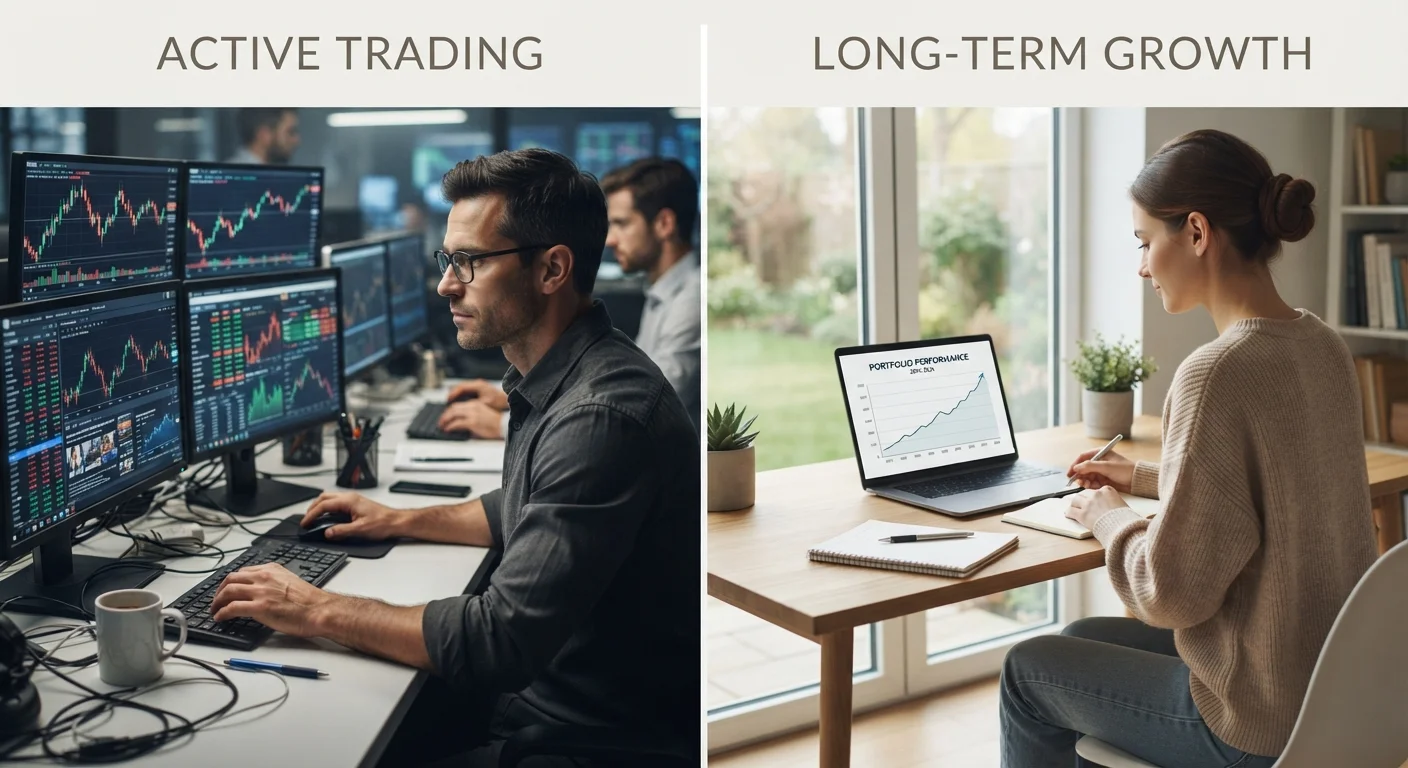
Active investing involves portfolio managers - or individual investors - making deliberate decisions about which securities to buy and sell, and when. The goal is to outperform a benchmark, such as the S&P 500, by identifying mispriced assets or anticipating market movements. This requires ongoing research, analysis, and frequent trading.
Passive investing takes the opposite stance. Rather than trying to beat the market, it seeks to replicate the performance of a market index. Investors hold a broad basket of securities that mirror an index - and simply stay put. Index funds and exchange-traded funds (ETFs) are the most common vehicles for this strategy.
Understanding how these two philosophies differ starts with the underlying building blocks of any portfolio - both approaches use stocks, bonds, and funds, but in very different ways.
| Criterion | Active Investing | Passive Investing |
|---|---|---|
| Primary goal | Beat a market benchmark | Match a market benchmark |
| Typical expense ratio | 0.5%-1.5% or higher | 0.03%-0.20% |
| Trading frequency | High - frequent buying and selling | Low - minimal turnover |
| Management style | Human judgment and research | Rules-based, automated |
| Long-term performance vs. index | Most underperform after fees | Mirrors index return minus low fees |
| Tax efficiency | Lower - more taxable events | Higher - fewer capital gains distributions |
| Complexity for investor | Higher - manager selection required | Lower - simple to implement |
The Cost Difference: Why Fees Matter More Than You Think
One of the starkest differences between active and passive investing is cost. Active funds employ research teams, analysts, and managers - expenses that are passed on to investors through higher expense ratios (the annual fee charged as a percentage of assets). Passively managed index funds, by contrast, require little human intervention and typically carry much lower fees.
~0.66%
Average active US equity fund expense ratio
According to Morningstar's annual fund fee study, the asset-weighted average expense ratio for actively managed US equity funds was approximately 0.66% in recent years.
~0.05%
Average passive index fund expense ratio
Morningstar data shows the asset-weighted average fee for passive US equity index funds has fallen to around 0.05%, reflecting decades of competitive fee reduction.
Over 80%
Active large-cap funds underperforming S&P 500 over 20 years
S&P Dow Jones Indices' SPIVA reports have consistently found that more than 80% of actively managed large-cap US equity funds underperform the S&P 500 over a 20-year horizon.
Over decades, even a seemingly small difference in annual fees can compound into a significant gap in final portfolio value. A fund charging 1% annually versus one charging 0.05% may seem trivial year to year - but over 30 years, the higher-fee fund can cost an investor tens of thousands of dollars on a modest initial investment.
This cost drag is one reason many financial educators and researchers point to low-cost passive funds as a practical foundation for long-term investing - particularly for those just beginning their investment journey.
Performance: Can Active Managers Consistently Beat the Market?
The central promise of active investing is outperformance. But the evidence, accumulated over decades, is sobering. Research from S&P Dow Jones Indices - published in their SPIVA (S&P Indices Versus Active) reports - has consistently found that the majority of actively managed US equity funds underperform their benchmark index over periods of 10 to 20 years, especially after fees are accounted for.
This doesn't mean active management never adds value. Some managers do outperform over certain periods, and some market segments - such as less-efficient small-cap or emerging market stocks - may offer more opportunity for skilled stock-pickers. The challenge is identifying which managers will outperform in advance, and whether their track record will persist.
Passive investing sidesteps this problem entirely by accepting market returns rather than chasing above-market ones. Many common investing myths - like the idea that you can reliably pick winning fund managers - are challenged by this body of evidence.
Past Performance Is Not a Guarantee
Even a fund manager with a strong 5-year track record may not sustain that performance. Research shows that top-quartile fund managers frequently fail to maintain their ranking in subsequent periods. When evaluating any actively managed fund, consider the long-term, after-fee return relative to a comparable passive benchmark - not short-term headlines alone.
Choosing What Fits Your Situation
Neither approach is universally right. The better fit depends on your goals, timeline, and how much you want to pay for professional management. Many investors use a blend: a core of low-cost passive index funds for broad market exposure, with a smaller active allocation in areas where they believe management skill may be rewarded.
When weighing your options, also consider the specific investment vehicles available to you. Mutual funds and ETFs can be either actively or passively managed - understanding how they differ in cost, trading, and tax treatment is a practical next step.
This article is for general informational and educational purposes only and does not constitute personalized financial, investment, or tax advice. Past performance of any fund or strategy does not guarantee future results. Please consult a licensed financial adviser before making decisions based on your individual circumstances.