

Why Asset Types Matter
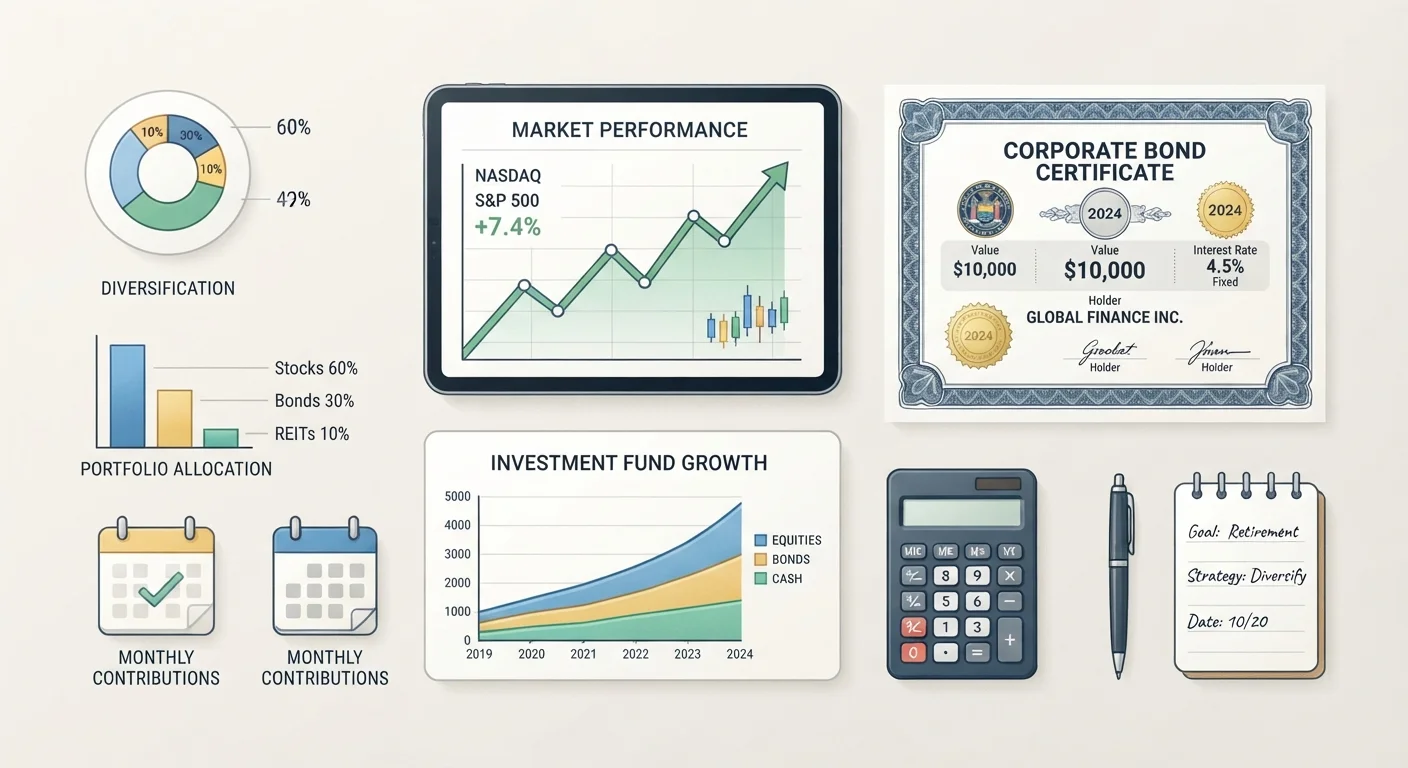
Before you can build a portfolio, you need to understand what goes inside one. Three categories form the foundation of most investment strategies used by everyday Americans: stocks, bonds, and funds (including mutual funds and ETFs). Each carries its own risk profile, return potential, and role in a broader financial plan.
Knowing the difference helps you make intentional choices rather than guessing. If you're newer to the topic, our beginner's guide to investing covers the broader groundwork. This article focuses specifically on the asset types themselves.
This article is for general educational purposes only and does not constitute personalized investment, tax, or legal advice. Consider consulting a licensed financial adviser before making investment decisions.
Stocks: Ownership Shares in a Company
When you buy a stock, you're purchasing a small ownership stake - called a share - in a publicly traded company. If the company grows in value, your shares generally rise in price. If it struggles, the share price can fall. Stockholders may also receive dividends, which are periodic cash payments some companies distribute from their profits.
Stocks are generally considered higher-risk than bonds because their value can fluctuate significantly in the short term. Over longer time horizons, broad stock market investments have historically produced stronger average returns than many other asset classes - though past performance never guarantees future results. Understanding how market conditions affect your holdings is useful; see our overview of bull and bear market cycles for context.
Share
A single unit of ownership in a company. Buying shares means you hold a proportional stake in that company's value and earnings.
Dividend
A portion of a company's profits paid out to shareholders, typically on a quarterly basis. Not all stocks pay dividends.
Bond coupon
The fixed interest payment a bond issuer promises to pay the bondholder at regular intervals until the bond matures.
Maturity date
The date on which a bond's principal amount is repaid to the investor. Bonds can range from short-term (months) to long-term (30+ years).
ETF (Exchange-Traded Fund)
A fund that holds a basket of securities and trades on a stock exchange throughout the day, typically with lower costs than actively managed funds.
Asset class
A broad category of investments with similar characteristics - stocks, bonds, and cash are the three primary asset classes.
Bonds: Lending Money to Earn Interest
A bond is essentially a loan you make to a government or corporation. In exchange, the issuer agrees to pay you interest - called a coupon - at regular intervals and return your principal when the bond matures (reaches its end date). U.S. Treasury bonds, municipal bonds, and corporate bonds are the most common types.
Bonds are generally less volatile than stocks and can provide a more predictable income stream, making them a stabilizing force in a portfolio. However, they typically offer lower long-term return potential. They also carry risks: if a bond issuer defaults, you may not receive the full amount owed. Interest rate changes also affect bond prices - when rates rise, existing bond prices tend to fall.
~$53T
U.S. bond market size
The U.S. bond market is one of the largest in the world, reflecting the central role fixed-income securities play in institutional and individual portfolios.
~$27T
U.S. mutual fund assets under management
According to the Investment Company Institute, U.S. mutual funds held approximately $27 trillion in assets, underscoring how widely funds are used by American investors.
Over 8,000
ETFs available in the U.S.
The number of ETFs listed in the U.S. has grown dramatically over the past two decades, giving investors a wide range of strategies and asset classes to choose from.
Funds: Built-In Diversification
Rather than buying individual stocks or bonds, many investors use funds - pooled investment vehicles that hold a collection of securities. Two dominant types are mutual funds and exchange-traded funds (ETFs).
- Mutual funds are managed by investment professionals who select which securities to include. They're priced once per day after the market closes.
- ETFs (exchange-traded funds) trade on stock exchanges throughout the day, like individual stocks. Many ETFs track a market index - such as the S&P 500 - rather than relying on active management. These are often called index funds.
Funds can reduce risk through built-in diversification across asset classes, because a single fund may hold dozens or hundreds of securities. For a deeper look at how mutual funds and ETFs differ in cost and tax treatment, see our mutual funds vs. ETFs comparison.
Where You Hold These Assets Matters Too
The account type you use - such as a 401(k), IRA, or taxable brokerage account - can affect how your investments are taxed. Stocks, bonds, and funds can generally be held in most account types, but the tax treatment differs. Our guide to investment account types explains the key differences in plain language.