

Key Takeaways
- You don't have to be completely debt-free before starting to save - both goals can run at the same time.
- High-interest debt generally warrants aggressive payoff first, while low-interest debt can coexist with saving.
- A small emergency fund built alongside debt repayment can prevent new debt from forming when unexpected costs arise.
- Employer retirement matches are often worth capturing even while carrying moderate debt, since the match is effectively a guaranteed return.
- The right balance between saving and debt payoff is personal and depends on your interest rates, income stability, and goals.
Parallel Debt and Savings Strategy
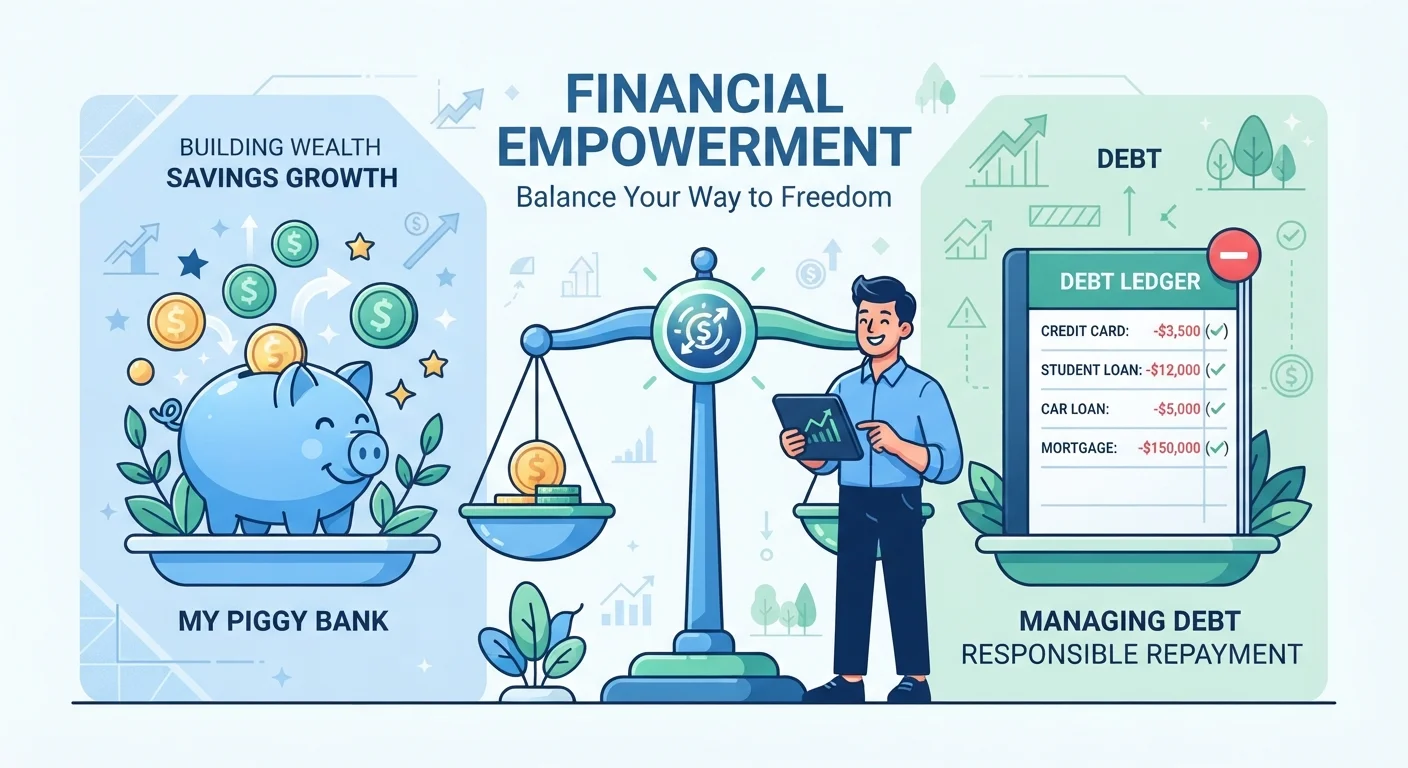
A parallel debt and savings strategy means actively reducing what you owe while simultaneously setting money aside for savings goals - rather than waiting until debt is fully paid off to start saving. Most financial planners consider this a practical, realistic approach for people who carry everyday debt like student loans, car loans, or credit card balances. It recognizes that life doesn't pause for debt repayment.
The decision of how much to allocate to each goal typically depends on a comparison of the effective interest rate on debt versus the expected return on savings or investments - a concept sometimes called the "opportunity cost of debt repayment."
The Either/Or Trap - and Why It's a False Choice
A persistent belief in personal finance is that you should eliminate all debt before saving a single dollar. The logic seems sound on its surface: why earn 4% in a savings account while paying 20% interest on a credit card? But taken to its extreme, this approach leaves people financially exposed for years - or even decades - with no cushion against life's unpredictability.
The reality is that saving and paying off debt are not mutually exclusive. They serve different purposes. Debt repayment reduces a liability; savings build a resource. Waiting to do one until the other is complete often means missing critical windows - like an employer's retirement match - or leaving yourself one car repair away from borrowing again.
To understand the full picture of how these two goals interact, see our complete overview of saving and debt.
77%
Americans carrying some form of debt
According to Federal Reserve consumer finance data, the vast majority of U.S. households hold at least one type of debt, making debt-free living before saving an unrealistic baseline for most families.
$1,000
Emergency fund threshold recommended by many financial educators
A commonly cited starting benchmark for an emergency fund while in debt repayment mode, intended to cover routine unexpected expenses without resorting to credit.
40%+
Workers who don't contribute enough to get full employer match
Research from multiple retirement industry surveys has found a significant share of eligible employees leave employer matching contributions - essentially free compensation - uncaptured each year.
How Interest Rates Shape the Decision
The most useful tool for deciding how to split your money is comparing interest rates. If your debt carries a higher interest rate than you could reasonably earn on savings, accelerating debt payoff produces a better financial outcome. But not all debt works this way.
A federal student loan at 5% or a mortgage at 6% may not warrant the same aggressive paydown approach as a credit card at 22%. Understanding how compound interest works against you in debt and for you in savings helps clarify why the rate comparison matters so much - the same math that grows your savings also grows what you owe.
In practical terms, a common framework looks like this:
- High-interest debt (roughly above 8-10%): Prioritize payoff aggressively while maintaining only a minimal emergency fund.
- Moderate-interest debt (roughly 5-8%): Balance payoff with building savings, especially if the savings serve a specific protective purpose.
- Low-interest debt (below 5%): Saving and investing alongside regular debt payments is often a reasonable approach.
These are general guidelines, not rules tailored to your specific situation. A licensed financial adviser can help you apply this framework to your actual numbers.
Start with Your Highest-Rate Debt First
If you're splitting money between debt payoff and savings, make sure the debt portion targets your most expensive balances first. Paying minimums on low-rate debt while directing extra funds to high-rate balances reduces your total interest cost most efficiently. See the debt avalanche vs. the debt snowball for a detailed comparison of how each approach works.
The Emergency Fund as a Debt Prevention Tool
One of the strongest arguments for saving even while in debt is the emergency fund. Without liquid savings, an unexpected expense - a medical bill, a broken appliance, a job disruption - typically gets charged to a credit card, creating new debt or deepening existing balances.
Even a modest emergency fund acts as a circuit breaker. Most financial educators suggest starting with a target of $500 to $1,000 while in active debt repayment, then building toward one to three months of essential expenses once high-interest debt is cleared. This is not money invested for growth; it's money parked in an accessible account for protection.
Sinking funds take this idea further - setting aside small, regular amounts for predictable irregular costs like annual insurance premiums or car maintenance, so those expenses never have to go on a card.
Retirement Contributions: A Special Case
Employer-sponsored retirement plans - particularly those with matching contributions - represent one of the clearest cases where saving while in debt makes sense. If your employer matches 50% of your contribution up to 6% of your salary, choosing not to contribute means forfeiting compensation that is already available to you. No reasonable interest rate on debt exceeds a 50% immediate return.
Beyond the match, the calculus becomes more personal. Contributing to a Roth or traditional 401(k) while carrying moderate debt involves trade-offs worth thinking through carefully. Before making any decision to withdraw or pause retirement savings to address debt, review what's at stake - including taxes, penalties, and long-term compounding effects. Our article before you touch your retirement savings to pay off debt outlines the full range of considerations.
This article provides general financial information for educational purposes and is not personalized financial, investment, tax, or legal advice. Consult a qualified financial professional before making decisions based on your individual circumstances.