

Key Takeaways
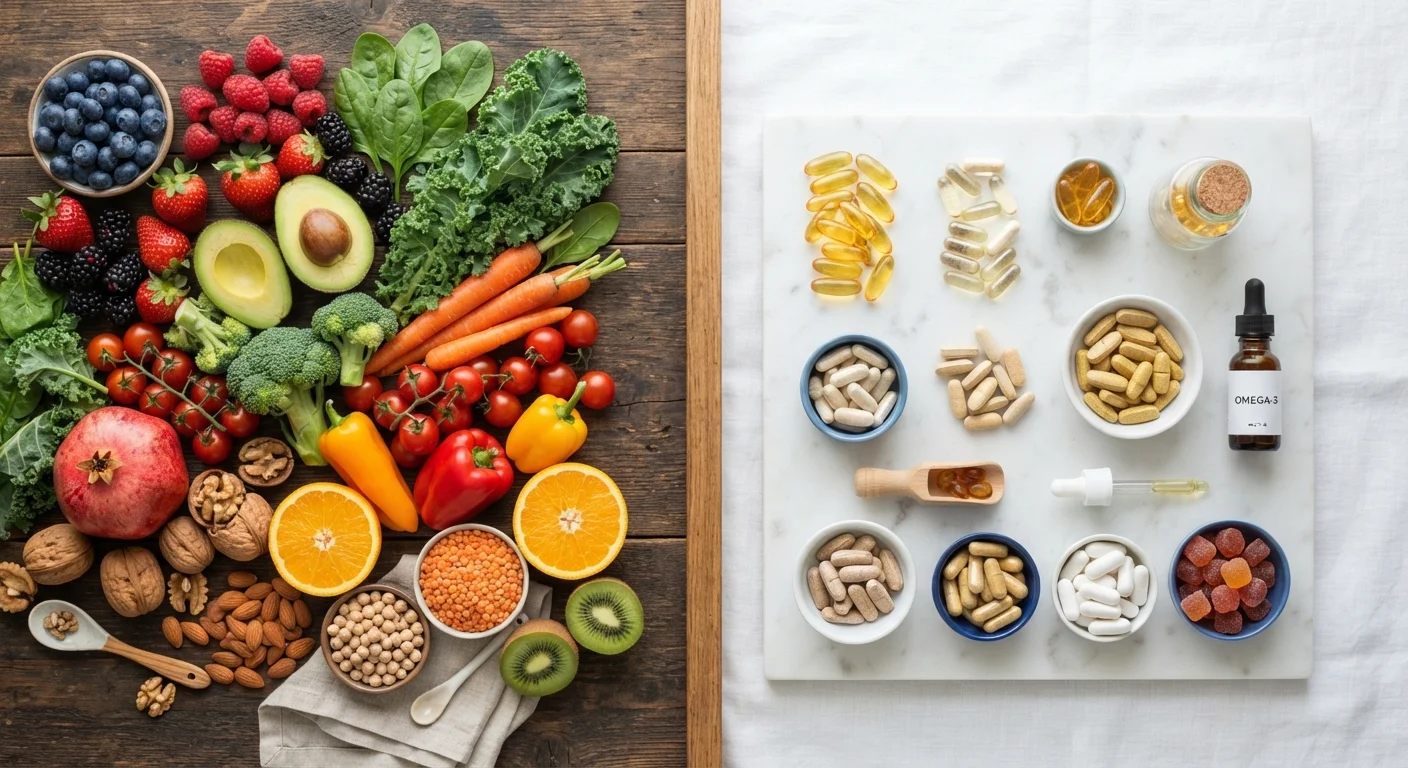
- Whole foods provide nutrients in combinations the body absorbs more effectively than isolated supplements.
- Supplements can fill genuine gaps - especially for vitamin D, B12, iron, and folate in certain populations.
- No supplement replicates the fiber, phytochemicals, and synergistic compounds found in whole foods.
- Most healthy adults eating varied diets don't need routine supplementation, but individual needs vary.
- Always discuss supplement use with a qualified healthcare professional before starting.
Our Verdict
Whole foods are the nutritional gold standard for most people: they deliver nutrients in a form the body is built to use, packaged with fiber, phytochemicals, and compounds that work together in ways science is still mapping. Supplements serve a real but targeted purpose - correcting documented deficiencies or meeting needs that diet alone genuinely can't cover. Neither replaces the other entirely, but food should almost always come first.
| Best for | Recommended |
|---|---|
| Most healthy adults with varied diets | Whole food nutrition |
| Pregnant individuals, vegans, older adults, or those with confirmed deficiencies | Targeted supplementation under professional guidance |
| Anyone with restricted diets or limited food access | Combination of food-first strategy and specific supplements as advised |
Why the Food vs. Supplement Debate Matters
The supplement industry in the United States generates tens of billions of dollars annually, and a significant share of American adults take at least one supplement regularly. Yet nutrition researchers consistently find that whole food patterns - not pill cabinets - drive the strongest health outcomes in population studies. Understanding why requires a closer look at what food and supplements actually deliver differently.
This isn't an either/or argument. The science supports nuance: food wins broadly, supplements help specifically. Knowing where each belongs helps you make grounded decisions rather than reactive ones. For a broader foundation, see our nutrition fundamentals guide.
What Whole Foods Offer That Supplements Cannot Replicate
Whole foods are nutritionally complex in ways that isolate supplements simply aren't. When you eat a handful of almonds, you're getting vitamin E alongside healthy fats, fiber, magnesium, and plant compounds - all in ratios that affect how each nutrient is absorbed and used. This concept, sometimes called the food matrix effect, means nutrients in whole foods behave differently than the same nutrients extracted and encapsulated.
Fiber is perhaps the clearest example. No supplement delivers soluble and insoluble fiber alongside the microbiome-supporting compounds found in an apple or a cup of lentils. Phytochemicals - plant compounds like flavonoids and carotenoids - number in the thousands, and most aren't available in any bottle. Research consistently links diets rich in these compounds to better long-term health outcomes, though the mechanisms are still being studied.
Nutrient density - getting more nutritional value per calorie - is another concept that favors whole foods almost universally. A cup of spinach delivers vitamin K, folate, iron, and antioxidants for very few calories; a supplement provides isolated versions of those nutrients without the synergistic package.
| Whole Foods | Dietary Supplements | |
|---|---|---|
| Nutrient complexity | Hundreds of compounds working together | Isolated or limited nutrient combinations |
| Fiber content | Naturally present | Absent in most supplements |
| Phytochemicals | Thousands of plant compounds included | Not meaningfully replicated |
| Bioavailability | Enhanced by food matrix; varies by nutrient | Variable; some forms highly bioavailable |
| Best use case | Foundation of daily nutrition | Correcting specific, documented deficiencies |
| Regulatory oversight (US) | Covered by food safety standards | Less rigorous than pharmaceuticals |
When Supplements Fill a Genuine Gap
Despite the advantages of whole food nutrition, certain groups face real challenges getting enough of specific nutrients from diet alone. In these cases, targeted supplementation is scientifically supported and often clinically recommended.
- Vitamin D: Synthesis requires sun exposure, and many Americans - especially those in northern latitudes, those who work indoors, or people with darker skin tones - have insufficient levels. Few foods naturally contain meaningful amounts.
- Vitamin B12: Found almost exclusively in animal products, B12 is a well-recognized gap for people following plant-based diets. Our plant-based eating guide covers this and other common shortfalls.
- Folate: Critical during pregnancy to support fetal development; prenatal supplements are a standard recommendation from healthcare providers.
- Iron: Menstruating individuals, pregnant people, and some vegetarians may have higher needs that diet alone doesn't reliably meet.
The key word is targeted. Broad-spectrum multivitamins taken without a known deficiency have shown inconsistent benefit in research. A healthcare provider can test for deficiencies and guide appropriate supplementation - that's a much sounder approach than self-prescribing based on marketing.
More Is Not Always Better With Supplements
Higher doses don't reliably mean greater benefit - and with fat-soluble vitamins like A and D, excess intake can accumulate and reach harmful levels over time. Even some water-soluble supplements carry risks at high doses. Before adding any supplement to your routine, speak with a healthcare provider who can assess your actual needs rather than estimated ones.
The Bioavailability Question
Bioavailability - how much of a nutrient your body actually absorbs and uses - varies significantly between food sources and supplements, and not always in favor of supplements. Heme iron from meat, for example, is absorbed at a higher rate than the non-heme iron in plant foods or supplements. Conversely, some synthetic forms of vitamins (like folic acid) are actually absorbed more readily than their food-bound counterparts - which is part of why prenatal supplementation is specifically recommended rather than simply relying on dietary folate.
Fat-soluble vitamins (A, D, E, K) require dietary fat to be absorbed at all - eating them alongside a source of fat, whether from food or at the time of supplementation, matters. Water-soluble vitamins like C and the B vitamins are generally absorbed efficiently from both food and supplements, though excess amounts are excreted rather than stored.
The takeaway: bioavailability is nutrient-specific and context-dependent. It's one more reason why sweeping claims about supplements being equivalent to food - or categorically inferior - don't hold up to scrutiny. For a deeper look at complexity in nutrition science, see where nutrition science gets complicated.
Pair Fat-Soluble Vitamins With Food
If you take supplements containing vitamins A, D, E, or K, take them with a meal that includes some dietary fat - olive oil, avocado, nuts, or similar. Fat is required for your body to absorb these vitamins properly, whether they come from food or a capsule. Taking them on an empty stomach can significantly reduce their effectiveness.
Practical Guidance: A Food-First Framework
The most defensible approach, consistent with mainstream nutrition science, is to build your diet around varied, minimally processed whole foods - vegetables, fruits, legumes, whole grains, nuts, seeds, and quality protein sources - and use supplements only to address documented needs. This is consistent with guidance from major nutrition and public health bodies.
A few practical principles:
- Prioritize dietary variety. The wider the range of plant foods in your diet, the more likely you are to cover your micronutrient bases naturally.
- If you restrict entire food groups - animal products, for example - identify which nutrients become harder to get and discuss supplementation with a healthcare provider.
- Avoid megadose supplements without clinical justification. Fat-soluble vitamins can accumulate to harmful levels, and even some water-soluble vitamins carry risks at very high doses.
- Remember that supplements aren't regulated as rigorously as medications in the US - look for products that have been independently tested for quality and purity.
For more on navigating common nutrition misconceptions, our nutrition myths article addresses several persistent ones with evidence-based context.
This article is for general informational purposes only and is not a substitute for personalized medical or dietary advice. Consult a qualified healthcare professional before starting any supplement regimen or making significant changes to your diet.