

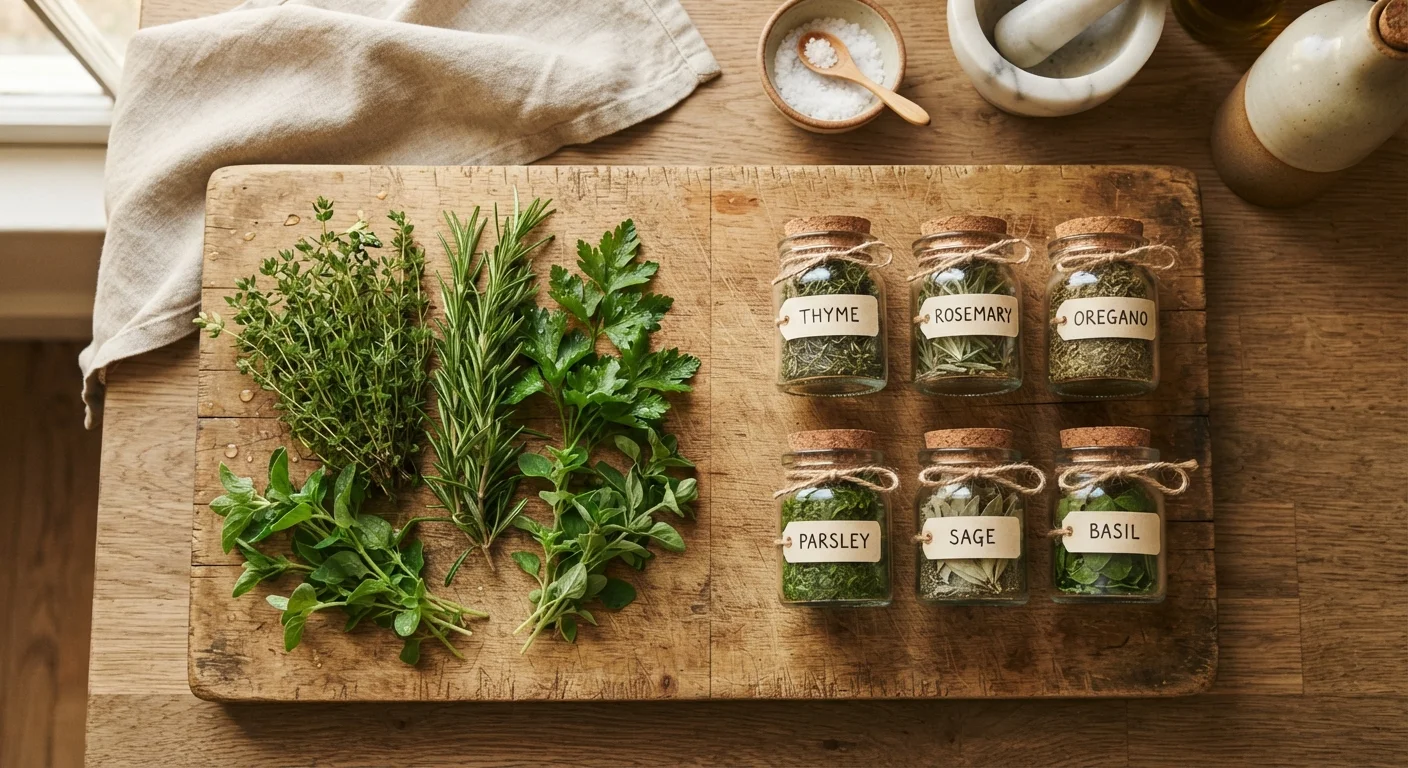
Key Takeaways
- Fresh herbs deliver bright, delicate flavor best added at the end of cooking or raw.
- Dried herbs are more concentrated - use roughly one-third the amount a recipe calls for in fresh.
- Most dried herbs lose significant potency after 1-2 years; color and fragrance are reliable freshness tests.
- Certain herbs, like basil and cilantro, lose much of their character when dried; others like oregano intensify.
- Proper storage - cool, dark, airtight - extends the life of both fresh and dried herbs considerably.
Option A
Fresh Herbs
The bright, aromatic choice for finishing and flavor-forward dishes.
Best for: Best for dishes where herbaceous brightness, color, and delicate aroma should shine at the moment of serving.
Option B
Dried Herbs
The pantry-stable powerhouse for long-cooked, layered flavors.
Best for: Best for soups, braises, and marinades where slow cooking allows dried herbs to fully rehydrate and release deep flavor.
If you're finishing a dish at the table or making a fresh salad
Fresh Herbs
Raw or last-minute applications preserve the volatile oils that give fresh herbs their signature brightness and color.
If you're building a slow-cooked soup, stew, or braise
Dried Herbs
Extended cooking time allows dried herbs to fully rehydrate and diffuse their concentrated flavor throughout the dish.
If you want a reliable, budget-friendly pantry staple
Dried Herbs
Dried herbs have a much longer shelf life and are available year-round at a fraction of the cost of fresh bunches.
If the recipe calls for a delicate herb like basil, cilantro, or chives
Fresh Herbs
These herbs lose most of their nuance during drying; the fresh form is almost always the superior choice.
Why Fresh and Dried Herbs Aren't Simply Interchangeable
Many home cooks treat fresh and dried herbs as identical options separated only by convenience. In reality, they behave very differently in a pan - and understanding why helps you make smarter choices at every stage of cooking.
The key difference comes down to volatile oils, the aromatic compounds responsible for an herb's flavor and fragrance. In fresh herbs, these oils are intact and abundant. Heat, airflow, and the drying process drive off a significant portion of them, which is why dried herbs taste more muted in some ways - and paradoxically more concentrated in others. What remains after drying is a more shelf-stable but fundamentally altered flavor profile.
This matters because the goal of seasoning isn't just adding flavor - it's adding the right kind of flavor at the right moment. A handful of fresh basil torn over a finished pizza and dried basil stirred into a sauce at the start of cooking will produce completely different results, even from the same plant.
| Criterion | Fresh Herbs | Dried Herbs |
|---|---|---|
| Flavor intensity | Bright, delicate, aromatic | Concentrated, deeper, earthier |
| Best cooking stage | End of cooking or raw | Beginning or middle of cooking |
| Substitution ratio | 1 tablespoon fresh | 1 teaspoon dried |
| Shelf life | Days to 2 weeks | 1-2 years (peak potency) |
| Best herb examples | Basil, cilantro, chives, dill | Oregano, thyme, rosemary, bay |
| Visual / textural role | Yes - color, garnish, texture | No visual contribution |
| Cost and availability | Seasonal, perishable, pricier | Year-round, shelf-stable, economical |
When to Use Fresh Herbs (and Which Ones Benefit Most)
Fresh herbs are at their best when used raw or added in the final minutes of cooking. Heat rapidly degrades the volatile oils that give them character, so adding fresh parsley or tarragon to a dish too early results in limp, flavorless greenery rather than the bright punch you're after.
Some herbs suffer significantly when dried. Basil, cilantro, chives, and dill fall into this category - their flavor depends heavily on aromatic compounds that don't survive the drying process well. If a recipe calls for dried cilantro and fresh isn't available, you're better off omitting it or substituting a different herb entirely.
Fresh herbs also serve a textural and visual function. A scatter of fresh mint over a grain salad or a chiffonade of basil on bruschetta adds color and crunch that dried herbs simply cannot replicate. When a dish needs to look as good as it tastes, fresh is nearly always the answer. For building dishes that rely on layered aromatics, see our guide on building a foundational spice collection.
A Note on Herb Quality and Nutrient Content
Both fresh and dried herbs contain antioxidants and micronutrients, though quantities vary by herb and preparation. Drying concentrates some compounds while reducing others. For a broader look at how food form affects nutritional value, see our comparison of nutrition from food vs. supplements. For everyday cooking purposes, flavor - not micronutrient content - is the primary reason to choose one form over the other.
When to Use Dried Herbs - and How to Substitute
Dried herbs excel in applications where time and heat work in their favor. Oregano, thyme, rosemary, bay leaf, and marjoram all intensify during drying and hold up beautifully in slow-cooked dishes. The rehydration that happens during simmering releases their flavor gradually, making them ideal for pasta sauces, braises, soups, and marinades.
The standard substitution ratio is 1 teaspoon of dried herbs for every 3 teaspoons (1 tablespoon) of fresh. Because dried herbs are more concentrated, using the same volume as fresh will overwhelm a dish. When in doubt, start with less and adjust - you can always add more, but you can't take it out. These principles apply equally when you're seasoning a flavorful base like the ones discussed in our overview of stocks, broths, and bouillon.
3:1
Fresh-to-dried herb substitution ratio
This is the widely cited culinary standard: 1 tablespoon of fresh herbs equals approximately 1 teaspoon of dried herbs in most recipes.
12-24 months
Peak potency window for dried herbs
Food science sources generally indicate that most dried herbs retain optimal flavor for one to two years when stored properly in airtight, cool, and dark conditions.
Dried herbs also make sense when fresh isn't available, affordable, or practical - particularly for weeknight cooking where a pantry-stable option speeds up the process without sacrificing flavor.
Storing Fresh and Dried Herbs to Maximize Flavor
Fresh herbs fall into two categories for storage purposes. Tender herbs like basil prefer room temperature - trim the stems and stand them upright in a glass of water on the counter, loosely covered with a plastic bag. Hardier herbs like thyme, rosemary, and sage store better wrapped in a slightly damp paper towel and placed in an airtight container in the refrigerator, where they can last up to two weeks.
Dried herbs keep longest when stored in airtight containers away from heat, light, and moisture - a cool pantry shelf works well, but directly above the stove does not. While dried herbs are technically shelf-stable for years, most lose meaningful potency after 12-24 months. A simple freshness test: crumble a small amount between your fingers. If the scent is faint or absent, the herb is past its prime and won't add much to your cooking.
Replacing expired dried herbs on a reasonable schedule - rather than hoarding a cabinet full of aging jars - is one of the simplest ways to improve the flavor of everyday cooking.