

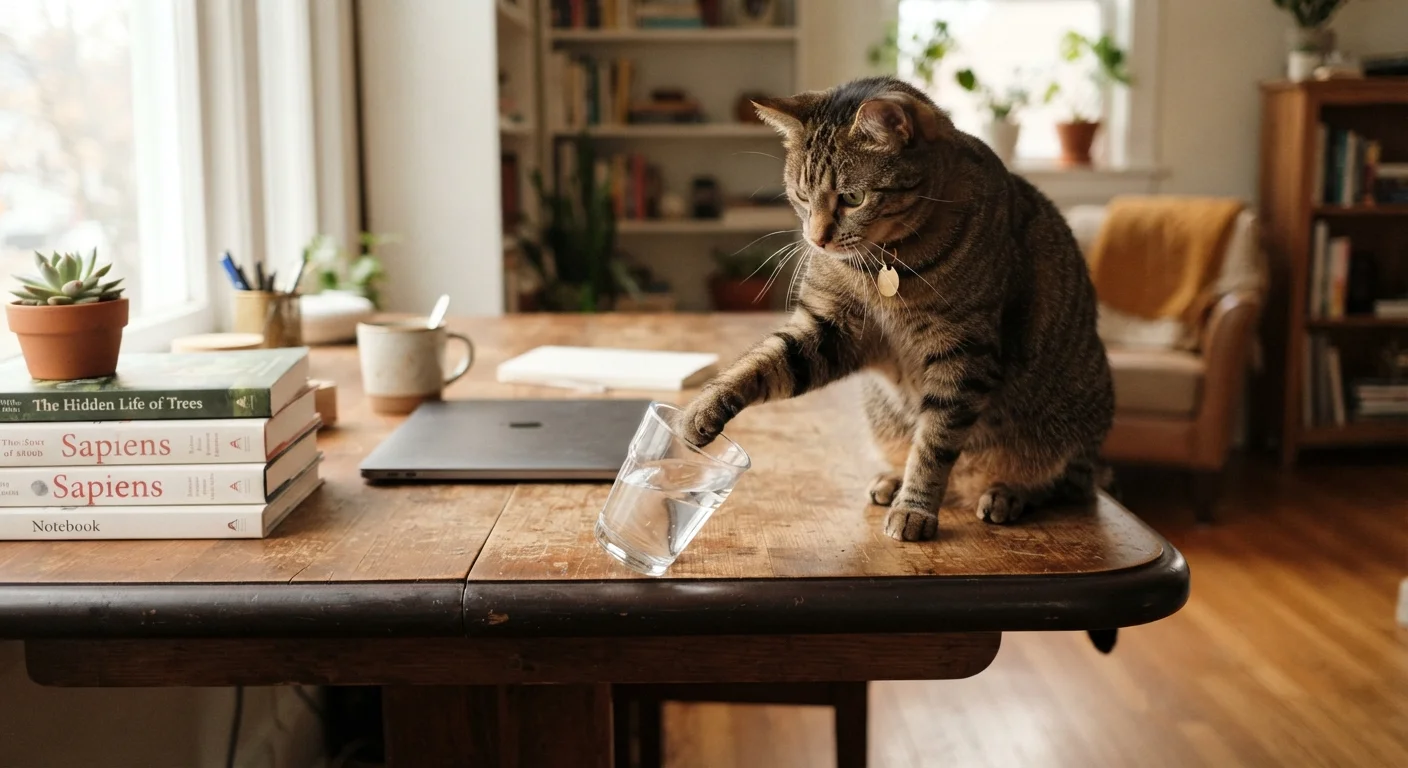
Key Takeaways
- Cats knock things over due to instinct, curiosity, and sometimes a need for attention - not spite.
- The behavior mimics hunting movements cats use to test whether prey is alive or safe.
- Boredom and under-stimulation are among the most common triggers for this behavior.
- Enrichment activities and consistent play can significantly reduce how often it happens.
- Fragile or hazardous objects should be stored safely to protect both your cat and your belongings.
Object Displacement Behavior
Object displacement behavior is what researchers call it when cats deliberately push, bat, or knock items off surfaces. Rather than random mischief, it reflects instinctual drives around hunting, sensory exploration, and attention-seeking. It is a normal feline behavior seen across domesticated cats of all breeds and ages.
In ethology - the scientific study of animal behavior - this type of action is sometimes linked to predatory motor sequences, where cats practice the same paw movements used to test whether prey is still alive or safe to approach.
It Starts With How Cats Hunt
Watch a cat bat an object a few times before committing to picking it up - that's not randomness. It mirrors the way cats interact with prey in the wild. Before grabbing a mouse or small bird, cats will tap it repeatedly to assess whether it's still moving, whether it poses any risk, and how it responds to touch. Knocking a pen off your desk activates the same neurological pathway.
Animal behaviorists generally agree that this predatory motor sequence - stalk, bat, assess - is deeply embedded in feline biology regardless of whether a cat has ever hunted outdoors. Indoor cats with no access to live prey still carry these instincts, and household objects conveniently fill the role of stand-in prey. The fact that objects fall, roll, or make noise when knocked is especially rewarding because it mimics the unpredictable movement of a living target.
“Much of what looks like mischief in cats is simply predatory behavior with nowhere productive to go. When we understand the instinct behind the action, the solution becomes obvious: give the instinct a better outlet.”
— Mikel Delgado, Certified cat behavior consultant and researcher in animal behavior
Curiosity and Sensory Feedback Matter Too
Cats gather a great deal of information through their paws. The pads are densely packed with sensory receptors that detect texture, temperature, and vibration. When a cat presses a paw against an unfamiliar object, it is actively collecting data. Pushing something off a surface and watching it fall provides additional feedback - sound, movement, and sometimes a human reaction - that can be genuinely interesting to a curious cat.
This sensory-seeking dimension means that certain objects are more irresistible than others. Lightweight items that slide easily, objects near the edge of a surface, or anything that produces a satisfying clatter when it lands tend to be repeat targets. It is less about destruction and more about the richness of the experience from the cat's perspective.
Redirect Before the Object Falls
If you notice your cat approaching a surface and beginning to sniff or paw at objects, introduce a toy immediately - before anything gets knocked off. Catching the behavior at the start and offering an alternative is far more effective than reacting after the fact. Over time, consistent redirection can reshape the habit.
Attention and Boredom Play a Big Role
Cats are observant animals, and they learn quickly what behaviors produce a response. If knocking a glass off the counter consistently causes their owner to jump up, make noise, or redirect attention toward them, many cats will file that information away and use it deliberately. This does not make them manipulative in a human sense - it makes them effective learners.
Boredom is one of the most underappreciated drivers of this behavior. A cat that is under-stimulated will find ways to create its own entertainment. Surfaces loaded with interesting objects become an impromptu playground, especially during the early morning or evening hours when cats are naturally most active. Aligning daily play sessions with your cat's natural activity peaks is one of the most effective ways to reduce restless behavior like this.
~60%
Indoor cats showing predatory play behaviors daily
Research on domestic cat behavior suggests the majority of indoor-only cats regularly engage in predatory motor sequences, including batting and pouncing, even without access to live prey.
30+ min
Recommended daily interactive play for adult cats
Many veterinary behaviorists recommend at least 30 minutes of active, interactive play per day split across multiple sessions to meet a typical indoor cat's stimulation needs.
What You Can Do About It
Understanding the behavior makes the solution clearer: give cats better outlets for the same drives. Scheduled interactive play - using wand toys, feather lures, or puzzle feeders - addresses the hunting instinct directly. Cats that receive adequate daily play are generally less likely to seek stimulation through destructive or disruptive behavior.
For objects you genuinely cannot afford to lose, the simplest approach is to remove them from accessible surfaces. Securing breakable items or moving them to enclosed shelving removes the temptation entirely. This is worth thinking about alongside broader home safety - a thorough home safety audit often reveals other hazards that go unnoticed until a cat investigates them.
Avoid scolding your cat after the fact. Cats do not connect delayed reprimands with earlier actions, so punishment after the event accomplishes nothing beyond eroding trust. If you catch the behavior in the moment, a calm, neutral redirect to a toy is more productive.
If the behavior escalates suddenly or seems linked to other changes - like altered appetite or hiding - it may be worth checking in with a veterinarian. Behavioral shifts can occasionally reflect discomfort cats are masking. For more on that, see the signs that a cat may be in pain. And if you have ever wondered which other common beliefs about cats don't quite hold up, vets encounter plenty of misconceptions every day.