

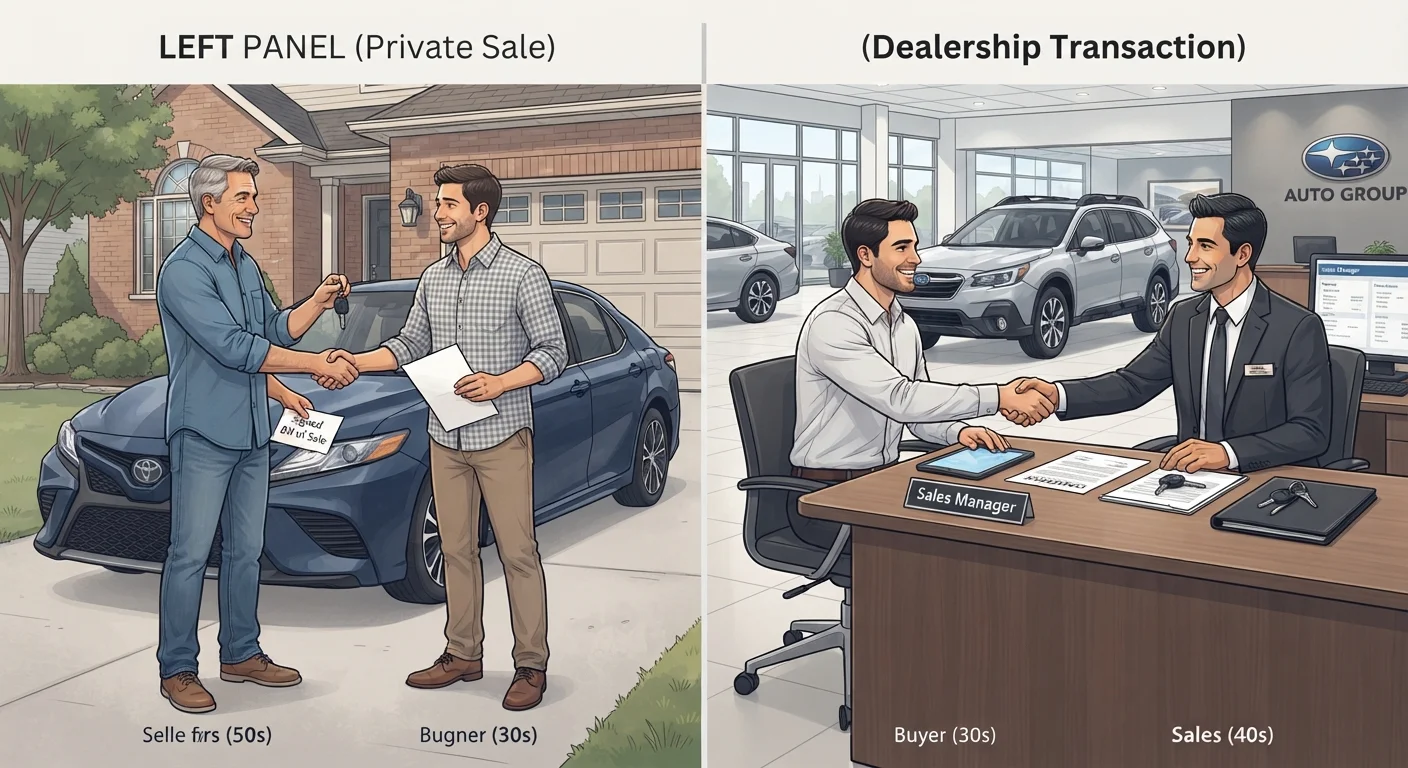
Key Takeaways
- Private sellers typically offer lower prices but provide no legal consumer protections or warranties.
- Dealerships must comply with federal and state consumer protection laws, adding layers of buyer security.
- Financing is generally only available through dealerships; private sales almost always require cash or a pre-arranged loan.
- Title transfer and paperwork are more straightforward at a dealership, but doable privately with care.
- A pre-purchase inspection by a mechanic is strongly advisable in both scenarios, but especially for private sales.
Our Verdict
Neither channel is universally superior - the right choice depends on your priorities. Dealerships offer structure, financing access, and legal protections that reduce risk, while private sellers can deliver genuine price savings for buyers who are prepared to do more due diligence. Understanding what changes between the two transactions puts you in a far stronger negotiating position regardless of which route you take.
| Best for | Recommended |
|---|---|
| First-time buyers or those who want built-in consumer protections | Dealership |
| Experienced buyers comfortable with independent inspections and paperwork | Private Seller |
| Buyers who need financing arranged at the point of sale | Dealership |
| Budget-focused buyers seeking below-market prices on specific used vehicles | Private Seller |
How the Two Transactions Are Fundamentally Different
Buying a car is not a single, uniform process - the channel you choose reshapes nearly every part of the experience. A dealership is a licensed business operating under state and federal regulations, which means the transaction carries legal accountability on both sides. A private seller is typically an individual with no such obligations beyond basic honesty and valid title.
That difference cascades through pricing, paperwork, warranties, financing, and what recourse you have if something goes wrong. Neither path is inherently better, but each suits a different type of buyer and situation. For a broader look at where this decision fits in the overall car-buying process, see the first-timer's roadmap to buying a car.
Consumer Protections and Legal Accountability
This is the sharpest distinction between the two routes. Licensed dealerships are subject to the Federal Trade Commission's Used Car Rule, which requires them to display a Buyers Guide disclosing warranty terms on every used vehicle. State lemon laws and consumer protection statutes also typically apply to dealer sales, giving buyers legal avenues if the vehicle was misrepresented.
Private sales are almost always "as-is" transactions. Once you hand over the money and drive away, your legal options are extremely limited unless you can prove outright fraud - a high bar to clear. The seller has no obligation to disclose mechanical issues they weren't aware of, and no implied warranty applies.
Private Sales Offer Little Recourse After the Fact
Once a private sale is complete, reversing the transaction is extremely difficult without evidence of deliberate fraud. Mechanical problems discovered after the sale are generally your responsibility. This makes a thorough pre-purchase inspection - conducted by a mechanic of your choosing, not the seller's - one of the most important steps you can take before signing anything.
This doesn't mean private sellers are dishonest - most are simply selling a vehicle they no longer need. But it does mean the burden of due diligence falls entirely on the buyer.
Pricing, Negotiation, and What You're Actually Paying For
Private sellers frequently list vehicles below dealership retail because they carry no overhead - no reconditioning costs, no lot fees, no sales staff. That price gap can be meaningful, particularly on older or high-mileage vehicles. However, dealership pricing often reflects services that add genuine value: safety inspections, detailing, certification programs, and administrative support for title transfer.
Dealerships also charge documentation fees - sometimes called "doc fees" - that can add hundreds of dollars to the transaction. Understanding dealer terminology before you negotiate helps you identify which fees are negotiable and which are fixed by state law.
| Factor | Private Seller | Dealership | |
|---|---|---|---|
| Consumer legal protections | Minimal - typically as-is | FTC Used Car Rule, state laws apply | |
| Warranty coverage | Rarely included | Implied, express, or certified options available | |
| Pricing | Often below retail | Retail price plus doc fees | |
| Financing access | Must arrange independently | Available at point of sale | |
| Title/paperwork handling | Buyer and seller manage it | Dealership handles submission | |
| Negotiation flexibility | Often high - motivated sellers | Varies by dealership and market | |
| Vehicle inspection | Buyer arranges independently | May be inspected; verify independently |
Financing: A Major Practical Difference
Most private sellers require payment in full at the time of sale - cash, cashier's check, or an electronic transfer. That means if you need to borrow money, you must arrange financing independently through a bank or credit union before the transaction, not during it.
Dealerships, by contrast, have established lending relationships and can arrange financing on the spot. This is convenient but introduces its own considerations - dealer-arranged loans may carry higher interest rates or terms that benefit the dealer's finance department. Comparing dealer financing to direct bank loans is worth doing before you sit down at a dealership.
Get Pre-Approved Before You Shop
Securing pre-approval from your bank or credit union before visiting a dealership gives you a concrete rate to compare against any dealer financing offer. It also makes private-sale purchases straightforward since the funds are already arranged. Pre-approval doesn't commit you to borrowing - it simply gives you leverage and clarity.
Title Transfer and Paperwork
At a dealership, the administrative staff typically handles title transfer, registration, and sales tax collection on your behalf - submitting the paperwork to your state's DMV as part of the purchase process. This reduces the chance of errors and eliminates a follow-up trip to a government office.
In a private sale, both parties are responsible for completing the title transfer correctly. The seller must sign over the title, and the buyer must bring it to the DMV within the timeframe required by their state (which varies). Sales tax is paid directly to the DMV at that point, not to the seller. Errors in private title transfers - missing signatures, incorrect odometer disclosures - can create title problems that are costly to unwind.
If you're also weighing what to do with your current vehicle, the trade-in vs. private sale comparison lays out the financial and practical differences on the selling side.
Due Diligence: What to Do Regardless of Source
Whether you're buying from a private party or a dealership, certain steps protect your investment. Run a vehicle history report using the VIN to check for title issues, accident history, and odometer rollback flags. Arrange an independent pre-purchase inspection by a qualified mechanic - this is especially critical in private sales where no certification exists, but it's worth doing even with certified pre-owned vehicles.
For used vehicles in general, the new vs. used car trade-off comparison provides useful context on what risks and costs come with buying used from any source.
~40%
Used vehicles sold privately in the US
Industry estimates suggest roughly 40% of used vehicle transactions in the US occur through private party sales rather than dealerships.
$1,000-$3,000
Typical private sale price advantage
Consumer automotive research commonly finds private party listings priced $1,000-$3,000 below comparable dealer retail listings, depending on vehicle age and condition.