

Key Takeaways
- A budget is a forward-looking spending plan, not a record of what you already spent.
- Budgeting works for people at all income levels - not just those in financial trouble.
- A budget does not require perfection; it requires awareness and regular adjustment.
- Fixed and variable expenses are treated differently inside a budget.
- A budget is a tool for freedom, not a financial punishment.
Personal Budget
A personal budget is a written or tracked plan that maps out how much money you expect to receive and how you intend to spend or save it over a set period - usually one month. It gives you a clear picture of your cash flow so you can make deliberate choices rather than guessing. Think of it as a financial roadmap, not a set of rules designed to make your life harder.
In personal finance, a budget encompasses both income and expenditures across fixed, variable, and discretionary categories, and is distinct from a balance sheet (which captures assets and liabilities) or a cash flow statement (which records actual transactions after the fact).
The Core Idea: A Plan, Not a Punishment
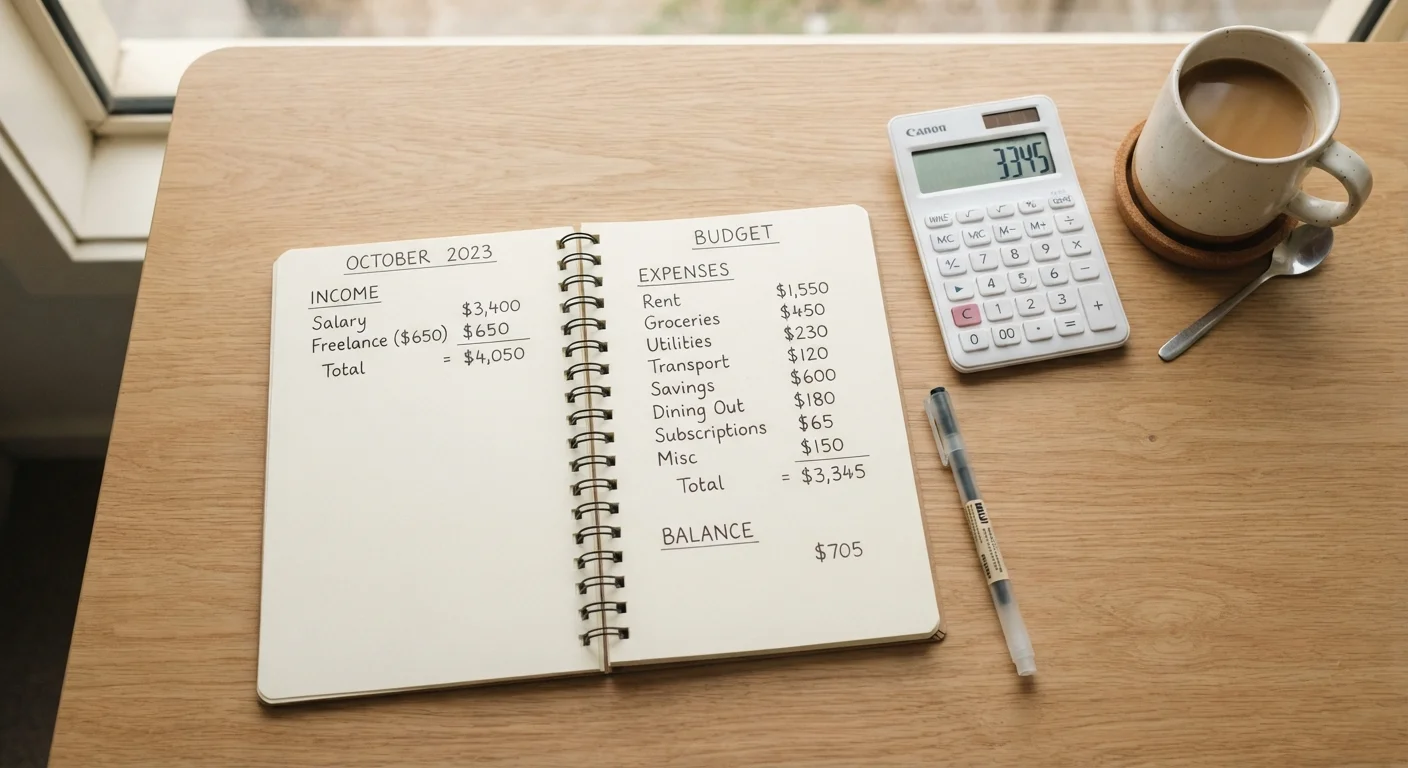
At its most basic, a personal budget is a plan for your money before you spend it. You estimate the income coming in - wages, freelance pay, benefits - and you decide in advance how that money will be allocated: rent, groceries, savings, transportation, and so on.
What a budget is not is a punishment, a sign of financial failure, or a rigid cage. Those misconceptions stop millions of Americans from ever starting one. If that sounds familiar, our article on budgeting myths that keep people from starting examines those beliefs directly.
The key word is plan. A budget looks forward. It is made at the beginning of a period - usually a month - and guides decisions throughout. It is not a punishment for past spending and it does not require perfection to be useful.
Start Simpler Than You Think You Need To
New budgeters often overcomplicate their first attempt by creating dozens of spending categories. Start with just five to seven broad buckets - housing, food, transportation, savings, and discretionary - and add detail only once the habit is established. A simple budget you actually use beats a detailed one you abandon after two weeks.
What Goes Into a Budget
A personal budget has two sides: income and expenses.
- Income includes every dollar you reliably expect to receive - your take-home pay after taxes, side income, government benefits, or any other regular inflow.
- Fixed expenses are costs that stay the same each month: rent or mortgage, a car payment, insurance premiums, subscription services.
- Variable expenses change month to month: groceries, gas, utilities, dining out, clothing.
- Savings and debt repayment are treated as expenses in a well-constructed budget - money set aside before you spend what remains.
Understanding these categories matters because fixed and variable expenses require different strategies. Fixed costs are harder to adjust quickly; variable costs are where most people find short-term flexibility. For plain-English definitions of these and related terms, see our budgeting terms every adult should know.
~1 in 3
Americans who follow a written budget
Surveys by Gallup and similar pollsters consistently find that fewer than half of U.S. adults maintain a formal written or tracked budget.
74%
Adults living paycheck to paycheck at some point
Multiple consumer finance surveys have found a large share of American adults report having little or no financial cushion between paychecks at some stage of their adult lives.
Common Budgeting Approaches
There is no single correct way to budget. The right method depends on your personality, income type, and financial goals. A few widely discussed frameworks include:
- The 50/30/20 rule - allocating roughly 50% of after-tax income to needs, 30% to wants, and 20% to savings and debt repayment. It is a useful starting guide, not a rigid law.
- Zero-based budgeting - assigning every dollar of income a job until nothing is left unallocated. It requires more tracking but leaves no money in a vague "leftover" category.
- The envelope method - dividing cash into labeled envelopes for each spending category and stopping when an envelope is empty.
Each approach has genuine trade-offs. Our comparison of zero-based budgeting vs. the envelope method walks through who each style tends to suit.
“A budget is telling your money where to go instead of wondering where it went.”
— Dave Ramsey, Personal finance author and radio host
Why It Matters for Everyday Financial Health
A budget creates awareness - the foundation of every sound financial decision. Without one, it is genuinely difficult to know whether you are spending more than you earn, how much you are saving, or where your money actually goes each month.
Research consistently shows that households without a spending plan are more likely to carry high-interest debt and less likely to have an emergency fund. Budgeting does not require a high income; it simply requires the intention to use whatever income you have deliberately.
There are real trade-offs to strict budgeting, too - rigidity can cause stress, and overly tight plans often collapse. Understanding both sides helps you build a system you will actually maintain. Our piece on the upsides and downsides of strict budgeting covers this honestly.
Ready to put this into practice? Our step-by-step guide to your first monthly budget walks through the process from scratch - no finance degree required.
This article is for general informational and educational purposes only and does not constitute personalized financial advice. Consider consulting a qualified financial professional for guidance specific to your situation.