

Key Takeaways
- Zero-based budgeting assigns every dollar of income to a specific category until nothing is left unallocated.
- The envelope method uses physical (or digital) cash envelopes to cap spending in targeted categories.
- Zero-based budgeting demands more time and planning; the envelope method is simpler but more limited in scope.
- Both methods work best when paired with consistent tracking - the tool you actually use is the one that helps.
- Neither method is universally superior; the right fit depends on your spending habits and lifestyle.
Option A
Zero-Based Budgeting
The comprehensive, every-dollar-assigned framework.
Best for: People who want detailed, category-by-category control over their entire monthly income.
Option B
The Envelope Method
The tactile, cash-in-hand spending limiter.
Best for: People who overspend in specific categories and benefit from a physical spending boundary.
If you want full visibility into every dollar you earn and spend
Zero-Based Budgeting
Zero-based budgeting requires you to account for every dollar of income, leaving no money unassigned - ideal for people who want a complete financial picture each month.
If you consistently overspend in specific categories like dining or groceries
The Envelope Method
Cash envelopes create a hard spending limit that is immediately visible, making it harder to rationalize overspending in problem areas.
If you have irregular income or variable monthly expenses
Zero-Based Budgeting
Zero-based budgeting is flexible enough to be rebuilt from scratch each month, adapting to income that fluctuates between pay periods.
If you prefer a simple, low-tech approach to managing spending
The Envelope Method
Physical envelopes require no apps or spreadsheets - just cash and labeled envelopes, making setup fast and ongoing use straightforward.
If you share finances with a partner and need a shared framework
Zero-Based Budgeting
A jointly built zero-based budget makes both parties' priorities visible and negotiated upfront, reducing friction around spending decisions. See also: budgeting as a couple.
How Each Method Works
Understanding the mechanics of each approach is the clearest starting point. Before diving in, it helps to be familiar with core terms like discretionary spending and cash flow - our budgeting terms reference covers these in plain English.
Zero-Based Budgeting
Zero-based budgeting (ZBB) starts with your total monthly take-home income and systematically assigns every dollar to a category - housing, groceries, savings, debt payments, entertainment, and so on - until the remaining balance reaches zero. The goal isn't to spend everything; it's to give every dollar an intentional purpose, including savings and investments. If your income is $4,200 this month, your budget categories must collectively add up to exactly $4,200.
The Envelope Method
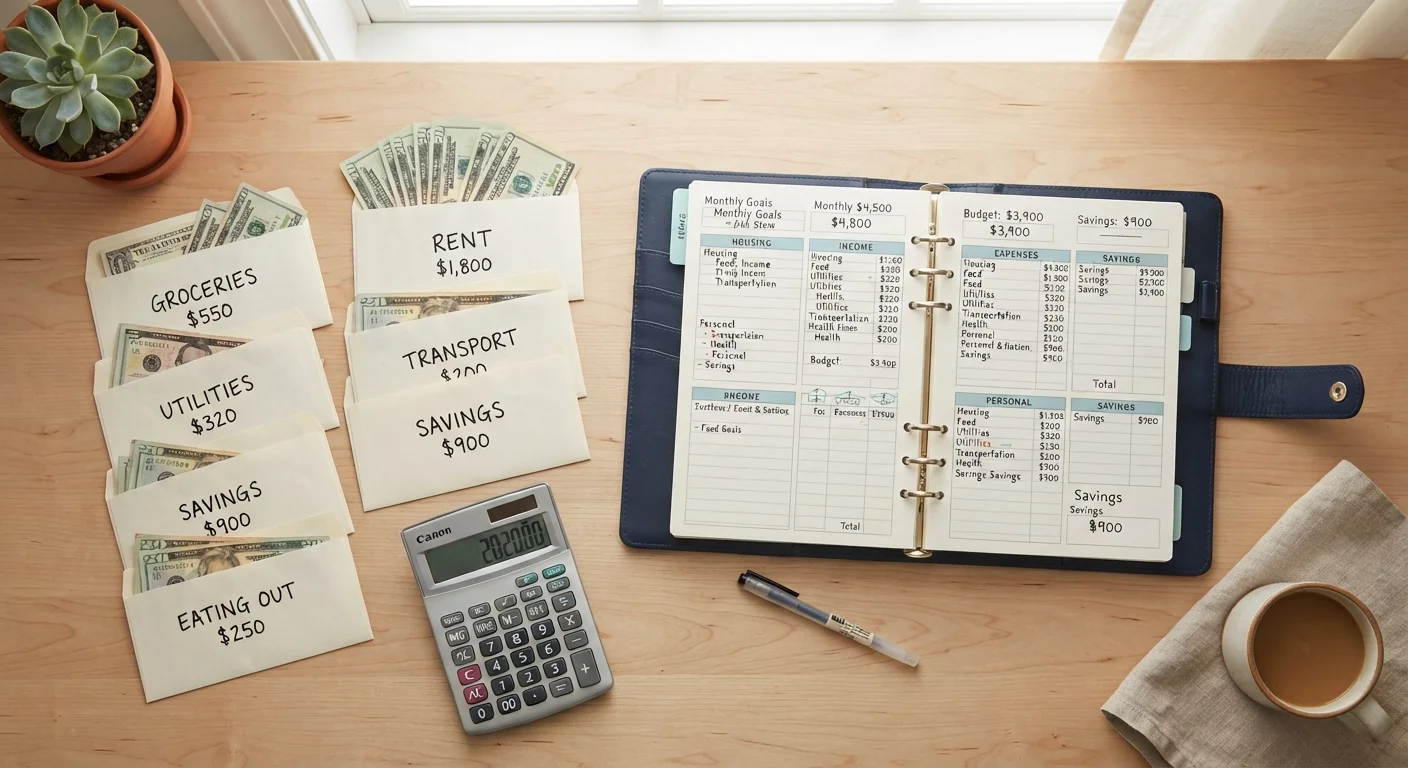
The envelope method focuses on variable, discretionary spending categories where overspending is most common - groceries, dining out, clothing, and entertainment, for example. You withdraw a set amount of cash at the start of the month and physically place it into labeled envelopes. When an envelope is empty, spending in that category stops until the next budget period. Digital versions of this method use virtual envelopes within budgeting apps, mimicking the same constraint without physical cash.
| Criterion | Zero-Based Budgeting | The Envelope Method |
|---|---|---|
| Core concept | Assign every dollar a purpose | Cap spending with cash envelopes |
| Scope | Covers entire monthly income | Focuses on variable categories only |
| Setup effort | High - rebuilt each month | Low - fill envelopes and go |
| Works for fixed expenses | Yes - all expenses are assigned | Not directly - separate management needed |
| Cash required | No - works digitally | Traditionally yes; digital versions exist |
| Best for irregular income | Yes - flexible month to month | Less suited - assumes stable income |
| Learning curve | Moderate to high | Low |
Practical Trade-Offs Worth Knowing
Each method has real limitations alongside its strengths. Zero-based budgeting is more time-intensive - it requires building a fresh budget each month and revisiting every category, which can feel burdensome for people with busy schedules. It also demands reasonable forecasting of irregular expenses like car repairs or medical bills. For a candid look at the broader trade-offs of strict budgeting, see the upsides and downsides of strict budgeting.
The envelope method is simpler but narrower. It doesn't naturally account for fixed expenses like rent, insurance premiums, or loan payments - those still need to be managed separately. Using cash-only also means forgoing credit card rewards and can create friction for online purchases or recurring subscriptions.
Digital Envelopes Are a Valid Alternative
Several budgeting apps replicate the envelope method without requiring physical cash. Virtual envelope systems let you allocate funds digitally to spending categories, automatically tracking what remains. This makes the method more practical for households that rely on debit cards or make frequent online purchases, while preserving the same spending-limit discipline.
Both methods benefit from consistent spending categories. If you're unsure what categories belong in a household budget, our guide on spending categories for a monthly budget is a practical starting point.
Which Method Fits Your Situation
The most effective budget is the one you maintain consistently. Research on personal finance behavior consistently finds that structured budgeting - regardless of specific method - is associated with higher savings rates and lower financial stress, but only when the system matches the individual's habits and lifestyle.
~1 in 3
U.S. adults who maintain a detailed monthly budget
According to Gallup polling, a minority of American households follow a formal written budget, suggesting most people manage spending informally.
Under $400
Emergency savings available to many Americans
Federal Reserve surveys have consistently found a significant share of U.S. adults could not cover a $400 unexpected expense without borrowing - underscoring the value of structured budgeting.
Zero-based budgeting tends to suit people who enjoy planning, work with variable income, or want to align spending with larger financial goals like eliminating debt or building an emergency fund. The saving and debt hub has practical guidance on both fronts.
The envelope method is often a better fit for people who find detailed budgeting overwhelming but have one or two spending categories where self-control is genuinely difficult. It can also serve as a training-wheels approach - once spending patterns become more instinctive, some people graduate to a more comprehensive system like ZBB or even the 50/30/20 framework.
Some households combine both: a zero-based framework for the full budget picture, with physical or digital envelopes for the three or four categories where overspending is most likely. Tracking method also matters - whether you use a spreadsheet, app, or paper, consistency is what drives results. Our spending tracker comparison breaks down the honest trade-offs of each approach.
This article is for general informational purposes only and does not constitute personalized financial advice. For guidance tailored to your individual situation, consider consulting a qualified financial professional.