

Key Takeaways
- A bull market is generally defined as a rise of 20% or more from a recent low; a bear market is a decline of 20% or more from a recent high.
- Market cycles are driven by economic fundamentals, investor sentiment, interest rates, and corporate earnings.
- No one can consistently predict the timing of market cycles - even professional investors.
- Long-term investors historically benefit from staying invested through full market cycles rather than trying to time entries and exits.
- Understanding cycles can reduce emotional reactions to market downturns and support more disciplined decision-making.
Market Cycles
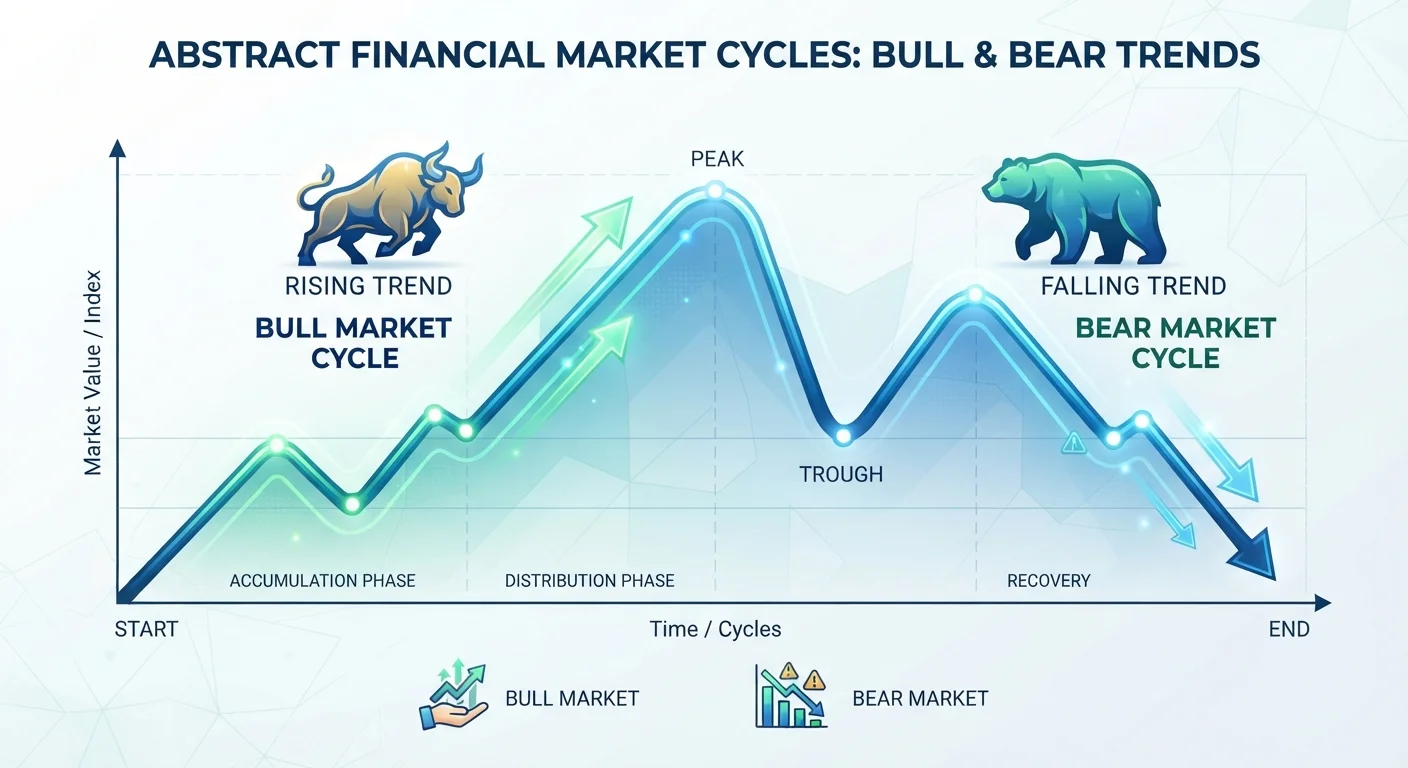
A market cycle refers to the recurring pattern of expansion and contraction in financial markets over time. These cycles typically move through four broad phases: accumulation, uptrend (bull market), distribution, and downtrend (bear market). Understanding these phases helps investors contextualize short-term volatility within a longer historical pattern.
Economists often distinguish between secular (long-term, decade-spanning) and cyclical (shorter, within-trend) market cycles, both of which can coexist simultaneously.
The Four Phases of a Market Cycle
Financial markets do not move in a straight line. They expand, peak, contract, and recover - repeatedly, over decades. This broad pattern is what investors and economists call a market cycle. Recognizing where markets may sit within a cycle can help investors interpret current conditions more clearly, even though pinpointing exact turning points in real time is notoriously difficult.
Most market cycles include four recognizable phases:
- Accumulation: Prices stabilize after a downturn. Informed, long-term investors begin buying at lower valuations while general sentiment remains pessimistic.
- Uptrend (Bull Market): Confidence grows, economic indicators improve, and prices rise broadly. More investors enter the market, reinforcing momentum.
- Distribution: The market reaches or approaches a peak. Early investors begin selling, and enthusiasm starts to outpace fundamentals.
- Downtrend (Bear Market): Prices fall 20% or more from their peak. Fear replaces optimism, and selling accelerates.
To understand the assets that move through these cycles, see our guide to stocks, bonds, and funds.
What Drives Market Cycles?
No single factor controls market cycles. They emerge from the interaction of several overlapping forces:
- Economic growth: Rising GDP, employment, and consumer spending typically support bull markets. Slowdowns or recessions often accompany bear markets.
- Interest rates: When central banks raise rates to control inflation, borrowing costs increase and corporate profits can compress - often weighing on stock prices. Lower rates tend to have the opposite effect.
- Corporate earnings: Strong profit growth attracts investment; declining earnings signal trouble ahead.
- Investor sentiment: Optimism and pessimism can amplify economic signals in either direction, sometimes pushing markets beyond what fundamentals alone would justify.
20%
Threshold defining a bear market decline
A widely used convention among market analysts defines a bear market as a decline of 20% or more from a recent peak in a broad market index.
~9.6 months
Average bear market duration (historical)
Based on historical S&P 500 data analyzed by Hartfordfunds and other market researchers, bear markets have averaged roughly 9-10 months in duration, though individual cycles vary significantly.
~2.7 years
Average bull market duration (historical)
Historical analysis of U.S. equity markets suggests bull markets have generally lasted considerably longer than bear markets, reinforcing the case for long-term investing discipline.
Understanding that risk and return are always intertwined is central to interpreting these forces. Our article on risk and return explores that relationship in detail.
How Long-Term Investors Typically Respond
One of the most consistent findings in financial research is that investors who remain invested through full market cycles have historically fared better than those who attempt to move in and out based on short-term predictions. This is not a guarantee - all investing involves risk - but it reflects the difficulty of timing markets accurately.
Stay Focused on Your Time Horizon
If your investment goals are years or decades away, short-term market downturns may matter far less than they feel in the moment. Regularly reviewing your asset allocation and ensuring it matches your actual risk tolerance and time horizon is more productive than reacting to cycle headlines. A licensed financial adviser can help you stress-test your plan against various market scenarios.
Bear markets can feel alarming, but they are a normal part of investing history. The S&P 500 has experienced multiple bear markets and has recovered from each of them over time, though past performance does not guarantee future results.
Emotional reactions during downturns - panic selling, chasing rallies - are among the most common ways individual investors undermine their own goals. For a deeper look at these patterns, see our piece on emotional investing behaviors.
It's also worth separating cycle awareness from market-timing myths. Our article on common investing myths addresses why the belief that you need to time the market often leads to worse outcomes.
This article is for general informational and educational purposes only and does not constitute personalized financial, investment, or tax advice. Please consult a qualified, licensed financial professional before making decisions about your own financial situation.