

Key Takeaways
- Higher potential returns almost always come with higher potential losses - there are no free lunches in investing.
- Risk tolerance is personal and depends on your time horizon, financial situation, and emotional comfort with uncertainty.
- Diversification can reduce certain types of risk without necessarily sacrificing expected returns.
- Understanding risk and return is the foundation for building any sound investment strategy.
- Past investment returns do not guarantee future results - all investing involves risk.
Risk-Return Trade-Off
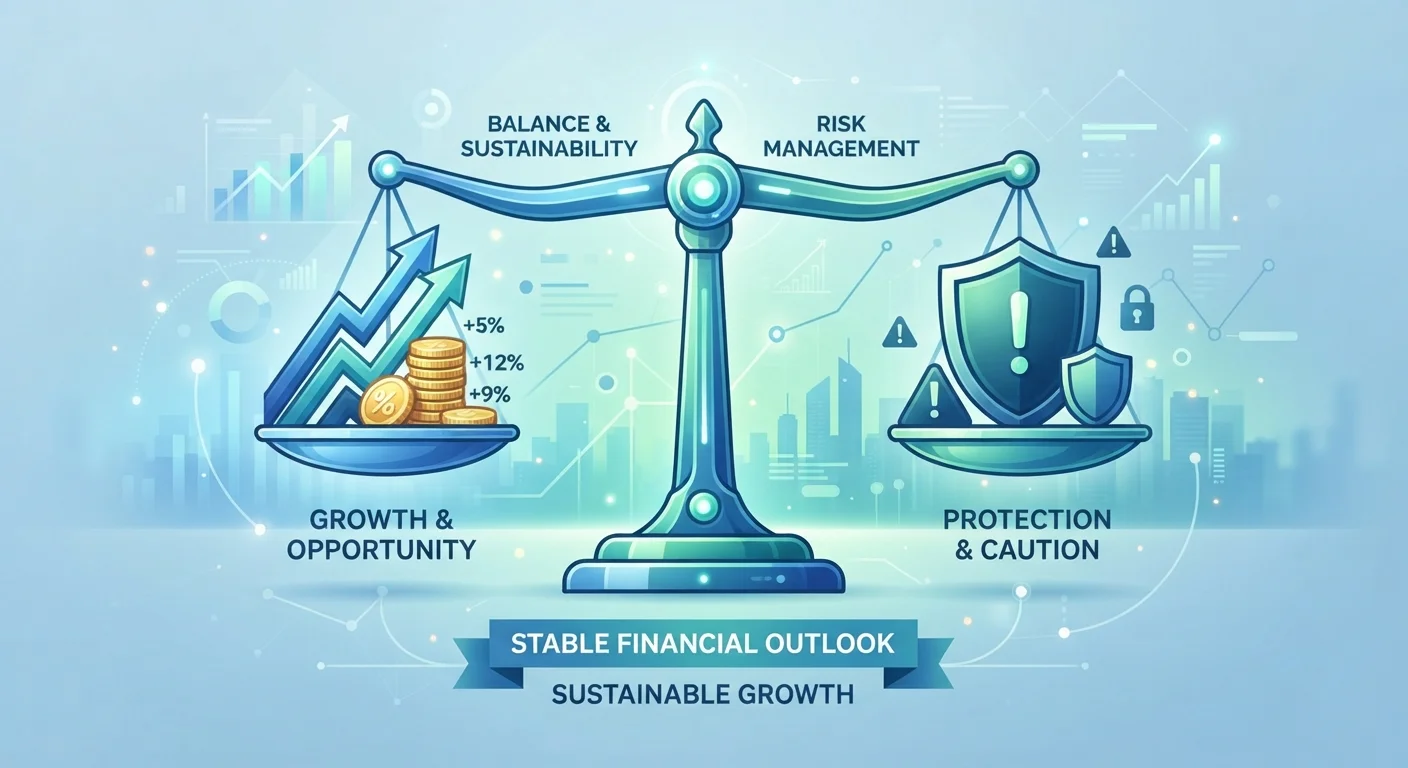
The risk-return trade-off is a fundamental investing principle: the greater the potential reward of an investment, the greater the chance of losing money. Conversely, investments with lower risk typically offer lower returns. Understanding this relationship helps investors choose assets that match both their goals and their comfort with uncertainty.
In finance, this relationship is often quantified using metrics like standard deviation (a measure of volatility) and the Sharpe ratio, which expresses return relative to the level of risk taken.
Why Risk and Return Are Inseparable
At the heart of every investing decision is a simple but powerful idea: you cannot pursue a meaningful return without accepting some degree of risk. This is not a rule invented by Wall Street - it reflects how markets actually work. Investors demand higher potential rewards to compensate for taking on greater uncertainty.
Think of it this way: a federally insured savings account carries almost no risk of losing your money, but it earns a modest interest rate. A startup's stock could multiply in value - or become worthless. The market compensates investors for the possibility of loss by offering the possibility of greater gain. That's the trade-off, and it applies across every asset class.
This principle is why savvy investors don't simply chase the highest possible return. They ask: how much risk am I taking on to get there, and does that match my situation? To learn more about the building blocks that carry different levels of risk, see our guide on stocks, bonds, and funds.
~10%
Average annual US stock market return (historical)
The S&P 500 has historically averaged roughly 10% annual returns before inflation over long periods, though individual years vary dramatically and past performance does not guarantee future results.
~4-5%
Typical long-term US government bond yield
Long-term Treasury bonds have historically offered lower returns than stocks, reflecting their lower risk profile as debt backed by the federal government.
Types of Risk Every Investor Should Know
Risk isn't a single thing - it comes in several distinct forms, each relevant to different investment decisions:
- Market risk: The possibility that broad economic forces will push asset prices down across the board, as happened during the 2008 financial crisis.
- Inflation risk: When investment returns don't outpace inflation, your purchasing power shrinks even if your account balance grows in dollar terms.
- Credit risk: The chance that a bond issuer - a corporation or government - fails to make promised payments.
- Liquidity risk: Some assets, like real estate or certain private investments, can be difficult to sell quickly without accepting a lower price.
- Concentration risk: Holding too much of your portfolio in a single company, sector, or asset type amplifies the damage if that area struggles.
No investment is entirely free of risk - even cash held in savings loses real value when inflation runs high. The goal is to understand which risks you're taking and ensure they're appropriate for your goals.
Risk Tolerance Is Not Fixed
Your comfort with risk can and should change over time as your income, debts, family situation, and proximity to financial goals evolve. What made sense at 30 may not make sense at 55. Revisiting your risk assumptions periodically - especially after major life changes - is a healthy financial habit.
Matching Risk to Your Personal Situation
Your appropriate level of risk isn't determined by what the market is doing - it's shaped by three personal factors: your time horizon, your financial cushion, and your emotional tolerance for seeing your portfolio decline in value.
Someone in their 30s saving for retirement has decades to ride out market volatility, so they may reasonably accept more short-term risk in pursuit of long-term growth. A retiree drawing income from their savings has far less room to absorb losses. Neither approach is universally right - they reflect different circumstances.
Emotional tolerance also matters. Even if your timeline supports a higher-risk strategy, panic-selling during a downturn can turn paper losses into real ones. Understanding how you might react is an honest and necessary part of building a plan. For a closer look at how emotional reactions can damage investment outcomes, see our article on emotional investing patterns.
“Risk comes from not knowing what you're doing. The goal of investing is not to avoid risk entirely, but to understand and price it correctly.”
— Warren Buffett, Chairman and CEO of Berkshire Hathaway, widely cited investor
Managing Risk Without Abandoning Returns
Accepting that risk and return are connected doesn't mean accepting unnecessary risk. There are well-established strategies for taking on only the risks you need to achieve your goals.
Diversification is the most widely recognized tool. By spreading investments across different asset types, industries, and geographies, you reduce exposure to any single point of failure. You can explore how this works in practice in our guide on diversification in practice.
Time in the market is another powerful factor. Staying invested through market cycles - rather than trying to time entries and exits - has historically allowed long-term investors to capture growth despite short-term volatility. Compounding plays a major role here: returns that build on prior returns over time are a significant force in long-term wealth. Learn more in our piece on compounding and long-term wealth.
Understanding risk and return also helps cut through misleading claims. Our article on common investing myths addresses why promises of high returns with no risk are almost always a red flag.
A Simple Starting Point for Risk Assessment
Ask yourself: if my portfolio dropped 20% tomorrow, would I stay the course or sell? Your honest answer reveals a lot about your real risk tolerance. Many financial institutions offer free risk-assessment questionnaires that can help you formalize this self-evaluation before building or adjusting a portfolio.
This article is for general informational and educational purposes only and does not constitute personalized financial, investment, or legal advice. Please consult a qualified financial adviser before making investment decisions based on your individual circumstances.