

Key Takeaways
- The stock market is where ownership stakes in public companies are bought and sold.
- Stock prices change constantly based on supply and demand, not a fixed formula.
- Anyone with a brokerage account can participate - not just professionals or wealthy investors.
- Major U.S. indexes like the S&P 500 track the overall performance of a broad group of stocks.
- Market prices reflect collective expectations about a company's future, not just its current state.
- Investing involves risk, including the possibility of losing money; no outcome is guaranteed.
The Stock Market
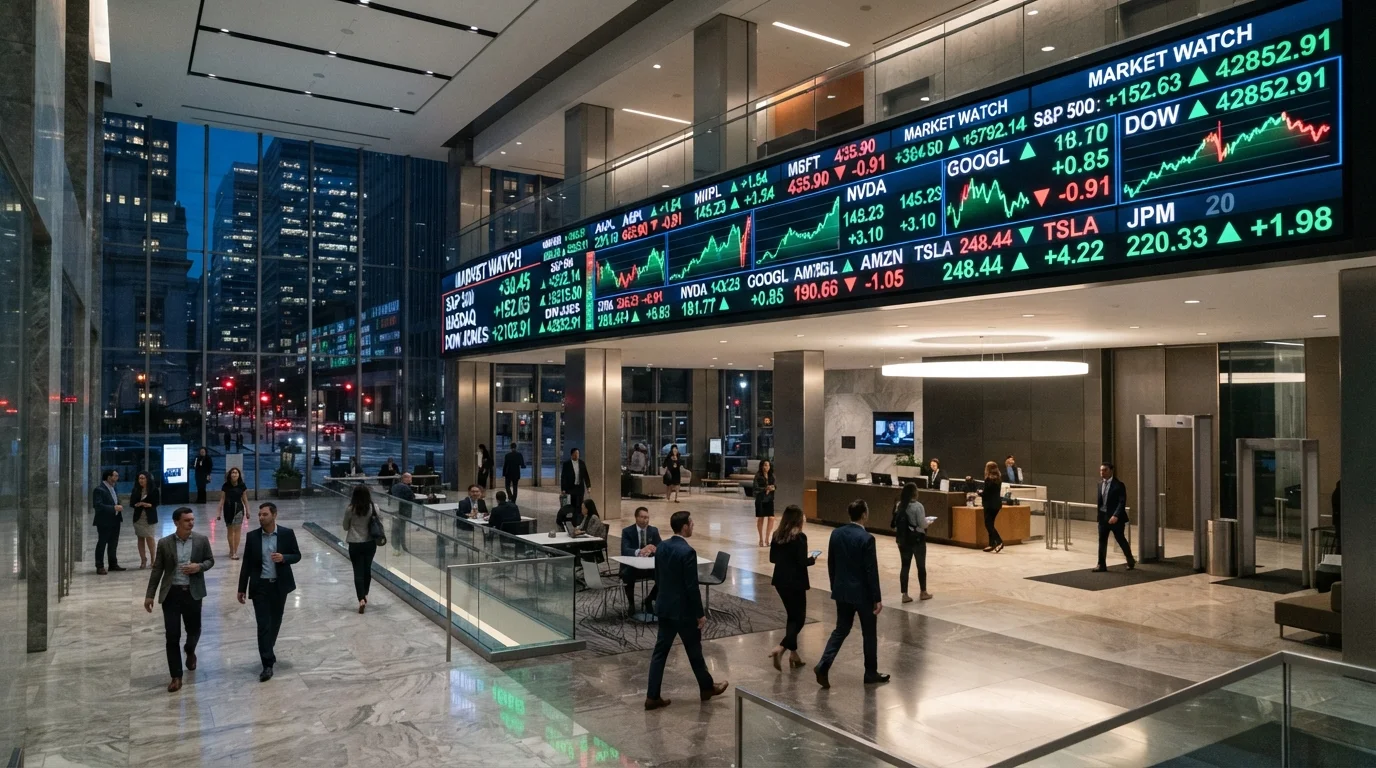
The stock market is a network of exchanges where shares of publicly traded companies are bought and sold. When a company sells shares to the public, it gives investors a small ownership stake in the business. Buyers and sellers agree on prices through open competition, much like an auction that runs continuously during trading hours.
In the U.S., the two primary exchanges are the New York Stock Exchange (NYSE) and Nasdaq. Prices are set by matching 'bid' (buy) and 'ask' (sell) orders through electronic systems called order-matching engines.
What the Stock Market Actually Is
At its core, the stock market is a marketplace - a structured system where buyers and sellers trade ownership stakes in companies. Those ownership stakes are called shares or stocks. When a company wants to raise money to grow, it can sell shares to the public in a process called an initial public offering (IPO). After that, those shares trade freely on an exchange between investors.
Think of it less like a casino and more like a farmers' market: buyers and sellers show up, agree on prices, and exchange something of real value. The difference is that what's being exchanged is a small piece of a business - and prices shift constantly based on new information and changing expectations.
The U.S. market is regulated by the Securities and Exchange Commission (SEC), a federal agency that enforces rules designed to keep trading fair and transparent. This regulatory structure is a key reason why the U.S. stock market is one of the most trusted in the world.
The Market Is Not the Same as a Single Stock
When people refer to 'the market,' they typically mean a broad index, not every individual company. A single stock can fall sharply on the same day that the overall market rises. Understanding this distinction helps investors avoid drawing sweeping conclusions from any one company's performance.
How Prices Are Set
Stock prices are not assigned by any central authority. They emerge from the continuous back-and-forth between buyers and sellers. Every trade involves a bid price (what a buyer is willing to pay) and an ask price (what a seller will accept). When those two numbers match, a trade happens and that price becomes the latest recorded value of the stock.
What drives those bids and asks? A wide range of factors, including:
- Company earnings - stronger profits generally attract more buyers
- Economic conditions - interest rates, inflation, and employment data shape investor confidence
- News and sentiment - product launches, lawsuits, or leadership changes can shift expectations overnight
- Broader market trends - sometimes entire sectors rise or fall together regardless of individual company news
This is why stock prices can seem unpredictable in the short term. They reflect millions of individual judgments happening simultaneously. Over longer periods, prices have historically trended upward alongside economic growth - but that pattern is not guaranteed and involves real risk of loss.
~$40T
Total U.S. stock market capitalization
The combined market value of all U.S.-listed publicly traded companies regularly exceeds tens of trillions of dollars, reflecting the scale of the marketplace.
58%
U.S. adults who own stocks
According to Gallup polling, roughly 58% of American adults report owning stocks, either directly or through funds in retirement accounts.
6.5 hrs/day
U.S. market trading hours
Major U.S. exchanges operate from 9:30 a.m. to 4:00 p.m. Eastern Time on weekdays, excluding federal holidays.
Who Participates - and How You Can Too
The stock market was once accessible mainly to wealthy individuals and large institutions. Today, that has changed significantly. Individual investors - sometimes called retail investors - can open a brokerage account online, often for free, and begin trading within days. Many platforms also offer fractional shares, so you don't need hundreds of dollars to own a piece of a large company.
Beyond individual investors, the market includes institutional participants like:
- Mutual funds and pension funds - which pool money from many investors
- Insurance companies - investing premiums to meet future obligations
- Hedge funds - private investment pools that use a variety of strategies
- Market makers - firms that stand ready to buy or sell at quoted prices to keep trading liquid
If you're new to investing, see our beginner's guide to getting started for a practical overview of account types and first steps. And if you want to understand what you'd actually be buying, stocks, bonds, and funds explained covers the core building blocks of a portfolio.
This article is for general informational and educational purposes only. It is not personalized financial or investment advice. Consider speaking with a licensed financial adviser before making investment decisions.
Indexes, Cycles, and What 'the Market' Really Means
When news reports say 'the market was up today,' they're usually referring to a stock market index - a curated collection of stocks used to gauge overall performance. The most widely cited include:
- S&P 500 - tracks 500 large U.S. companies across multiple industries
- Dow Jones Industrial Average (DJIA) - follows 30 major U.S. companies
- Nasdaq Composite - weighted heavily toward technology companies
No index captures every stock or every investor's experience. A day when the S&P 500 rises might still be a losing day for someone concentrated in a single sector.
Markets also move in recognizable patterns over time. Extended periods of rising prices are called bull markets; prolonged declines are bear markets. Understanding these cycles can help you keep perspective when headlines turn alarming. Our article on market cycles and what drives them explains how these phases typically unfold.
For investors who don't want to pick individual stocks, index funds offer a way to own a broad slice of the market in a single, low-cost investment. And if persistent doubts are holding you back, common investing myths debunked separates fact from fiction.
Focus on the Long Term, Not Daily Moves
Short-term price swings are a normal part of how markets work and rarely signal a need for action. Investors who react emotionally to daily headlines often buy high and sell low - the opposite of a sound strategy. If you're unsure how to interpret market volatility, speaking with a licensed financial adviser can help you build a plan anchored to your own goals and timeline.