

Key Takeaways
- The Debt Avalanche targets the highest-interest debt first, minimizing total interest paid over time.
- The Debt Snowball pays off the smallest balance first, building motivation through quick wins.
- Research suggests the Snowball method may help more people actually finish paying off their debts.
- Both strategies require making minimum payments on all debts while directing extra funds to one target account.
- Your personality and financial situation should guide which method you choose - neither is universally superior.
- Consulting a certified financial counselor can help you build a personalized debt payoff plan.
Option A
Debt Avalanche
The mathematically optimal, interest-minimizing approach.
Best for: People who are motivated by saving the most money on interest and can stay disciplined without quick wins.
Option B
Debt Snowball
The psychologically driven, momentum-building method.
Best for: People who need early motivational wins to stay on track and find it hard to stick with long-term plans.
If you want to pay the least interest mathematically
Debt Avalanche
Targeting high-interest balances first reduces the total cost of your debt, saving money over the life of your payoff plan.
If you need early motivational wins to stay committed
Debt Snowball
Eliminating smaller balances quickly gives you a sense of progress that keeps many people engaged and on track for the long haul.
If your high-interest debt also happens to be your smallest balance
Debt Avalanche
In this case, both methods point to the same account, so you get the psychological win and the financial savings simultaneously.
If you've struggled to stick with debt payoff plans in the past
Debt Snowball
Behavioral research indicates that visible early progress is one of the strongest predictors of follow-through on debt elimination goals.
How Each Strategy Works
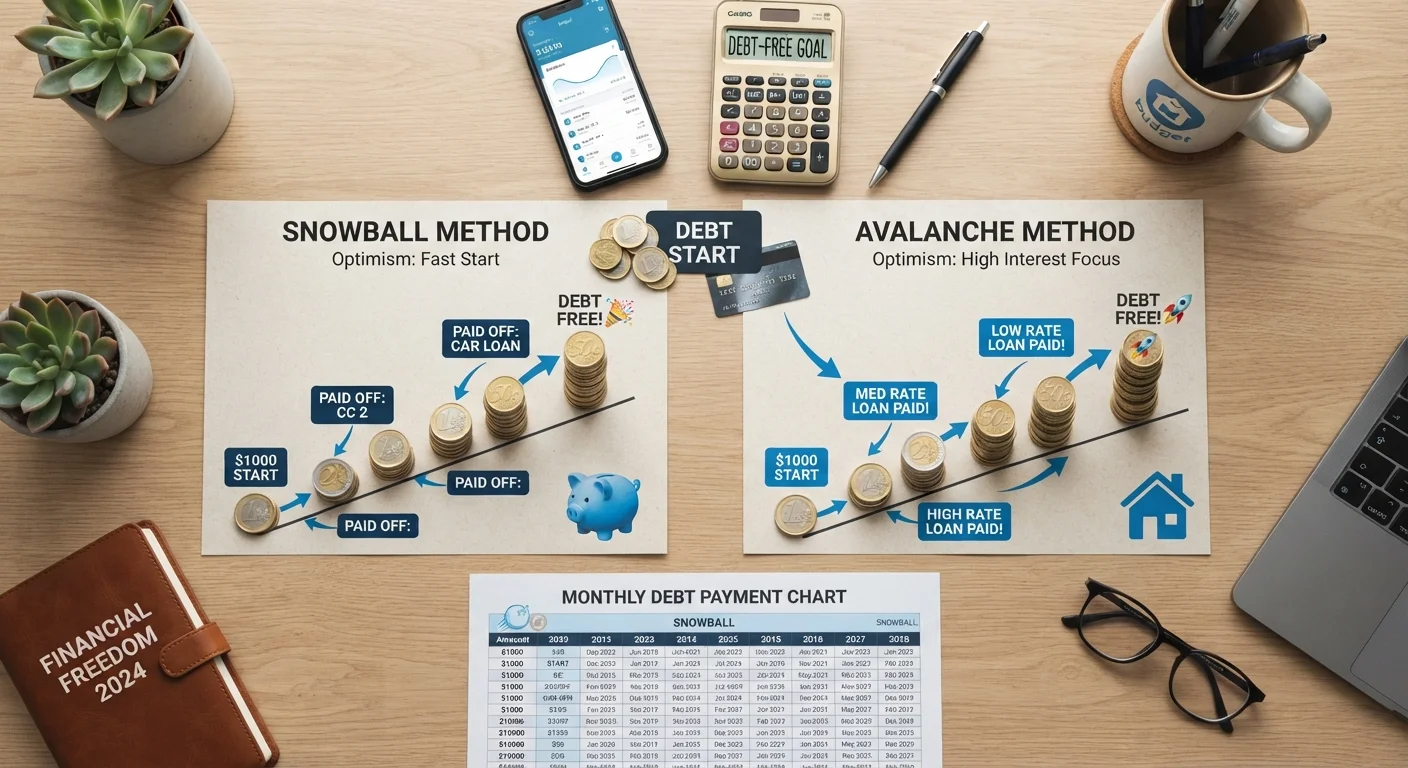
Both the Debt Avalanche and Debt Snowball follow the same basic structure: make minimum payments on every debt, then direct any extra money toward one target debt. The difference is entirely in how you choose that target.
With the Debt Avalanche, you rank your debts by interest rate, from highest to lowest. You throw every spare dollar at the highest-rate debt until it's gone, then move to the next. Because high-interest debt grows fastest, eliminating it first limits the total interest that accumulates across your entire debt load.
With the Debt Snowball, popularized by personal finance educators, you rank debts by balance - smallest to largest. You attack the smallest balance first, regardless of its interest rate. Once it's paid off, you roll that payment into the next smallest balance, creating a growing "snowball" of monthly payments pointed at successive debts.
Both methods work within whatever budget you currently have. Neither requires a windfall or an income increase - just a consistent commitment of whatever extra cash you can free up each month. If you're still sorting out how much room you have, see our budgeting fundamentals guide for a practical starting point.
| Criterion | Debt Avalanche | Debt Snowball |
|---|---|---|
| Payoff order | Highest interest rate first | Smallest balance first |
| Total interest paid | Lower (mathematically optimal) | Potentially higher |
| Time to first payoff | Longer if high-rate debt is large | Faster - smallest balance cleared first |
| Motivational structure | Delayed rewards; requires discipline | Frequent wins; built-in momentum |
| Ideal personality fit | Goal-oriented, analytically motivated | Progress-driven, needs early feedback |
| Best for debt profiles | High-rate accounts with large balances | Multiple smaller accounts to eliminate |
| Completion likelihood | Lower if motivation fades | Higher among behaviorally motivated users |
What the Math and Research Actually Say
On pure numbers, the Avalanche wins every time. By reducing high-interest balances first, you slow the rate at which interest compounds across your debts. Depending on your interest rates and balances, this approach can save hundreds or even thousands of dollars compared to the Snowball - though the exact amount varies widely by individual situation.
However, a debt payoff strategy only works if you stick with it. Research in behavioral economics - including studies published in the Journal of Consumer Research - has found that people are more likely to stay motivated and complete debt payoff when they can see accounts closing. The Snowball method is specifically designed to generate that sense of progress.
80%
Of personal finance success tied to behavior
Personal finance educators widely attribute most debt payoff outcomes to consistent behavior and follow-through rather than mathematical strategy alone.
~$1,000+
Potential interest savings with Avalanche
Estimates vary, but households with mixed high- and low-rate debt can save substantially by prioritizing higher-rate accounts - exact savings depend on balances and rates.
1 in 3
Americans carrying credit card debt month to month
According to Federal Reserve consumer credit data, a significant share of U.S. households carry revolving credit card balances, making payoff strategy selection practically relevant.
This matters because incomplete plans cost more than imperfect ones. A borrower who follows the Snowball method to completion will almost always end up in a better financial position than one who starts the Avalanche but abandons it midway. The "best" method is, practically speaking, the one you'll actually finish.
These strategies also intersect with broader financial goals. Our guide on balancing debt payoff with saving explores how to handle both priorities at once without overextending yourself.
Choosing the Strategy That Fits Your Situation
Start by being honest about your behavioral tendencies. Do you stay engaged with long-term goals even when early results are slow? If yes, the Avalanche's financial efficiency may suit you well. If you tend to lose steam without visible milestones, the Snowball's quick wins could be the structure you need to succeed.
Also consider your debt profile. If your highest-interest debt also carries a relatively small balance, the Avalanche and Snowball may point to the same account - giving you both the psychological and financial benefit simultaneously. On the other hand, if your largest balance carries the highest rate, the Avalanche will require a longer wait before your first payoff celebration.
It's worth noting that these two strategies aren't the only debt management tools available. If you're dealing with multiple high-rate accounts and finding it hard to manage them separately, you may want to explore other approaches. Our article on debt consolidation vs. debt management plans outlines alternatives worth understanding.
Once you have a payoff strategy in place, the next step is making sure your broader financial plan accounts for both debt elimination and future savings goals. The framework for building savings while carrying debt can help you think through that balance clearly.
This article is for general informational and educational purposes only and does not constitute personalized financial, tax, or legal advice. Please consult a licensed financial professional before making decisions about your specific debt or savings situation.