

Key Takeaways
- Not-from-concentrate juice is pasteurized but never stripped of water, keeping it closer to fresh-squeezed.
- Juice from concentrate has water removed then re-added, which can alter flavor and some heat-sensitive nutrients.
- Both types can legally be labeled '100% juice' with no added sugar, so the label distinction matters.
- Vitamin C levels in both types are often similar after fortification, but minor phytonutrient differences may exist.
- Fresh-squeezed juice has the shortest shelf life and is generally not pasteurized, which carries food-safety considerations.
- Reading the ingredient list, not just the front of the pack, is the most reliable way to know what you're drinking.
Option A
Not-from-Concentrate (NFC) Juice
The closer-to-fresh option with minimal processing.
Best for: Consumers who prioritize taste, aroma, and a product closer to the original fruit.
Option B
Juice from Concentrate (JFC)
The practical, widely available reconstituted choice.
Best for: Budget-conscious shoppers who want a shelf-stable, consistent juice product.
If you want the most fruit-forward flavor and aroma
Not-from-Concentrate (NFC) Juice
NFC juice retains more of the volatile aromatic compounds that give fresh juice its characteristic taste, since it skips the evaporation step.
If cost and long shelf life are your main priorities
Juice from Concentrate (JFC)
Removing water during processing makes concentrate cheaper to ship and store, so reconstituted juice is typically the most affordable option on the shelf.
If you're focused on minimizing processing steps
Not-from-Concentrate (NFC) Juice
NFC juice goes from fruit to bottle without the concentration and reconstitution steps, making it the least-processed shelf-stable juice option.
If you want the absolute freshest option and plan to use it within days
Fresh-squeezed juice
Freshly pressed juice has no heat treatment, but it also has no pasteurization - so it must be refrigerated and consumed quickly, and is not recommended for young children, pregnant individuals, or immunocompromised people.
How Each Type of Juice Is Made
Walk down any grocery store juice aisle and you'll see terms like fresh-squeezed, not from concentrate, and from concentrate. These phrases describe fundamentally different production methods - and understanding them helps you decide what you're actually pouring into your glass.
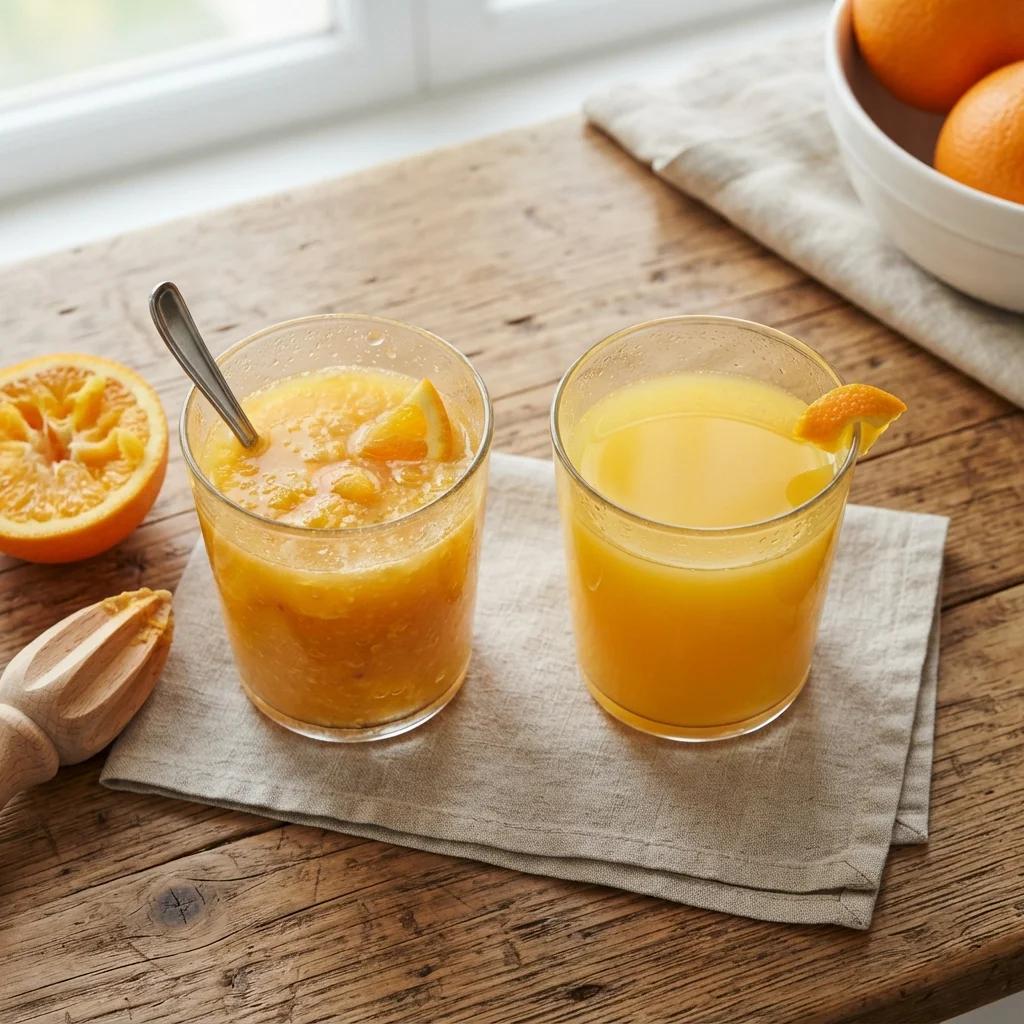
Fresh-squeezed juice is pressed directly from the fruit and sold without pasteurization (heat treatment to kill pathogens) or any further processing. It has the shortest shelf life - typically just a few days - and is the closest thing to eating the fruit itself. Because it's not pasteurized, the U.S. Food and Drug Administration requires unpasteurized juice to carry a safety warning, and health authorities advise that vulnerable groups, including young children, pregnant individuals, older adults, and people with weakened immune systems, avoid it.
Not-from-concentrate (NFC) juice is squeezed, pasteurized, and then stored - often for extended periods in large oxygen-depleted tanks - before being packaged and sold. It never has its water removed. Some producers add back flavor packs (natural flavor compounds derived from the fruit itself) to compensate for taste changes during storage, which is legal and doesn't need to be listed separately on the ingredient label under current U.S. rules.
Juice from concentrate (JFC) goes through an extra step: water is evaporated out of the freshly squeezed juice to create a dense concentrate. This makes it easier and cheaper to transport and store. At the bottling facility, water is added back in (reconstitution), and the juice is pasteurized. The heat applied during water removal and pasteurization can degrade some heat-sensitive compounds, though many producers fortify the final product with vitamin C to compensate.
For a deeper look at how to interpret what's on the package, see what the Nutrition Facts label is actually telling you.
Nutrition and Taste: How Do They Actually Compare?
| Criterion | Not-from-Concentrate (NFC) | Juice from Concentrate (JFC) |
|---|---|---|
| Processing steps | Squeezed, pasteurized, stored | Squeezed, evaporated, reconstituted, pasteurized |
| Water removed during production | No | Yes, then re-added |
| Shelf life (refrigerated) | Weeks to months | Weeks to months (similar) |
| Typical retail price | Generally higher | Generally lower |
| Flavor complexity | Often more fruit-forward | Can be more uniform, less complex |
| Vitamin C (post-fortification) | Naturally retained | Often added back |
| Added sugar | None (if labeled 100% juice) | None (if labeled 100% juice) |
| Fiber content | Minimal | Minimal |
From a sugar standpoint, both NFC and JFC juice contain naturally occurring fruit sugars - neither has sugar added if the label says "100% juice." The total sugar content per serving is driven by the fruit itself, not the process. To understand why this distinction matters, natural sugar and added sugar are not the same thing.
Where differences do appear is in micronutrients and flavor compounds. Heat applied during evaporation can reduce levels of heat-sensitive vitamins and phytonutrients (beneficial plant compounds). However, because many JFC products are fortified post-processing, vitamin C levels in grocery-store concentrate-based juices are often comparable to NFC options. The gap is more noticeable for less heat-stable compounds that aren't routinely added back.
On taste, NFC juice tends to score higher in consumer preference studies for flavor complexity, largely because more volatile aromatic compounds survive the process. That said, taste is subjective, and a well-produced JFC product may be indistinguishable to many palates.
~114 cal
Calories in 8 oz of orange juice (any type)
Per USDA FoodData Central data, calorie content varies little between NFC and JFC orange juice at equivalent serving sizes.
~21g
Natural sugars per 8 oz serving of OJ
The naturally occurring sugar content is driven by the fruit, not the processing method, for both NFC and JFC varieties labeled 100% juice.
0g
Fiber in most commercial juices
Pressing removes nearly all dietary fiber from fruit, regardless of whether the juice is NFC or from concentrate, per standard nutritional analysis.
It's also worth noting what juice - in any form - lacks compared to whole fruit: dietary fiber. Pressing separates most of the fiber from the liquid. For a full comparison of how juicing and blending handle nutrients differently, see our piece on smoothies vs. juices and what happens to fiber and nutrients.
This article is for general informational purposes only and does not constitute medical or dietary advice. Consult a qualified healthcare professional or registered dietitian for guidance specific to your health needs.