

| Added Sugar in a 12-oz Regular Soda | ~39 grams (USDA FoodData Central average) |
| FDA Daily Value for Added Sugars | 50 grams (2,000-calorie diet) (FDA Nutrition Facts label rules) |
| Sugar Alcohols: Calories per Gram | 0.2-3 kcal/g (vs. 4 kcal/g for sucrose) (FDA guidance on sugar alcohols) |
| Largest Beverage Sugar Source in US Diet | Sugar-sweetened beverages (Dietary Guidelines for Americans, 2020-2025) |
| Label Term for Natural Juice Sugars | Listed under Total Sugars, not Added Sugars (FDA Nutrition Facts labeling requirements) |
The Sugar Landscape in Packaged Drinks
Sugars in beverages fall into two broad camps: those that occur naturally in an ingredient (like fructose in fruit juice) and those added during manufacturing to sweeten, preserve, or improve mouthfeel. The distinction matters because the Nutrition Facts label lists both under "Total Sugars," with only "Added Sugars" broken out separately - a line that many consumers overlook.
| Added Sugar in a 12-oz Regular Soda | ~39 grams (USDA FoodData Central average) |
| FDA Daily Value for Added Sugars | 50 grams (2,000-calorie diet) (FDA Nutrition Facts label rules) |
| Sugar Alcohols: Calories per Gram | 0.2-3 kcal/g (vs. 4 kcal/g for sucrose) (FDA guidance on sugar alcohols) |
| Largest Beverage Sugar Source in US Diet | Sugar-sweetened beverages (Dietary Guidelines for Americans, 2020-2025) |
| Label Term for Natural Juice Sugars | Listed under Total Sugars, not Added Sugars (FDA Nutrition Facts labeling requirements) |
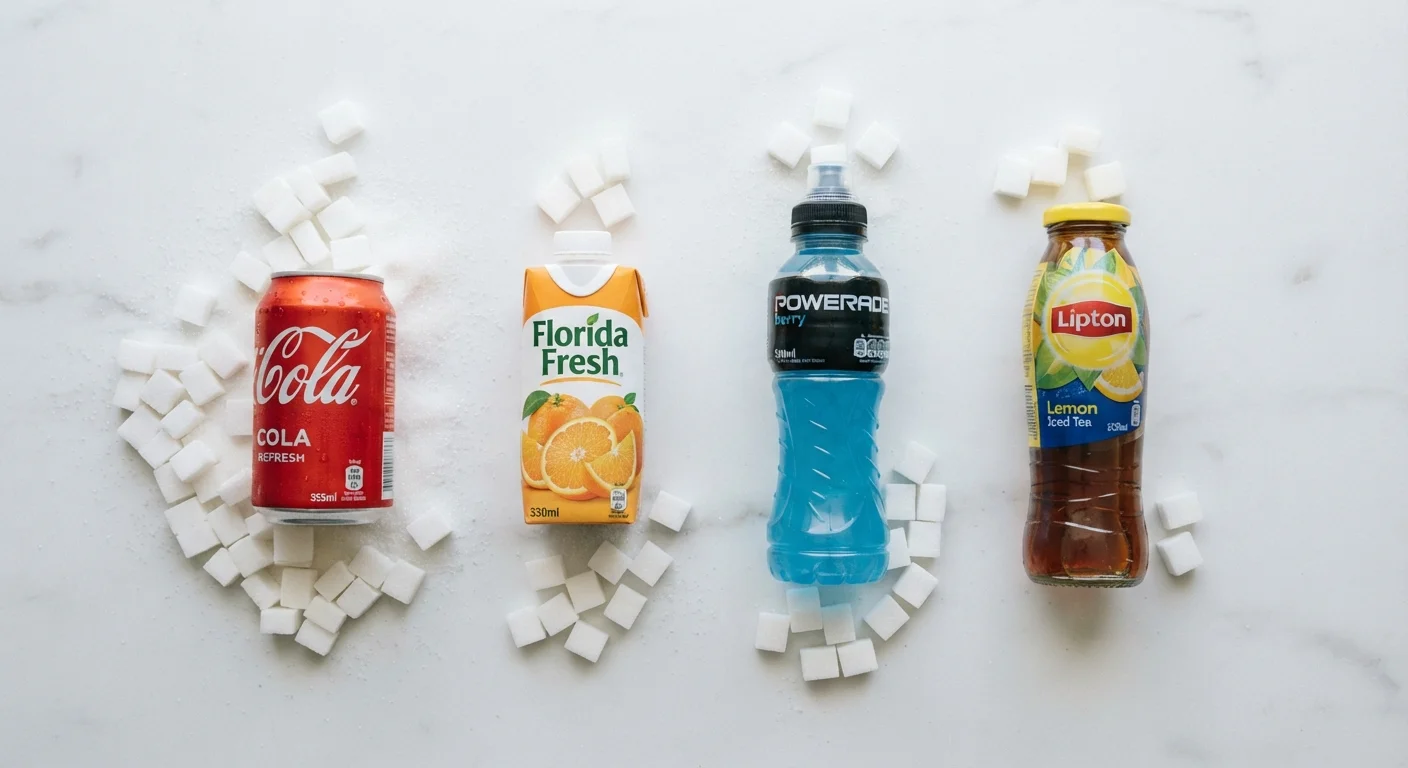
Drinks are one of the largest sources of added sugar in the American diet. A standard 12-oz regular soda can contain roughly 39 grams of added sugar, while a 20-oz bottle of a popular fruit-flavored drink may carry even more. Even beverages marketed as "natural" or "100% juice" can deliver a significant sugar load - though their sugars are naturally occurring rather than added.
Understanding how to read labels, and knowing the different forms sugar takes, helps you make more informed choices. For a deeper look at how ingredient lists are structured and where sweeteners tend to hide, see our guide on reading an ingredient list.
Common Sugar Types Found in Drinks
Added Sugars
Sugars and syrups added to a food or drink during processing or preparation. Unlike naturally occurring sugars, they are tracked separately on the Nutrition Facts label and counted against daily recommended limits.
High-Fructose Corn Syrup (HFCS)
A liquid sweetener made from corn starch in which some glucose has been converted to fructose. Widely used in sodas and fruit drinks in the US; classified as an added sugar.
Sugar Alcohols
A class of low-calorie sweeteners (e.g., erythritol, xylitol, sorbitol) that provide sweetness with a lower glycemic impact than sucrose. Found in sugar-free and reduced-sugar beverages; may cause digestive discomfort in large quantities.
Fructose
A simple sugar found naturally in fruit and honey, and also a component of sucrose and HFCS. When consumed as part of whole fruit it comes with fiber; in drinks it is delivered without that buffer.
Juice Concentrate
Fruit juice from which water has been removed. When used as an ingredient to add sweetness beyond what straight juice would provide, regulators treat it as an added sugar.
Sucrose
Common table sugar, composed of one glucose and one fructose molecule. Used as a benchmark for sweetness and widely added to carbonated soft drinks and flavored beverages.
Beyond sucrose (table sugar), beverage makers use a range of sweeteners - each with different metabolic behavior and labeling conventions. High-fructose corn syrup (HFCS) is one of the most common added sweeteners in mass-market sodas and fruit drinks in the US. It is produced by converting some of the glucose in corn syrup into fructose, yielding a product that is slightly sweeter than sucrose and less expensive to use at scale.
Fruit juice concentrate is another form of added sugar that often surprises consumers. When juice is reduced into concentrate and added back into a drink, it functions as a sweetener - and the FDA requires it be counted as an added sugar if it exceeds the amount in the equivalent straight juice. Agave syrup, honey, and cane juice are all functionally similar: they are sugar, regardless of how they are positioned on a label.
Sugar alcohols - such as erythritol, xylitol, and sorbitol - appear in sugar-free and reduced-sugar drinks. They provide fewer calories per gram than sucrose and have a lower glycemic impact, but can cause digestive discomfort in large amounts. For more detail on how natural and added sugars behave differently in the body, see why added sugar and natural sugar are not the same thing.
Where Sugar Hides Across Drink Categories
Sodas are the obvious culprit, but sugar appears across nearly every packaged drink category:
- Sports and electrolyte drinks: Many contain 20-34 grams of added sugar per serving, often from sucrose or dextrose. Serving sizes are frequently listed as two per bottle.
- Fruit juices and juice drinks: 100% juice contains only naturally occurring sugars, but "juice drinks" or "juice cocktails" typically contain added sweeteners. The word "juice" on the front label does not confirm the absence of added sugar.
- Flavored waters and teas: These are a common source of unexpected added sugar. A bottled iced tea or enhanced water may contain 20-30 grams of sugar with no obvious visual cue on the front of the package.
- Energy drinks: Many standard energy drinks contain significant added sugar alongside caffeine and other active ingredients. See what's inside energy drinks for a full breakdown of how those ingredients interact.
- Sparkling waters: Unflavored sparkling water contains no sugar. However, some flavored sparkling beverages cross into lightly sweetened territory - always verify with the label. Sparkling water, club soda, and tonic each behave quite differently in this respect.
"No Added Sugar" Doesn't Mean Sugar-Free
A label reading "no added sugar" only means no sweeteners were introduced during manufacturing - it says nothing about naturally occurring sugars. A glass of 100% apple juice, for example, may still contain 24 or more grams of naturally occurring fructose and glucose. Always check the Total Sugars line alongside the Added Sugars line for the full picture.