

Key Takeaways
- The pinch grip gives you more control and reduces the risk of slipping.
- Four basic cuts - slice, chop, dice, and mince - cover the vast majority of recipes.
- A damp towel under your cutting board prevents dangerous slipping.
- A dull knife requires more pressure, which makes it more likely to slip and cut you.
- Consistent knife cuts are not just aesthetic - they help food cook evenly.
Start here
Start with the Right Grip
Next
The Four Cuts You'll Use Every Day
Then
Keeping Your Cutting Board Stable and Safe
Finally
Knife Maintenance: Why a Sharp Knife Is a Safe Knife
Start with the Right Grip
Most at-home knife accidents trace back to one moment: the knife slips. And the most effective way to prevent slipping is to hold the knife correctly from the start.
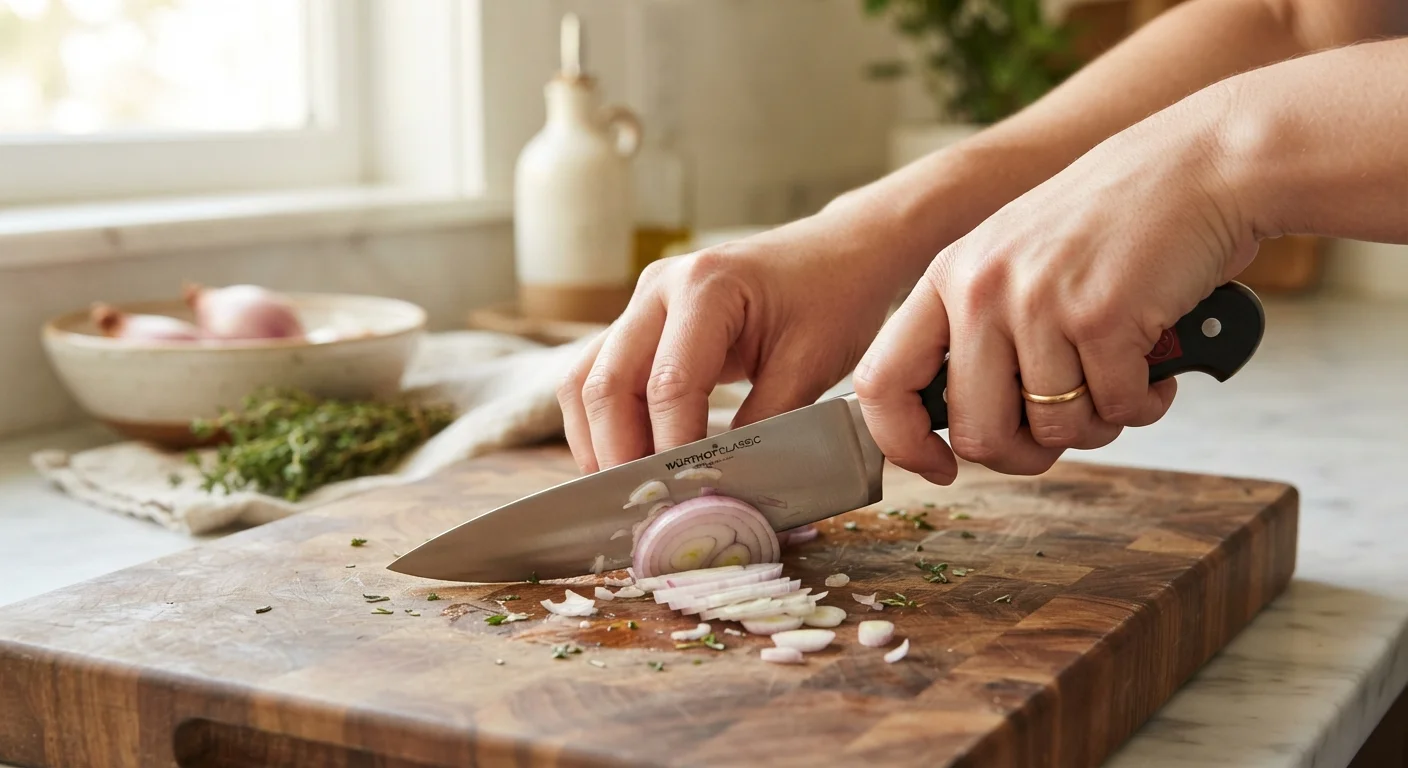
The technique professional cooks rely on is the pinch grip. To use it, pinch the blade itself - not just the handle - between the pad of your thumb and the side of your bent index finger, right at the point where the blade meets the handle. Your remaining three fingers wrap naturally around the handle. At first this may feel counterintuitive, even a little scary. But this grip keeps the knife firmly in your control because your hand is connected directly to the blade, not just the handle.
Your other hand guides the food. Use the claw position: curl your fingertips under so your knuckles face the blade. The flat side of the blade rests gently against your knuckles as you cut. This keeps your fingertips safely out of the path of the knife and gives you a reliable guide for consistent cuts.
Pinch grip
A way of holding a knife where you pinch the blade between your thumb and bent index finger just above the handle, giving you direct control over the blade's direction.
Claw position
A protective hand shape for the guiding hand while cutting, where the fingertips curl under and the knuckles face the blade to protect fingers from the knife edge.
Honing
Realigning the fine edge of a knife blade using a honing steel, done frequently to maintain sharpness without removing metal.
Dice
A knife cut that produces uniform cube-shaped pieces of food, achieved by cutting the ingredient into planks, then sticks, then small cubes.
Julienne
Long, thin matchstick-shaped strips of food, often used as an intermediate step when dicing or as a finished cut for salads and stir-fries.
If you're working toward a stress-free prep routine overall, our kitchen prep checklist walks through organizing your workspace before you pick up a knife.
The Four Cuts You'll Use Every Day
You don't need to master dozens of knife cuts. These four will get you through nearly every recipe.
- Slice: A single smooth stroke through an ingredient - used for tomatoes, mushrooms, onion rings, and bread. Use the tip of the blade as an anchor, then rock the heel through the food.
- Chop: A quick, downward cut used when rough, approximate pieces are acceptable - herbs, garlic, leafy greens. Precision matters less here than speed.
- Dice: Producing uniform cubes requires a three-step process - slice the ingredient lengthwise into planks, cut those planks into sticks (julienne), then cut across the sticks to form cubes. Consistent size matters because it helps food cook evenly.
- Mince: The finest cut. Typically used for garlic, ginger, or herbs. After chopping roughly, place your non-dominant hand flat on the spine of the blade and rock the knife back and forth repeatedly over the pile until the pieces are very small.
Practice on forgiving vegetables
Onions, potatoes, and zucchini are ideal for drilling the basic cuts because they're inexpensive, sturdy, and hold their shape well. Run through a full dice or mince on one of these before you tackle something delicate like a ripe tomato or fresh herbs.
Understanding what a recipe actually calls for when it says "finely chopped" versus "minced" will come with practice. Our guide on reading a recipe like a pro explains the vocabulary recipes assume you already know.
Keeping Your Cutting Board Stable and Safe
Your cutting board is as important as your knife. A board that slides is a hazard, regardless of how good your grip is.
Place a damp kitchen towel or a silicone mat beneath your board before you begin any prep. This locks it in place. If you're using a thin plastic board, this step is especially critical.
Choose the right board material for the job. Wood and bamboo boards are gentler on blade edges than plastic but require more care - wash by hand and dry thoroughly to prevent warping and bacterial growth in cracks. Plastic boards are dishwasher-safe but should be replaced when deep grooves appear, since those grooves can harbor bacteria that are difficult to remove.
Use separate boards for raw meat and produce
Using the same cutting board for raw proteins and ready-to-eat vegetables without washing it in between is a leading cause of foodborne illness at home. Dedicate at least one board to raw meat, poultry, or seafood, and keep it separate from boards used for produce and cooked food.
For more on how cross-contamination happens at the cutting board - particularly when switching between raw proteins and produce - see our piece on preventing cross-contamination in the home kitchen.
Knife Maintenance: Why a Sharp Knife Is a Safe Knife
A dull knife is the most underestimated kitchen hazard. When the blade can't bite into food cleanly, you compensate by pressing harder - and if the knife slips, it does so with significant force behind it.
There are two separate maintenance tasks to understand: honing and sharpening.
- Honing
- Done frequently - ideally before each use - with a honing steel. Honing does not remove metal; it realigns the microscopic edge of the blade that gets bent with normal use. A few strokes on each side of the blade before you start keeps the knife performing consistently.
- Sharpening
- Done infrequently - perhaps once or twice a year for a typical home cook. Sharpening grinds away a small amount of metal to restore a new edge. This can be done with a whetstone, a pull-through sharpener, or by a professional knife sharpener.
A well-maintained knife is a long-term investment in both safety and efficiency. A single chef's knife that's kept sharp will outperform a full block of dull knives every time.