

Key Takeaways
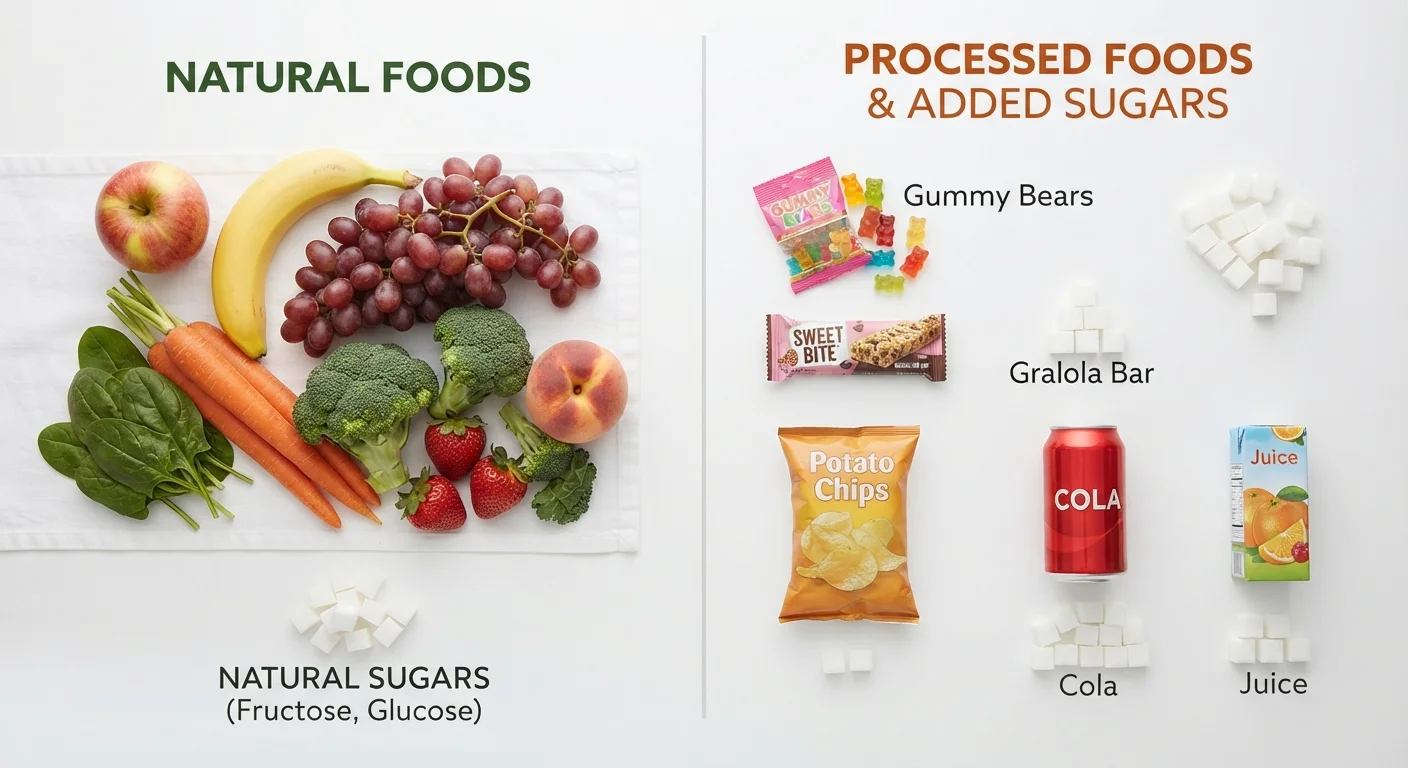
- Natural sugars arrive packaged with fiber, water, vitamins, and minerals that slow absorption and add nutritional value.
- Added sugars provide calories but little or no nutritional benefit beyond energy.
- The FDA now requires 'Added Sugars' to appear as a separate line on the Nutrition Facts label.
- The Dietary Guidelines for Americans advise limiting added sugars to less than 10% of daily calories.
- Whole food sources of natural sugar are generally not a concern for most healthy adults; added sugars are the primary target of public health guidance.
- Always consult a healthcare professional for dietary advice tailored to your individual health circumstances.
Option A
Natural Sugar
The sugar your food comes with built in.
Best for: Consumers who want to understand why sugars in whole fruits, vegetables, and dairy behave differently in the body than those added during processing.
Option B
Added Sugar
The sugar manufacturers put in during processing.
Best for: Readers tracking their intake of sugars introduced to food and beverages during production, preparation, or at the table.
If you're trying to reduce overall sugar intake for general wellness
Focus on limiting Added Sugar
Public health guidance specifically targets added sugars. Cutting back on sweetened beverages, packaged snacks, and condiments delivers the greatest reduction in empty calories.
If you're concerned about the sugar content of fruit
Natural Sugar (whole fruit)
Whole fruit delivers natural sugars alongside fiber, antioxidants, and micronutrients. Major dietary guidelines do not recommend limiting whole fruit for healthy adults.
If you're managing a condition like diabetes or metabolic syndrome
Consult a healthcare professional
Both natural and added sugars can affect blood glucose. A registered dietitian or physician can provide guidance specific to your health profile and medication situation.
If you want to decode food packaging quickly
Focus on Added Sugar
The 'Added Sugars' line on the Nutrition Facts panel is your clearest tool - it isolates sugars introduced during manufacturing from those naturally present in ingredients.
What Makes a Sugar 'Natural' or 'Added'?
The distinction isn't about the sugar molecule itself - fructose is fructose, glucose is glucose, regardless of its origin. What differs is the context in which that sugar arrives in food.
Natural sugars are those already present in a whole food before any processing occurs. The lactose in milk, the fructose in an apple, the glucose in a carrot - these are intrinsic to the food's original structure. They come bundled with fiber, water, protein, vitamins, and minerals that affect how quickly the body absorbs them and what nutritional value they deliver alongside the sweetness.
Added sugars, by contrast, are sugars and syrups introduced to a food or beverage during processing, preparation, or at the table. This includes cane sugar stirred into yogurt, high-fructose corn syrup in a soft drink, honey added to a granola bar, and maple syrup poured over pancakes. The key point is that these sugars are not native to the food - they are introduced to enhance flavor, texture, or shelf life. For a deeper look at the metabolic distinctions, see why added and natural sugars aren't the same thing.
| Criterion | Natural Sugar | Added Sugar |
|---|---|---|
| Origin | Inherent to the whole food | Introduced during processing or preparation |
| Common sources | Fruit, vegetables, dairy | Sodas, packaged snacks, condiments, baked goods |
| Nutritional package | Fiber, vitamins, minerals, water | Calories, minimal accompanying nutrients |
| Absorption rate | Moderated by fiber and food matrix | Often faster; fewer buffers |
| Dietary guideline focus | Not a primary target for restriction | Limit to <10% of daily calories (USDA) |
| Label visibility | Counted in "Total Sugars" only | Listed separately as "Added Sugars" on FDA label |
Why the Difference Matters Nutritionally
When you eat an orange, the natural sugars arrive alongside dietary fiber, vitamin C, potassium, and water. That fiber slows the rate at which sugar enters the bloodstream, moderating the glycemic response. The overall nutritional package supports health rather than simply delivering sweetness.
When you drink a sugar-sweetened beverage, added sugars arrive with little else. There is no fiber to slow absorption, and often minimal vitamins or minerals. The result is a faster rise in blood glucose and calories that contribute to energy intake without the accompanying micronutrients. Over time, a consistently high intake of added sugars is associated - in observational research - with increased risk of weight gain, type 2 diabetes, and cardiovascular disease. Associations do not prove direct causation, but the pattern is consistent enough that major public health bodies act on it.
17 tsp
Average daily added sugar consumed by U.S. adults
According to National Health and Nutrition Examination Survey (NHANES) data analyzed by the CDC, U.S. adults consume roughly 17 teaspoons of added sugar daily - well above recommended limits.
<10%
Recommended added sugar limit (% of daily calories)
The Dietary Guidelines for Americans recommend capping added sugars at less than 10% of total daily caloric intake across all age groups above two years.
~40%
Share of added sugars coming from beverages
Research published using NHANES data indicates that beverages - including soft drinks, energy drinks, and sweetened coffees - account for a substantial portion of added sugar intake in the U.S.
It's also worth noting that not all naturally sweet foods behave identically. Fruit juice, for example, loses much of its fiber during processing, which changes how its natural sugars are absorbed compared with eating the whole fruit. Context - including preparation and processing level - always matters. The distinction between whole and processed foods is explored further in our piece on whole foods vs. processed foods.
What Public Health Guidelines Say
The Dietary Guidelines for Americans - published jointly by the U.S. Department of Agriculture and the Department of Health and Human Services - recommend that added sugars account for less than 10% of daily calorie intake. For a 2,000-calorie diet, that translates to roughly 200 calories, or about 50 grams of added sugar per day. The American Heart Association sets an even lower target, particularly for women and children.
Crucially, these guidelines do not place the same restriction on naturally occurring sugars in whole foods. The concern is specifically about added sugars, which is why the U.S. Food and Drug Administration updated the Nutrition Facts label to include a dedicated "Added Sugars" line - a regulatory change designed to help consumers distinguish between the two categories at a glance.
How to Spot Added Sugars on a Label
Under current FDA rules, the Nutrition Facts panel must list both "Total Sugars" and, indented below it, "Added Sugars" in grams and as a percentage of Daily Value. If you see a high "Added Sugars" number on a product that doesn't contain naturally sweet ingredients like fruit or milk, the bulk of the sweetness is coming from what manufacturers put in. Over 60 different ingredient names can indicate added sugar - including maltose, corn syrup solids, fruit juice concentrate, and turbinado sugar - so scanning the ingredient list alongside the panel gives the fullest picture.
If you want to apply this knowledge at the supermarket, learning to read ingredient lists is essential. Manufacturers use dozens of names for added sugars - from "evaporated cane juice" to "agave nectar" to "dextrose." Our guide on reading an ingredient list walks through how to spot them. You can also find added sugars in places that may surprise you, including beverages - see our overview of sugar in drinks for a closer look.
This article is for general informational and educational purposes only and is not a substitute for professional medical or dietary advice. Please consult a qualified healthcare provider before making changes to your diet, especially if you have a health condition.