
Generations, Labels, and Why Putting People in Boxes Is More Complicated Than It Looks

Key Takeaways
- Generational cutoff dates are largely arbitrary and vary depending on who's doing the defining.
- Shared birth years don't guarantee shared values, politics, or lived experience.
- Race, class, geography, and gender shape people's lives far more than birth cohort alone.
- Generational thinking can reinforce stereotypes while obscuring real social trends.
- Researchers find generational categories useful as rough tools - not rigid identities.
Why We Can't Stop Sorting Ourselves by Birth Year
Generational labels are everywhere. Scroll through social media for five minutes and you'll encounter confident claims about what Boomers ruined, what Millennials killed, or what Gen Z is doing differently. These categories feel intuitive and sticky - they give us a shared vocabulary for talking about change across time. But the moment you poke at them, they get complicated fast.
The impulse to group people by when they were born isn't new. Sociologists have studied cohort effects - the idea that people who come of age during the same historical moment may share certain formative experiences - for decades. That's a legitimate, if limited, analytical tool. The jump from 'cohort' to 'generation' as a branded, personality-packed cultural identity is a much bigger leap, and one worth examining carefully.
For more on how communities form identity through shared references and mutual recognition, see our look at how communities signal who belongs.
Myth
Generational categories like 'Millennial' or 'Gen Z' are scientifically defined and universally agreed upon.
Fact
These labels are marketing and journalistic conventions, not standardized scientific classifications - and the birth-year boundaries shift depending on the source.
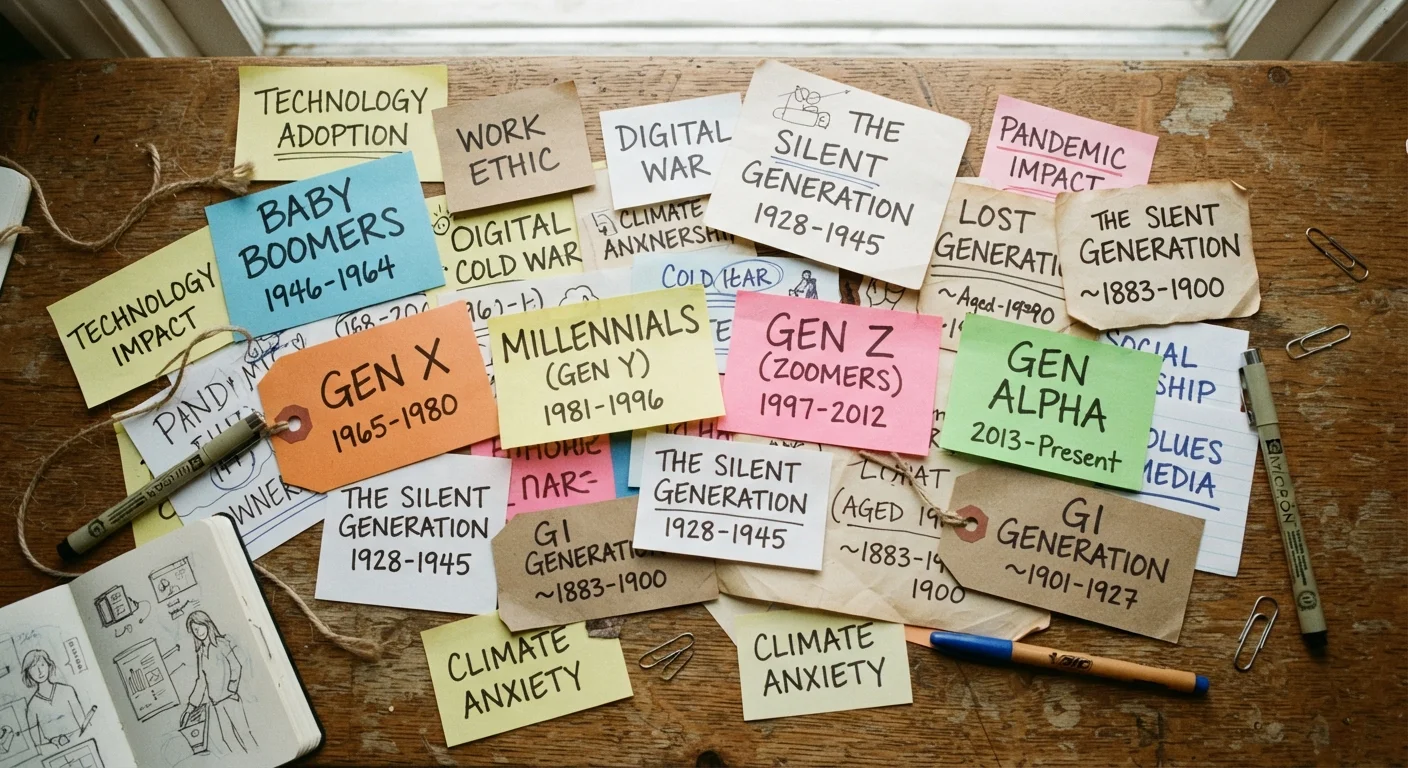
The Pew Research Center, for instance, has defined Millennials as those born between 1981 and 1996, while other organizations draw those lines differently. The U.S. Census Bureau doesn't officially define generations at all. These cohorts emerged largely from market research and pop sociology - useful as shorthand, but not precise instruments of social science. Treating them as fixed, objective groups misleads more than it clarifies.
Myth
Everyone born in the same generation shares broadly similar values and attitudes.
Fact
Within any generation, differences tied to race, income, education, geography, and family background typically dwarf differences between generations.
A Black woman raised in rural Mississippi and a white man raised in suburban Seattle may technically be the same generation, but their material realities, cultural touchstones, and outlook on institutions can diverge enormously. Sociologists have long cautioned that generational averages can mask more than they reveal. Lumping hundreds of millions of people together because they were born within a 15-to-20-year window smooths over profound internal variation.
Myth
Younger generations are uniquely lazy, entitled, or self-absorbed compared to their predecessors.
Fact
This complaint has been leveled at virtually every younger generation in recorded history - it reflects the gap between life stages more than lasting character traits.
Ancient Greek and Roman writers complained about youth having no respect for elders. Victorian-era commentators bemoaned the frivolity of young people. Research consistently shows that as people age, their habits, priorities, and community engagement change - what looks like entitlement in a 22-year-old often looks very different at 40. Generational criticism frequently conflates age effects (temporary traits linked to life stage) with cohort effects (traits tied to a specific generation).
Myth
Generational labels are harmless cultural shorthand that help us understand social change.
Fact
When used uncritically, these labels can reinforce stereotypes, fuel intergenerational resentment, and obscure the structural forces actually driving change.
Framing housing unaffordability as a 'Millennial problem' or political polarization as a 'Boomer legacy' personalizes what are largely structural and economic issues. This framing can also be weaponized - the viral 'OK Boomer' retort and counter-accusations of generational selfishness generate heat but rarely light. As social belonging researchers note, labels serve a gatekeeping function, sorting people into in-groups and out-groups in ways that aren't always productive.
Myth
Technology use neatly divides generations - digital natives vs. digital immigrants.
Fact
Technology adoption is shaped heavily by access, education, and socioeconomic status - not simply by birth year.
Many older adults are sophisticated, daily internet users, while many younger people lack reliable broadband access or devices - a reality sometimes called the 'digital divide.' The idea that everyone born after a certain year is fluently tech-savvy ignores the enormous gaps in digital access across income levels and rural versus urban communities. Skill and comfort with technology tracks closely with opportunity, not just age.
What Gets Lost When We Over-Rely on Generational Thinking
The practical danger of generational categories isn't that they're entirely useless - it's that they're easy to over-apply. Managers use them to make sweeping assumptions about employee motivation. Marketers segment entire campaigns around them. Political commentators use them to explain voting patterns that are actually better explained by income, education level, or geographic sorting.
14%
Variation explained by generational cohort
Research published in sociological journals suggests birth cohort explains only a small fraction of variance in attitudes compared to factors like education and income.
~15-20 years
Typical generational span used in popular media
Most widely cited generational definitions span roughly 15 to 20 birth years - a range wide enough to encompass enormous social and cultural diversity.
This matters for real relationships too. Families navigating different life stages and cultural reference points sometimes interpret disagreements as generational clashes when they're more accurately described as differences in circumstance. A multigenerational household dealing with friction around finances or privacy isn't necessarily facing a Boomer-versus-Millennial standoff - they may simply be navigating different economic realities and communication habits shaped by very different life histories.
Labels Can Obscure Structural Realities
When we attribute economic inequality, political polarization, or cultural shifts primarily to generational character, we risk obscuring the policy decisions, structural inequalities, and historical accidents that actually drive those outcomes. Framing systemic issues as personality conflicts between age groups makes them harder - not easier - to address constructively.
None of this means we should abandon generational language entirely. Used carefully, with humility, and alongside other social lenses - class, race, gender, geography - these categories can highlight genuine patterns worth discussing. The key is resisting the temptation to let a convenient label do the heavy analytical lifting that real human complexity demands.
Understanding how cultural categories form and shift is also relevant to how subcultures move into the mainstream - generational branding often follows the same arc from organic identity to commercial shorthand.