

Key Takeaways
- Memes function as cultural shorthand, encoding complex ideas in a recognizable, shareable format.
- They reinforce in-group identity by rewarding people who 'get the reference.'
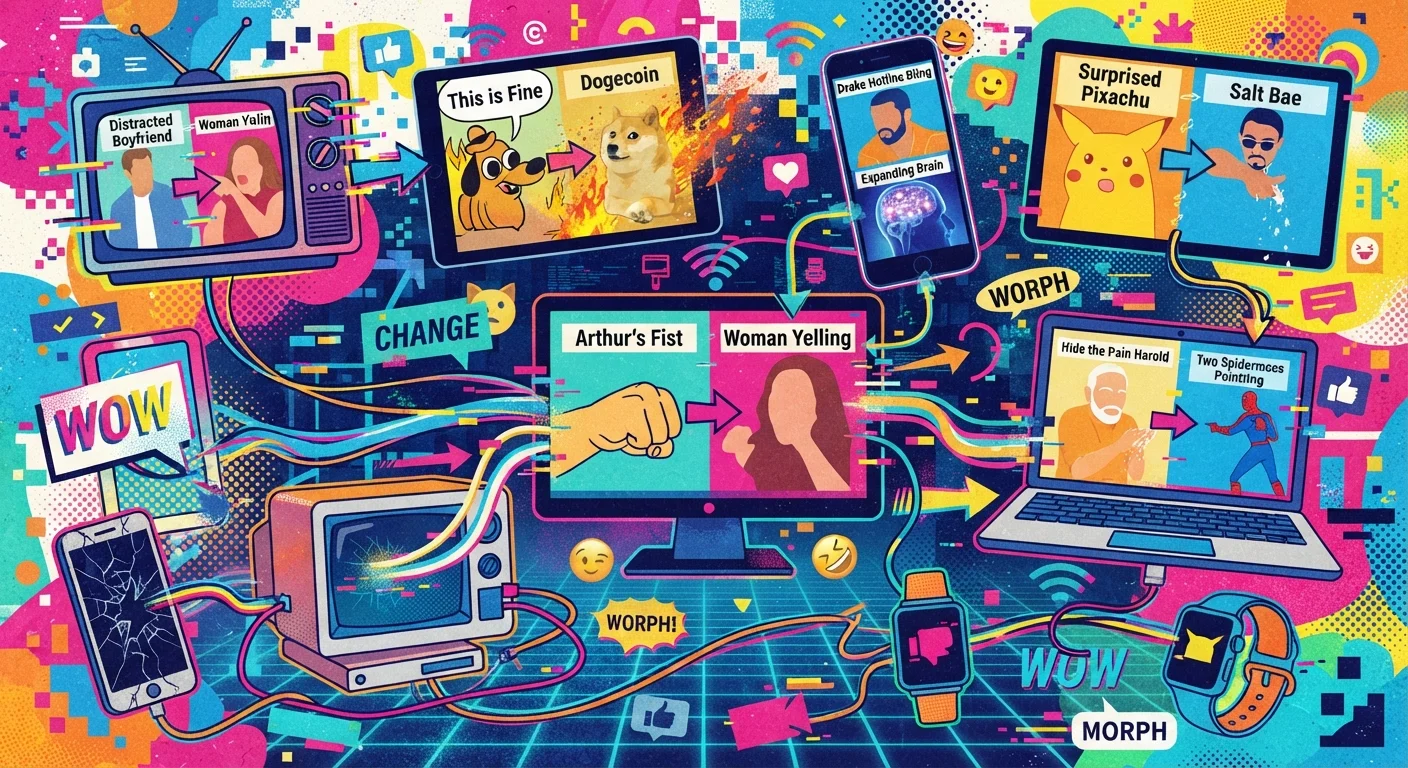
- Memes evolve through remixing, making them living artifacts that track cultural shifts.
- When memes cross communities, meaning can be lost, distorted, or appropriated.
- Researchers study memes as a window into collective attitudes and social dynamics.
Internet Meme
An internet meme is a piece of digital content - typically an image, video, phrase, or format - that spreads rapidly online while being remixed and reinterpreted by different communities. Memes aren't just humor; they're a form of compressed cultural communication that conveys shared values, attitudes, and in-group references. Think of them as the digital equivalent of folk sayings, adapted in real time by millions of people.
The word 'meme' was coined by evolutionary biologist Richard Dawkins in his 1976 book 'The Selfish Gene' to describe any idea, behavior, or style that spreads through imitation within a culture - long before the internet existed.
More Than a Joke: What Memes Are Actually Doing
If you've ever laughed at a meme and then struggled to explain it to someone outside your social circle, you've already experienced memes doing exactly what they're designed to do - creating a shared moment that belongs to a specific community, not the whole world.
At their core, memes are a form of compressed cultural communication. A single image with a few words of text can simultaneously reference a pop culture moment, signal a political stance, express an emotion, and identify the poster as a member of a particular online tribe - all without spelling any of that out explicitly. That layered density is what separates memes from simple jokes.
Sociologists and media researchers have started treating memes seriously as cultural artifacts - windows into collective attitudes in the same way that folk songs, slang, and fashion once were. They reflect what a group finds funny, threatening, worth mocking, or worth celebrating at a given moment in time.
“Memes are the folk culture of the digital age - they encode collective anxieties, humor, and identity in a form that travels faster and mutates more readily than any previous cultural artifact.”
— Limor Shifman, Professor of Communication and author of 'Memes in Digital Culture'
The Mechanics of Meaning: How Memes Encode Ideas
A meme's power lies in its format. Each recognizable template - the side-eye Chloe, the distracted boyfriend, the expanding brain - carries its own implicit grammar. Once a community establishes what a format means, creators can slot in new content and instantly produce legible, nuanced commentary without writing an essay.
This is why memes are such efficient carriers of in-group identity. Recognizing a meme requires cultural fluency - you need to know the original context, the expected usage, and the subtle variations that signal irony or sincerity. Communities like specific Reddit forums, gaming circles, or niche fandoms develop their own meme dialects that are nearly impenetrable to outsiders.
That gatekeeping function is no accident. As explored in our look at how communities signal belonging, shared references - including memes - are a primary way groups mark boundaries between insiders and outsiders.
55%
of 18-34 year-olds share memes weekly
According to a Morning Consult survey, a majority of younger Americans report sharing memes at least once a week, underscoring their role as everyday social currency.
60%
of internet users say memes reflect real feelings
A YouGov survey found that a significant majority of respondents felt memes were an accurate or somewhat accurate reflection of their own attitudes and emotions.
Memes as Living Culture: Remixing, Mutation, and Drift
What makes memes genuinely fascinating from a cultural standpoint is how they evolve. Unlike a newspaper article or a film, a meme is never really finished. Every person who reinterprets a format adds a layer. Communities tweak, subvert, and ironize templates until they carry meanings their originators never intended.
This mutation process mirrors how oral traditions and folk culture worked before mass media. A story or a saying would travel from village to village, absorbing local flavor at each stop. Memes do the same thing, but at internet speed - a format born in one community can migrate across platforms and arrive in a completely different context within days.
That migration isn't always clean. When memes travel across cultural boundaries, meaning can get lost or actively distorted. A format that carried gentle self-deprecation in one community might read as cruelty in another. This is closely related to the broader dynamics around cultural borrowing and what gets lost in translation.
How to Read a Meme More Critically
Next time a meme lands in your feed, pause and ask: Where did this format originate? What community first used it, and what did it mean there? Tracking a meme back to its source often reveals layers of meaning - or distortion - that aren't visible on the surface. It's a small habit that builds real cultural literacy.
What Happens When Memes Go Mainstream
The lifecycle of a meme often ends the same way: mainstream adoption. When brands start using a meme format in ad campaigns, or when news anchors reference it on television, the original community typically feels a mix of amusement and loss. The inside joke has become everyone's joke, which means it's no longer really doing the work of signaling membership.
This mirrors a pattern visible across subcultures more broadly. As we explore in our piece on how subcultures go mainstream, the journey from niche to mass culture almost always involves a trade-off: broader reach in exchange for specificity and authenticity.
That said, meme communities are remarkably resilient. When one format gets overexposed, creators simply move on to the next template - or deliberately evolve the old one into something too layered for casual observers to follow. The culture keeps moving, and the memes move with it. Understanding that cycle is one of the better ways to understand how online communities actually function and cohere - a dynamic central to what makes a community stick together in the first place.