

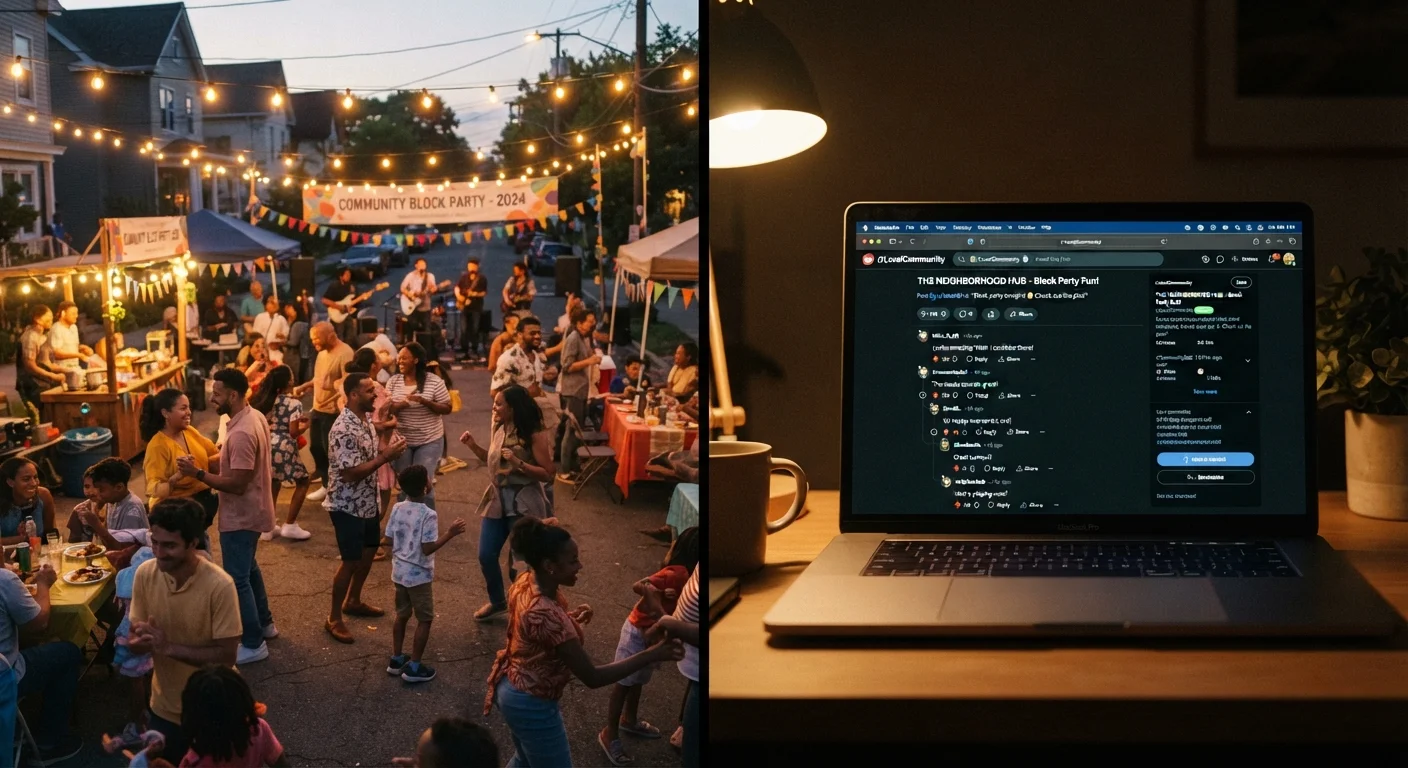
Key Takeaways
- Online tribes offer identity-matched belonging that geography cannot provide, but lack physical presence and platform stability.
- Neighborhood communities build practical mutual aid and accountability, but may feel limiting to those with niche identities or values.
- Research suggests both types of connection serve distinct psychological needs - they complement rather than replace each other.
- Platform dependency is a real vulnerability for online communities; a single shutdown can scatter years of social bonds.
- Most people today navigate a hybrid social life, blending digital and place-based belonging simultaneously.
Option A
Online Tribes
The identity-first community that meets you wherever you are.
Best for: People seeking deep connection around specific interests, identities, or experiences regardless of geography.
Option B
Neighborhood Communities
The place-rooted network built through proximity and shared space.
Best for: People who value face-to-face support, local accountability, and the texture of daily shared life.
If you have a niche identity or interest that your zip code can't support
Online Tribes
Online communities let you find genuine peers across geography, which can be life-changing for people whose local area simply lacks critical mass around their passion or identity.
If you need practical, day-to-day support from people nearby
Neighborhood Communities
Borrowing a cup of sugar, watching a neighbor's dog, or organizing a block cleanup all require physical proximity - things no online group can substitute.
If you're navigating loneliness or a major life transition
Online Tribes
During isolating periods, online groups can provide immediate, low-barrier connection while deeper local ties are still being built. See also: what research says about loneliness.
If you want to invest in a community that can weather platform changes
Neighborhood Communities
Place-based communities don't disappear when a company folds or an algorithm shifts - their foundation is shared physical reality, not a server.
A New Kind of Belonging
For most of human history, community was more or less handed to you - defined by the village, the parish, or the neighborhood block. Today, many Americans belong to groups they discovered online before they ever met anyone in person. A home baker in rural Montana might feel more understood inside a bread-fermentation subreddit than at her local block association. A gay teenager in a conservative suburb might find their first real sense of acceptance in a Discord server before they find it at school.
This isn't fringe behavior - it's become a defining feature of modern social life. Sociologists distinguish between communities of place (built on geographic proximity) and communities of interest or identity (built on shared values, passions, or experiences). The internet radically expanded access to the second category. Understanding what each offers - and what each quietly costs - matters for anyone thinking seriously about relationships and belonging.
What Each Type Actually Provides
Online tribes excel at identity validation. If your sense of self is built around something specific - a rare health condition, an obscure musical genre, a political philosophy - the internet can surface thousands of people who genuinely get it. That kind of precise mirroring is something a neighborhood simply cannot guarantee.
Neighborhood communities, by contrast, excel at what sociologists call weak ties - the low-intensity but surprisingly important connections with acquaintances who share physical space. Research consistently shows these casual links are disproportionately valuable for job leads, local safety, emotional resilience, and practical help. The neighbor who notices your lights haven't been on, the parent who texts about a road closure - these small touchpoints accumulate into a safety net that's hard to replicate digitally.
| Criterion | Online Tribes | Neighborhood Communities |
|---|---|---|
| Basis of connection | Shared identity or interest | Shared physical space |
| Geographic reach | Global, borderless | Local, proximity-bound |
| Practical mutual aid | Limited; mostly informational | High; physical help possible |
| Identity validation | Very high; highly specific | Variable; depends on neighbors |
| Stability over time | Vulnerable to platform changes | Durable; not platform-dependent |
| Accountability between members | Low; exit is easy | Higher; proximity enforces it |
| Barrier to entry | Very low; find and join online | Requires physical presence |
The friction of proximity also creates accountability. When you share a street with someone, small conflicts get resolved differently than they do online. It's harder to block your neighbor. That constraint, frustrating as it sometimes feels, builds a kind of social muscle that purely online communities rarely develop. For a deeper look at what forces actually hold communities together, see what makes a community actually stick.
The Real Vulnerabilities
Both community types carry distinct fragility. Online tribes are platform-dependent in a way that most members underestimate until it's too late. When a platform shuts down or changes its policies, years of shared history and social bonds can evaporate overnight - a phenomenon explored in detail in our piece on what happens when platforms disappear.
Neighborhood communities face a different kind of erosion. Urban mobility, long commutes, private home design, and the decline of third places like coffee shops and parks have all reduced the spontaneous contact that once built local bonds naturally. Many Americans report not knowing most of their neighbors - a structural problem, not a personal one.
Online Communities Aren't a Monolith
The term 'online tribe' covers a huge range - from tight-knit Discord servers with strict norms to sprawling subreddits where most members never interact. The quality and depth of online belonging varies enormously depending on group size, moderation, and shared purpose. A small, well-maintained online group can offer genuine intimacy; a massive, loosely moderated one may function more like an audience than a community. See the real differences between a community and an audience for that distinction.
There's also a subtler risk with online tribes: the precision that makes them so validating can shade into insularity. Highly identity-matched groups can develop strong in-group signals and exclusionary norms, a dynamic explored in how communities signal who belongs.
Living in Both Worlds
For most people, the honest answer isn't to choose one form of community over the other - it's to be intentional about what each provides. Online tribes are often better for identity exploration and finding people who share your specific passions. Neighborhood communities are often better for the kind of embodied, reciprocal support that shapes daily life quality and long-term resilience.
If you're actively working to build either kind of connection - perhaps after moving somewhere new or stepping into an unfamiliar group - social science has practical things to say about how belonging actually develops over time. Our guide on building a sense of belonging in a new place is a useful starting point.
The larger cultural shift is worth sitting with: belonging is increasingly something Americans construct rather than inherit. That brings real freedom - and real work.