

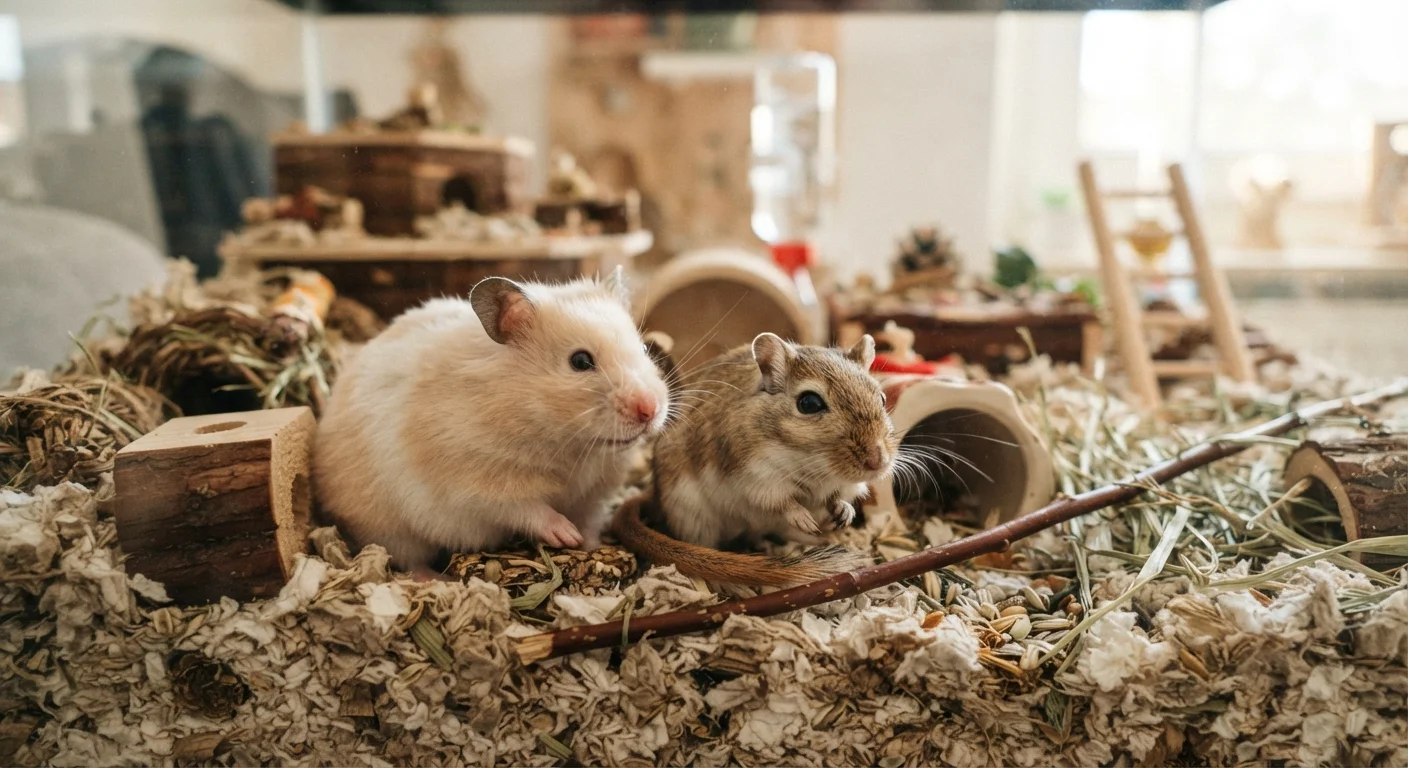
Key Takeaways
- Hamsters are solitary and nocturnal; gerbils are social and active during the day.
- Gerbils should be kept in same-sex pairs or small groups - lone gerbils can become stressed.
- Both animals need significantly more cage space than many pet stores suggest.
- Hamsters are generally easier for younger or more hands-off owners; gerbils suit those who enjoy watching natural social behavior.
- Neither species is ideal for very young children without close adult supervision.
- Lifespan is similar - roughly 2 to 4 years - so both are relatively short-term commitments.
Option A
Hamster
The independent, nocturnal solo pet.
Best for: Best for owners who are home in the evenings and prefer a low-social-maintenance pet that thrives alone.
Option B
Gerbil
The social, daytime-active companion animal.
Best for: Best for owners who want an interactive, pair-bonded pet active during daylight hours.
If you keep late hours and want a pet that's active when you're home
Hamster
Hamsters are crepuscular to nocturnal, meaning they're most lively in the evenings and overnight - a natural match for night-owl owners.
If you enjoy watching natural animal behavior and social interaction
Gerbil
Gerbils kept in pairs groom each other, play, and communicate actively, offering far more visible social behavior throughout the day.
If you want a single pet that doesn't require a companion animal
Hamster
Most hamster species are territorial and actually do better alone; pairing them typically causes stress or aggression.
If you have a family with older children who want to observe pets regularly
Gerbil
Their daytime activity and social interactions make gerbils more engaging to watch, and they tend to be more naturally curious around people.
If you have limited space but can still provide an appropriately sized enclosure
Hamster
A single Syrian hamster requires a large enclosure, but you're housing one animal rather than two, making it slightly simpler to manage space and cost.
Activity Patterns: Who's Awake When You Are?
One of the most practical factors in choosing between a hamster and a gerbil is their natural activity schedule - because a pet that sleeps all day while you're awake isn't very satisfying for either of you.
Hamsters are primarily nocturnal or crepuscular, meaning they're most active at dusk, through the night, and into early morning. Disturbing a hamster during the day can cause stress and, occasionally, defensive biting. For owners who work daytime hours and relax in the evenings, this timing can actually align well.
Gerbils follow a more flexible pattern, with bursts of activity spread throughout the day and night - though many gerbil owners find them most active and interactive during daylight hours. If you have children who want to watch a pet during after-school hours, gerbils are typically the more visible choice.
| Criterion | Hamster | Gerbil |
|---|---|---|
| Activity schedule | Nocturnal / crepuscular | Active throughout the day |
| Social needs | Solitary (most species) | Requires a same-sex companion |
| Typical lifespan | 2-3 years | 3-4 years |
| Handling temperament | Can startle; patient taming needed | Curious and active; fast-moving |
| Cage cleaning frequency | Every 1-2 weeks | Less frequent; spot-clean regularly |
| Key enrichment need | Solid-surface running wheel | Tunnels, digging substrate, companion |
| Number of animals needed | One (usually) | Minimum two |
Social Needs and Housing Requirements
This is where hamsters and gerbils diverge most sharply, and getting it wrong has real welfare consequences.
Hamsters - particularly the Syrian hamster, the most common pet species - are solitary by nature. In the wild they maintain and defend individual territories. Keeping two Syrian hamsters together almost always results in fighting and injury. Dwarf hamster species (such as Roborovski and Campbell's dwarf) are sometimes kept in same-sex pairs, but even then, careful introductions and monitoring are essential.
Gerbils are intensely social animals. A lone gerbil is a stressed gerbil. Veterinary and small animal welfare guidance consistently recommends housing gerbils in same-sex pairs or small groups. Without a companion, gerbils can develop repetitive stress behaviors and show signs of depression-like withdrawal.
Cage Size Is Often Underestimated
Many commercially sold 'starter' enclosures fall well below recommended welfare standards for both hamsters and gerbils. A Syrian hamster should have at least 600 square inches of unbroken floor space, while gerbils need room to burrow deeply - at least 6-8 inches of substrate. Aquarium-style tanks converted for small animals often work well for both species and allow deeper bedding than wire cages.
Both species require more cage space than typical pet-store starter kits provide. The RSPCA and many small animal welfare organizations recommend a minimum of 40 inches in length for a Syrian hamster enclosure, and similarly generous dimensions for gerbil tanks or terrariums with deep substrate for burrowing. For broader context on housing standards across small mammals, see our Small Mammal Care Basics guide.
Handling, Temperament, and Suitability for Families
Both hamsters and gerbils can become comfortable with gentle, regular handling - but their baseline temperaments differ in ways that matter for families.
Hamsters can be hand-tamed with patience, but they're more prone to startling when picked up suddenly, especially if woken from sleep. A startled hamster may nip. With consistent, calm handling from an early age, many hamsters become quite tolerant, but they generally don't seek out human interaction the way some other small pets do.
Gerbils tend to be naturally inquisitive and are often described as more confident explorers. They're fast-moving and agile, which can make them tricky for very young children to hold safely - but they're less likely to bite from a defensive sleep-startle response. Their curiosity often makes handling sessions more interactive and engaging.
Neither species is a strong fit for children under six without close adult supervision, due to both the fragility of small animals and the risk of accidental rough handling. If you're weighing small mammals against other pet types, our Parakeet vs. Cockatiel comparison offers useful perspective on interaction levels across different companion animals.
5-8 miles
Distance a hamster may run in one night
Research on wild and captive hamster locomotion highlights how critical an appropriately sized, solid-surface wheel is to their physical health.
2-4 years
Typical lifespan for both species
Both hamsters and gerbils have relatively short lifespans compared to cats or dogs, making them a lower-length commitment - though loss can still be emotionally significant.
90%+
Of gerbil welfare issues linked to solitary housing
Small animal behavioral studies suggest that the vast majority of stress-related behaviors in captive gerbils are associated with being housed alone without a conspecific companion.
Diet, Enrichment, and Everyday Care
Day-to-day care demands are broadly similar between the two species, but a few differences are worth knowing before you commit.
Diet: Both thrive on a base of quality commercial small-animal pellets or seed mixes formulated for their species, supplemented with small amounts of fresh vegetables and occasional protein sources such as mealworms. Hamsters are strict hoarders - they cache food in their bedding - so uneaten fresh food should be removed daily to prevent spoilage. Gerbils eat less overall due to their smaller size but have similar dietary needs.
Enrichment: A solid-surface running wheel is essential for hamsters; they can cover several miles per night in the wild. Gerbils benefit less from wheels (though they'll use them) and more from tunnels, digging substrate, and objects to gnaw and explore together. Both species need gnawing materials to maintain healthy teeth.
Cleaning: Hamster enclosures require full cleaning roughly every one to two weeks, with spot-cleaning in between. Gerbils produce less urine due to their desert-adapted physiology, which means their enclosures often stay fresher longer - though regular spot-cleaning still applies.
This article provides general educational information about small pet care and is not a substitute for advice from a qualified veterinarian familiar with small mammals. If your pet shows signs of illness or behavioral distress, consult a vet with exotic or small animal experience.