

Key Takeaways
- Parakeets are smaller, quieter, and generally easier to care for than cockatiels.
- Cockatiels live significantly longer - up to 20 years - requiring a greater long-term commitment.
- Both species need daily social interaction and mental stimulation to stay healthy.
- Cockatiels are more expressive and can learn to whistle tunes; parakeets may mimic words.
- Noise level and space available in your home should heavily influence your choice.
Option A
Parakeet (Budgerigar)
The compact, cheerful, beginner-friendly companion.
Best for: Owners who want an affectionate, low-maintenance bird that thrives in smaller living spaces.
Option B
Cockatiel
The sociable, expressive bird with a longer commitment.
Best for: Owners who can invest daily hands-on time and enjoy a bird with a strong personality and vocal range.
If you're a first-time bird owner with limited space
Parakeet (Budgerigar)
Parakeets are forgiving of beginner mistakes, need less room, and are generally easier to handle and maintain.
If you want a deeply interactive, bonding-focused companion
Cockatiel
Cockatiels form strong bonds with their owners, enjoy being handled, and show rich emotional expression through body language and song.
If noise is a concern in your household or apartment
Parakeet (Budgerigar)
Parakeets chatter softly and are less likely to produce the louder contact calls that cockatiels are known for.
If you're prepared for a decades-long commitment
Cockatiel
Cockatiels can live 15-20 years with good care, rewarding owners who can commit to a long-term relationship.
Size, Temperament, and What to Expect Day to Day
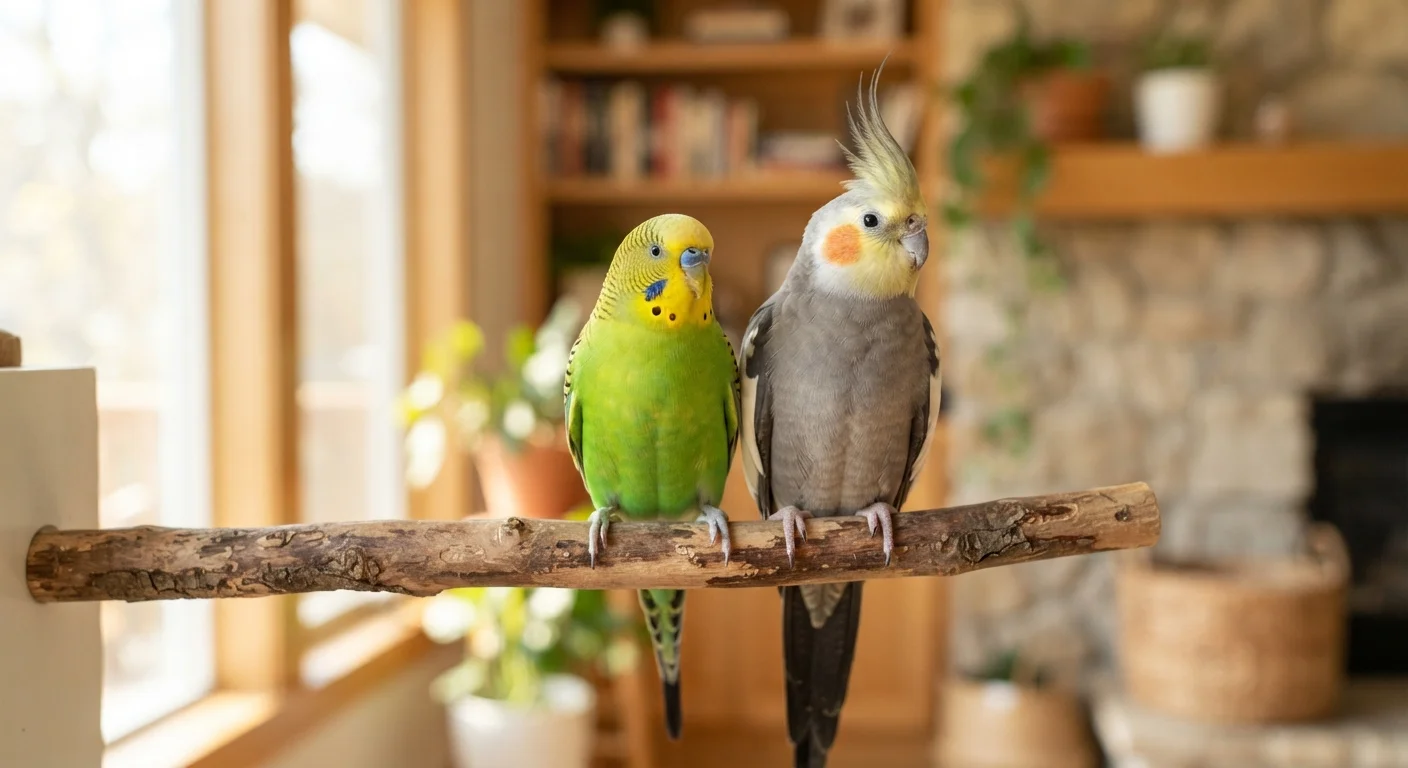
Parakeets - commonly known as budgies (short for budgerigars) - are small, sociable birds typically weighing between 1 and 1.4 ounces. They're naturally flock animals, meaning they enjoy company and are generally comfortable around people when handled regularly from a young age. Their chatter is melodic but relatively soft, making them well-suited to apartments or smaller homes.
Cockatiels are noticeably larger, averaging 3 to 4 ounces, and carry a crest of feathers on their heads that rises and falls to signal mood - a built-in emotional indicator that owners quickly learn to read. They tend to be more emotionally expressive and can become quite attached to a specific person in the household. Understanding those signals early makes a real difference; our guide to bird body language is a helpful starting point.
Day to day, both birds need out-of-cage time and interaction. Cockatiels generally demand more one-on-one engagement; leaving one alone for long stretches without stimulation can lead to stress behaviors like feather plucking or incessant calling.
| Criterion | Parakeet (Budgerigar) | Cockatiel |
|---|---|---|
| Average size | ~1-1.4 oz; 7 inches | ~3-4 oz; 12-13 inches |
| Typical lifespan | 7-12 years | 15-20 years |
| Noise level | Low to moderate chatter | Moderate to loud whistling |
| Bonding style | Social; adapts to family | Strong one-person bonds |
| Talking/mimicry | Can learn words and phrases | Excels at whistling tunes |
| Minimum cage size | 18 × 18 inches | 20 × 20 inches or larger |
| Beginner-friendliness | High | Moderate |
| Daily attention needed | 1-2 hours out-of-cage time | 2+ hours interaction ideal |
Lifespan, Health, and Long-Term Commitment
One of the most important differences between these two species is lifespan. Parakeets typically live 7 to 12 years with proper care. Cockatiels, by contrast, routinely reach 15 to 20 years in healthy home environments - a commitment that rivals adopting a dog.
20 years
Maximum cockatiel lifespan in captivity
Avian veterinary sources consistently cite 15-20 years as a realistic range for well-cared-for cockatiels.
~7-12 years
Average parakeet lifespan in captivity
Parakeets living in enriched environments with appropriate diets tend to reach the higher end of this range.
2nd most
Cockatiels' popularity rank among US pet birds
The American Veterinary Medical Association consistently lists cockatiels among the most commonly kept pet birds in the United States.
Both birds are prone to respiratory issues if housed in drafty or smoky environments. Non-stick cookware coatings that release fumes when overheated are particularly hazardous to all pet birds; this is an established veterinary concern, not a minor caveat. Regular wellness exams with an avian-qualified veterinarian are recommended for both species.
Diet matters significantly. A seed-only diet - common in older care advice - is now understood to be nutritionally inadequate. Pellets, fresh vegetables, and limited fruit form the foundation of a well-rounded diet for both species. For a broader picture of what responsible bird ownership involves, see our article on what pet birds actually need to thrive indoors.
This article provides general pet care information and is not a substitute for guidance from a qualified avian veterinarian.
Noise, Space, and Which Bird Fits Your Home
Parakeets vocalize frequently but at a low volume - soft chirps and chattering that most people find pleasant rather than disruptive. Cockatiels can be louder, particularly when they want attention or are startled. Male cockatiels are especially vocal and may whistle persistently throughout the day.
Cage size is another practical consideration. A parakeet can thrive in a moderately sized cage (at minimum 18 × 18 inches for a single bird), while cockatiels need more horizontal space to move and stretch their wings - a cage no smaller than 20 × 20 inches is a common baseline recommendation, though larger is always better for either species.
If you're weighing a bird against other small companion animals entirely, our hamster vs. gerbil comparison explores how the needs of small mammals stack up - a useful frame of reference for first-time pet owners thinking through lifestyle fit.
Ultimately, both parakeets and cockatiels make rewarding companions. The right choice comes down to the time you can realistically offer, the noise level your living situation allows, and how long a commitment you're prepared to honor.
Consider Adopting Before You Shop
Bird rescues and shelters across the US frequently have parakeets and cockatiels available for adoption, including adult birds that may already be hand-tame. Adult birds offer the advantage of a known temperament. Reaching out to a local avian rescue is worth exploring before purchasing from any other source.