

Key Takeaways
- Modern smartphones use smart charging chips that stop drawing power once the battery reaches 100%.
- Lithium-ion batteries degrade most from heat and repeated full charge cycles, not overnight plugging.
- Keeping your phone between 20% and 80% charge is the single most effective habit for long-term battery health.
- Built-in features like Optimized Charging learn your routine and reduce trickle-charge stress automatically.
- Cheap, uncertified chargers pose a real risk - using quality, certified cables matters more than timing.
Why Overnight Charging Became Controversial
For years, the advice has circulated in tech forums and family group chats alike: never leave your phone plugged in all night - it will ruin the battery. Like many pieces of folk wisdom, this warning has a grain of historical truth wrapped inside a lot of outdated thinking.
Early rechargeable batteries - including older nickel-cadmium (NiCd) cells - genuinely could suffer from overcharging. But virtually every smartphone sold today uses lithium-ion (Li-ion) or lithium-polymer chemistry, which behaves very differently. Understanding the actual science behind your phone's battery is the first step toward habits that genuinely help. For a deeper look at what really drives capacity loss, see our guide to why smartphone batteries degrade.
Myth
Leaving your phone plugged in overnight will overcharge the battery and damage it.
Fact
Modern smartphones have dedicated charge-management hardware that stops power delivery once the battery is full - overcharging in the traditional sense is not possible.
Every current smartphone includes a battery management system (BMS) - a chip that monitors voltage and halts charging precisely at 100%. Once your phone reaches a full charge, it effectively stops accepting current. The charger remains connected, but the battery is no longer being actively charged. This protection has been standard in consumer smartphones for well over a decade.
Myth
Keeping your phone plugged in at 100% all night is completely harmless.
Fact
While overcharging isn't possible, holding a lithium-ion battery at 100% for extended periods does create mild, cumulative stress on the cells over time.
Lithium-ion chemistry is under the least strain at partial charge - roughly 50%. Sitting at 100% for hours isn't catastrophic, but it does apply a small, consistent voltage stress. This is why features like Optimized Battery Charging exist: they delay the final charge push until shortly before your alarm, reducing the time the battery spends fully saturated. Enabling this setting is a low-effort way to reduce long-term wear.
Myth
You should always charge your phone to 100% to get the most out of it.
Fact
Keeping charge levels between roughly 20% and 80% is better for long-term battery health than routine full charges.
Battery engineers refer to charge cycles - each full 0-to-100% charge counts as one cycle, and lithium-ion cells have a finite number before capacity meaningfully degrades. Partial cycles count proportionally, so charging from 40% to 80% uses only 40% of a cycle. Staying in the middle range consistently extends the usable lifespan of the battery. Many phones now include a built-in option to cap charging at 80% for exactly this reason.
Myth
The charger you use doesn't matter as much as how long you charge.
Fact
Charger quality has a direct impact on battery health and safety - uncertified chargers can deliver unstable voltage and generate excess heat.
A charger that delivers inconsistent current or runs hotter than specified puts genuine stress on both the battery and the phone's charging circuitry. Certified chargers - those carrying recognized safety certifications for your region - are designed to communicate with your phone's BMS and adjust output accordingly. Cheap, uncertified alternatives skip this dialogue, which can cause overheating. Using the cable and adapter recommended by your phone's manufacturer, or a certified third-party equivalent, matters more than obsessing over charge timing.
Myth
Fast charging overnight is the same as using a standard charger.
Fact
High-wattage fast charging generates more heat than standard charging, and heat is one of the primary causes of lithium-ion battery degradation.
Fast charging converts electrical energy to stored chemical energy at a higher rate, and some of that extra energy escapes as heat. Most phones automatically reduce fast-charging speeds when the battery is above roughly 80%, but sustained fast charging in a warm environment - such as a case-covered phone on a nightstand - can accelerate cell aging. For overnight use, a standard-speed charger is generally gentler on the battery. See our broader overview of smartphone battery myths for more on this topic.
What Actually Affects Long-Term Battery Health
Once the myths are cleared away, a clearer picture emerges: the habits that truly shorten a battery's lifespan are heat exposure, consistently charging to 100% and draining to 0%, and fast-charging repeatedly at high temperatures. Overnight plugging - on its own and with a quality charger - ranks well below these factors.
300-500
Typical full charge cycles before noticeable capacity loss
Battery manufacturers generally rate lithium-ion cells at 300-500 full cycles to approximately 80% of original capacity, though real-world results vary by usage and temperature.
~20%
Faster degradation from high-heat charging
Research published in battery science literature consistently shows that elevated temperatures during charging are among the leading accelerators of lithium-ion capacity fade.
That said, your charging environment matters. Charging under a pillow, in a hot car, or inside a thick case traps heat and genuinely accelerates wear. If your phone feels warm while charging, that's worth addressing. You can also explore always-on features that quietly drain your battery - reducing those keeps charge cycles lower overall.
Never Charge Under Pillows or in Enclosed Spaces
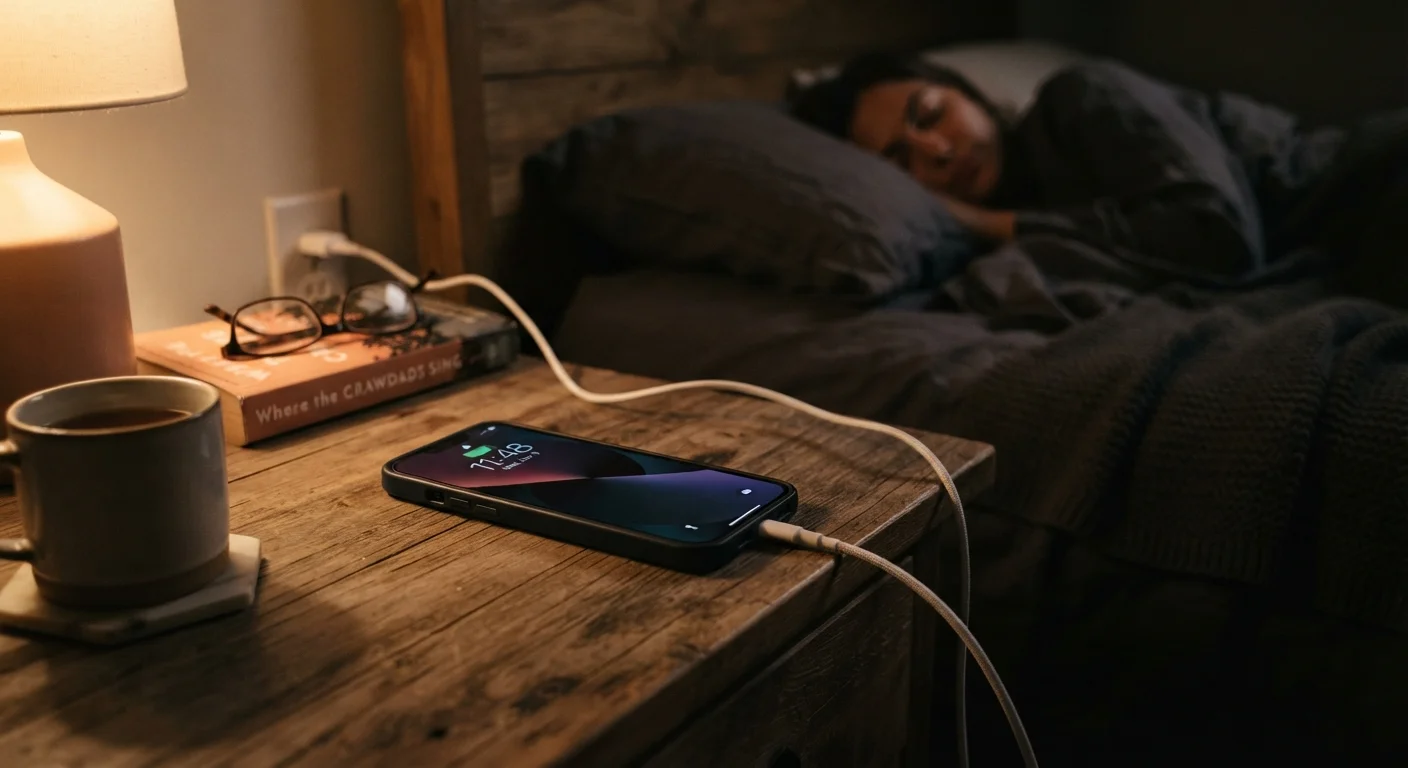
Trapping heat during charging is the highest-risk overnight habit - not the act of charging itself. Charging a phone under a pillow or thick blanket prevents heat dissipation and can, in rare cases, create a fire hazard. Always charge on a hard, open surface and avoid covering the phone while it's plugged in.
The most practical habit you can adopt is targeting the 20-80% charge window. Most modern phones offer a setting to cap charging at 80% automatically. Combined with Optimized Battery Charging - available on both major mobile platforms - your phone learns your sleep schedule and holds at 80% before topping up just before you typically wake. This is engineering doing the work for you. For a broader look at habits that silently shorten a phone's life, our article on things people accidentally do that shorten a phone's lifespan covers the full picture. And if you want to address battery drain from another angle, our guide on signs an app is draining your battery identifies software-side culprits worth checking.