

Key Takeaways
- Correct tire pressure comes from your vehicle's door jamb sticker, not the number printed on the tire sidewall.
- The penny test is a quick, reliable way to check whether your tread depth is dangerously low.
- Most vehicles benefit from tire rotation every 5,000-7,500 miles to prevent uneven wear.
- Temperature swings cause pressure to drop or rise - check tires monthly, not just when they look flat.
- Unusual wear patterns often signal alignment, inflation, or suspension problems worth addressing early.
Start here
Why Tires Deserve More Attention
Next
Tire Pressure: Finding and Holding the Right Number
Then
Tread Depth: How to Know When It's Gone
Build on it
Tire Rotation: Keeping Wear Even
Go deeper
Reading Unusual Wear Patterns
Why Tires Deserve More Attention
Every force that accelerates, steers, or stops your vehicle passes through four palm-sized contact patches where rubber meets asphalt. Tires are your car's only physical link to the road, yet tire maintenance is one of the most commonly skipped routines among everyday drivers.
Neglected tires don't just wear out faster - they reduce braking performance, increase blowout risk, and quietly drain fuel economy. The good news: the core checks take minutes and require nothing more than a $5 gauge and an observant eye. This guide walks through the three fundamentals - pressure, tread, and rotation - so you can keep your tires safe and long-lasting. For a broader look at vehicle upkeep, see your complete maintenance schedule guide.
Tire Pressure: Finding and Holding the Right Number
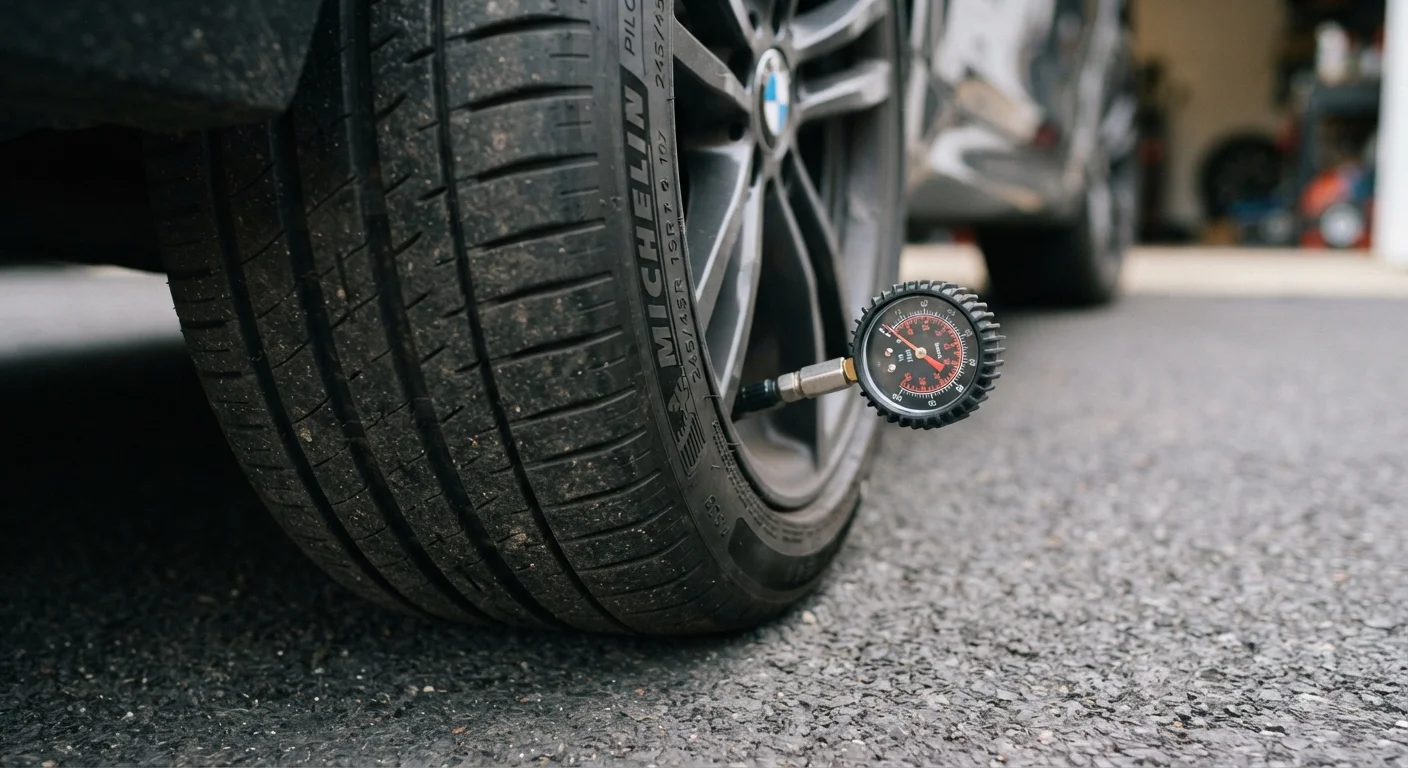
Tire pressure is measured in PSI. The right number for your vehicle is printed on a sticker inside the driver's door jamb - not on the tire sidewall. The sidewall number is the tire's maximum capacity, which is almost always higher than what your car actually needs.
Check pressure when the tires are cold - at least three hours after the vehicle was last driven. Driving heats the air inside, causing pressure to read higher than it truly is at rest. Use an inexpensive dial or digital gauge; eyeballing a tire's appearance is unreliable until pressure is dangerously low.
Build a Monthly Two-Minute Tire Habit
Pick the same day each month - the first, or a day tied to a recurring task - and spend two minutes checking all four tires with a gauge. Consistency matters more than precision: catching a tire that's 8 PSI low early is far better than discovering a flat in a parking lot. Store a gauge in your glove box so it's always available.
Temperature matters year-round. Pressure drops roughly 1 PSI for every 10°F decrease in outside temperature, so tires that were correctly inflated in summer may be underinflated by several PSI come winter. A monthly pressure check takes about two minutes and heads off problems before they start.
Underinflated tires flex excessively, generating heat and wearing the outer edges faster. Overinflated tires ride on a narrower center strip, reducing grip and making the ride noticeably harsher. Both conditions increase stopping distances. Make pressure checks part of your pre-drive vehicle check routine.
Tread Depth: How to Know When It's Gone
Tread grooves channel water away from the contact patch. As tread wears down, wet-weather grip deteriorates - sometimes sharply. In the U.S., the legal minimum tread depth is 2/32 of an inch, but many safety experts recommend replacing tires at 4/32 of an inch, particularly in wet or snowy climates.
PSI
Pounds per square inch - the unit used to measure the air pressure inside a tire. Your vehicle's recommended PSI is on the door jamb sticker.
Tread depth
The measurement from the top of the rubber tread blocks to the bottom of the grooves. Lower depth means less ability to channel water and grip the road.
Tire rotation
Moving each tire to a different position on the vehicle - such as swapping front tires to the rear - so that all four wear at a more even rate over time.
Tread wear indicator
A small raised bar molded into the tire's grooves at the 2/32-inch level. When tread wears flush with this bar, the tire has reached the legal minimum depth.
TPMS
Tire Pressure Monitoring System - a sensor-based system that triggers a dashboard warning light when tire pressure drops significantly below the recommended level.
Wheel alignment
The adjustment of the angles at which tires contact the road. Proper alignment ensures tires wear evenly and the vehicle tracks straight without pulling to one side.
The penny test: Insert a penny into the deepest groove with Lincoln's head pointing down. If you can see the top of his head, the tread is at or below 2/32 - replace the tire. For the 4/32 warning threshold, use a quarter: if Washington's head is fully visible, it's time to start planning for new tires.
Many modern tires include built-in wear indicators - small raised bars molded into the grooves at the 2/32 level. When tread wear reaches those bars, the surface across the indicator becomes flush with the tread - a clear visual signal. Check tread in multiple grooves around the circumference; uneven depth can reveal other problems addressed in the next section.
Tire Rotation: Keeping Wear Even
Because front and rear axles carry different loads and perform different jobs - steering versus trailing - they wear tires at different rates. On a front-wheel-drive vehicle, front tires handle acceleration, braking, and steering simultaneously, so they typically wear significantly faster than rear tires.
Rotating tires moves them to different positions on the vehicle on a regular schedule, spreading wear more evenly across all four. Most manufacturers recommend rotation every 5,000 to 7,500 miles, though your owner's manual is the authoritative source for your specific vehicle. Many drivers time rotation with every other oil change as a convenient reminder.
Directional and Staggered Tires Have Rotation Limits
Directional tires feature an arrow on the sidewall indicating the intended rolling direction. They can be rotated front-to-rear on the same side of the vehicle, but crossing them to the opposite side requires dismounting from the rim. Staggered setups - common on performance vehicles - may not support traditional rotation patterns at all. Consult your owner's manual or a qualified tire shop before rotating these tire types.
A few tire types have restrictions on rotation. Directional tires - designed to roll in only one direction - can be moved front-to-back on the same side but not crossed to the opposite side without dismounting and remounting the tire on the rim. Staggered fitments (where rear tires are wider than fronts) often cannot be rotated at all without a full dismount. Check your tire sidewall markings and owner's manual if you're unsure.
Keeping wear even extends the life of the full set, maintains consistent handling balance, and can reveal alignment or suspension issues early. For vehicles with high mileage where tire condition is especially critical, see keeping a high-mileage car on the road.
Reading Unusual Wear Patterns
Tires wear in predictable ways when everything is working correctly. Abnormal patterns are diagnostic clues worth paying attention to early.
- Center wear: Tread worn primarily in the middle suggests chronic overinflation - the tire's center bears most of the load.
- Edge wear on both sides: Wear on both outer edges points to chronic underinflation, causing the sidewalls to flex and the edges to carry excess load.
- One-sided edge wear: Wear on only one edge typically indicates a wheel alignment problem - the tire is not running perpendicular to the road.
- Cupping or scalloping: A wavy, dipped pattern around the circumference often signals worn shock absorbers or struts causing the wheel to bounce rather than track smoothly.
- Flat spots: Localized flat areas can result from hard braking episodes or leaving a vehicle stationary for an extended period.
If you notice any of these patterns, have a qualified technician assess alignment, tire pressure history, and suspension components before investing in new tires. Replacing tires without fixing the underlying cause simply repeats the problem. Keeping tires in good shape works hand-in-hand with your braking system - see how your braking system actually works for a fuller picture of stopping safety.