

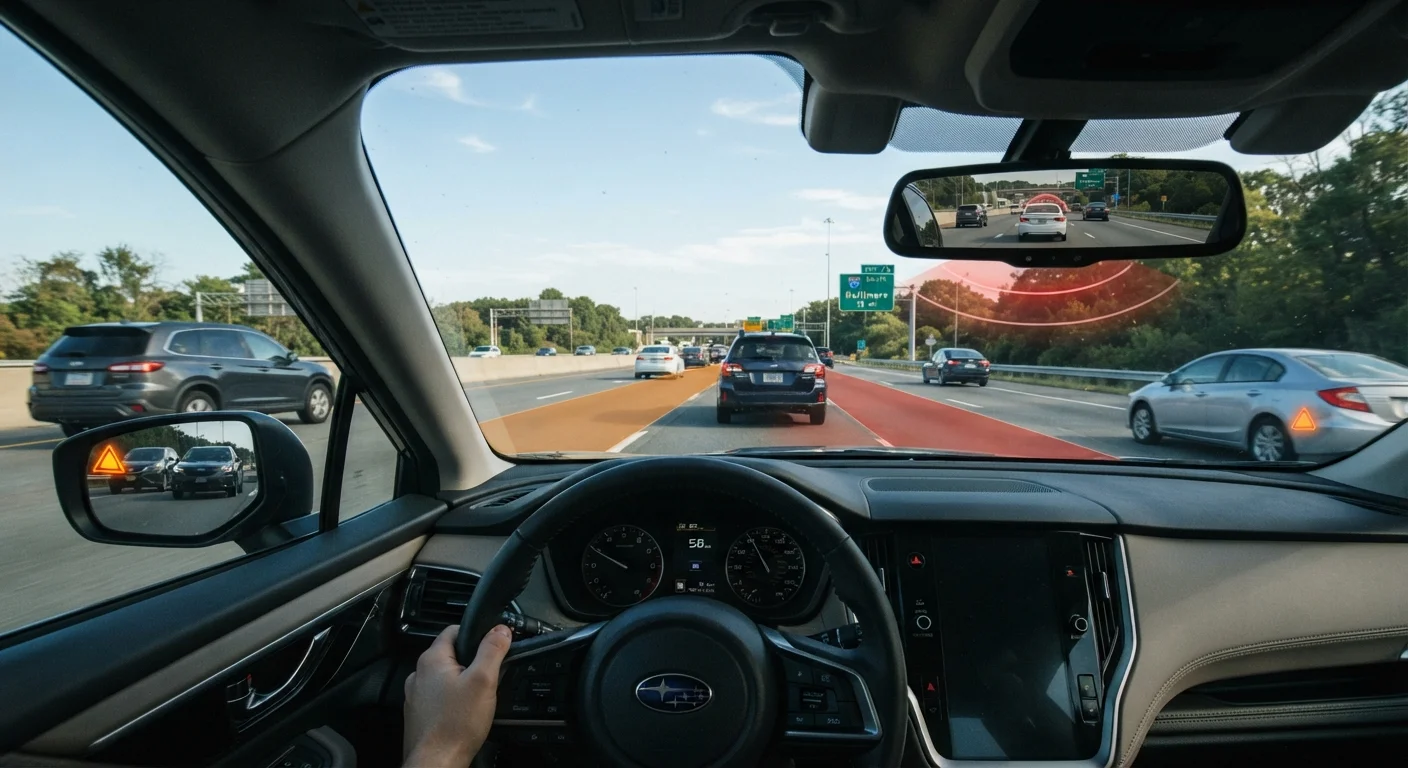
Key Takeaways
- Every vehicle has blind spot zones that mirrors cannot fully cover, regardless of mirror size or type.
- Proper mirror adjustment significantly reduces - but does not eliminate - blind spot risk.
- A brief physical shoulder check is still the most reliable way to confirm a lane is clear.
- Blind spot monitoring technology is a helpful supplement, not a substitute for driver awareness.
- Large vehicles like SUVs and trucks have larger blind zones than sedans, requiring extra caution.
Start here
What Blind Spots Actually Are
Next
Where Your Mirrors Fall Short
Then
How to Check Blind Spots Correctly
When you're ready
Adjusting Your Mirrors for Better Coverage
Going further
Technology Helps - But Doesn't Replace Habit
What Blind Spots Actually Are
A blind spot is any area around your vehicle that falls outside your direct line of sight and outside the coverage of your mirrors. Every production vehicle has them - they are a structural reality of how cars are built, not a flaw unique to older or smaller models.
The term is sometimes used loosely to mean any area a driver misses, but in the context of vehicle safety it refers specifically to defined zones where another vehicle, cyclist, or pedestrian can be present yet completely invisible to the driver. Understanding where those zones are is the first step toward consistently checking them.
Blind spot
An area around your vehicle that is not visible through your mirrors or direct forward gaze - a zone where another road user can be present without your knowledge.
C-pillar
The structural roof support located behind the rear passenger door. It creates one of the most significant rear-quarter blind spots on most passenger vehicles.
Shoulder check
A deliberate head turn - roughly 45-60 degrees - performed by the driver to visually inspect the blind spot area beside and behind the vehicle before changing lanes or merging.
Blind spot monitoring (BSM)
An electronic driver-assist feature that uses radar or cameras to detect vehicles in adjacent lanes and warns the driver, typically through a light near the side mirror.
Rear quarter panel
The section of a vehicle's body behind the rear door and ahead of the trunk. The area beside and behind this panel is one of the most common driver blind spot zones.
This foundational awareness connects directly to broader defensive driving habits - the discipline of continuously monitoring your surroundings rather than reacting only to what's directly ahead.
Where Your Mirrors Fall Short
Most drivers assume their three mirrors - the rear-view and two side mirrors - provide comprehensive coverage. In practice, they don't. Here is where the gaps exist:
- Rear quarter blind spots: The areas just behind and to either side of your vehicle, roughly where your C-pillar (the roof support behind the rear door) blocks your sightline. A full-size car can disappear into this zone.
- Direct rear: Your rear-view mirror shows what's directly behind, but it cannot show vehicles partially beside you or very low objects near the bumper.
- Front corners: On trucks, minivans, and some SUVs, the front corners and hood create a near-vehicle blind zone that hides pedestrians and small objects.
- Directly behind when reversing: Without a backup camera, the area immediately behind the rear bumper is entirely invisible to the driver.
Vehicle body style matters significantly. Sedans tend to have smaller lateral blind spots than SUVs or pickup trucks, whose higher ride height and longer bodies create proportionally larger zones on all sides.
Large Vehicles Have Significantly Larger Blind Zones
Pickup trucks, SUVs, and vans have substantially larger blind spots than compact sedans - especially directly behind and at the front corners. If you've recently switched to a larger vehicle, allow extra time to relearn where the edges of your vehicle are. Never assume a zone is clear based on what felt safe in a different vehicle.
How to Check Blind Spots Correctly
The most reliable method remains a quick, deliberate shoulder check - briefly turning your head to look over your shoulder in the direction you intend to move. A proper shoulder check involves rotating roughly 45-60 degrees, enough to view the adjacent lane without losing focus on the road ahead for too long.
Timing matters as much as technique:
- Before changing lanes: Signal first, then check mirrors, then perform a shoulder check before moving.
- Before merging: Check both the mirror and the zone beside and behind you, since the merging zone is a classic blind spot area.
- When pulling away from a curb: Check over your left shoulder before entering traffic - vehicles may be approaching faster than your mirrors suggest.
- When reversing: Check both side mirrors and look over your right shoulder. If available, use the backup camera as a supplement rather than a primary tool.
Consistent habits in low-stakes moments - quiet streets, familiar routes - build the muscle memory that makes the check automatic in higher-pressure situations. For conditions that further reduce visibility, adapting your driving in rain, snow, and fog becomes equally important.
Build the Habit Before You Need It
Practice shoulder checks on every lane change, even on quiet roads when you're certain no one is there. Consistent repetition in low-stakes environments makes the check feel natural when traffic is heavy and decisions must be made quickly. Deliberate practice is the foundation of reliable driving habits.
Adjusting Your Mirrors for Better Coverage
Mirrors that are correctly adjusted won't eliminate blind spots, but they will reduce their size. Many drivers position side mirrors to see their own vehicle prominently - which feels reassuring but wastes coverage on space you already know is there.
A more effective approach:
- Left (driver's) side mirror: Lean your head toward the driver's window and adjust the mirror until your car's rear corner is just barely visible at the inner edge. From your normal seated position, your car will no longer appear - the mirror will show the lane beside you.
- Right (passenger's) side mirror: Lean toward the center console and repeat the process. This widens the coverage of both mirrors outward.
- Rear-view mirror: Center it on the rear window. Avoid tilting it for convenience - its job is showing what's behind you, not reducing glare from headlights (use the night-mode lever for that).
Before every drive, take a moment to confirm your mirrors haven't shifted. A pre-drive mirror check is a simple habit that takes seconds and pays dividends over time.
Technology Helps - But Doesn't Replace Habit
Many modern vehicles include blind spot monitoring (BSM) systems that use radar or cameras to detect vehicles in adjacent lanes and alert the driver - typically via a light in or near the side mirror, sometimes accompanied by an audible chime.
These systems are genuinely useful. They can detect vehicles in your peripheral field faster than a mirror check alone, and they are particularly helpful on busy highways where traffic moves quickly. However, they have documented limitations:
- They may not reliably detect motorcycles, cyclists, or vehicles approaching at high speed.
- Sensors can be affected by heavy rain, snow, or mud obscuring the radar units.
- System coverage zones vary by manufacturer and may not match where you intuit the blind spot to be.
Treat BSM as an additional layer of awareness, not a clearance signal. The physical shoulder check remains necessary. Drivers who become reliant on alerts may find their manual checking habits atrophy - which creates risk in rental vehicles, borrowed cars, or situations where the system malfunctions.
Dashboard alerts more broadly are covered in our guide to understanding dashboard warning lights - useful context for knowing when a sensor-related alert warrants attention.
BSM Systems Vary by Vehicle
Not all blind spot monitoring systems work the same way or cover identical zones. Review your vehicle owner's manual to understand exactly what your system detects, its documented limitations, and how the alerts are presented. Familiarity with your specific system prevents over-reliance or misinterpretation of its signals.
This article provides general driver education information. Always follow the traffic laws and licensing requirements applicable in your state or jurisdiction.