

Key Takeaways
- Stopping distance has two distinct phases: reaction distance and braking distance.
- Speed has a disproportionately large effect - doubling speed roughly quadruples braking distance.
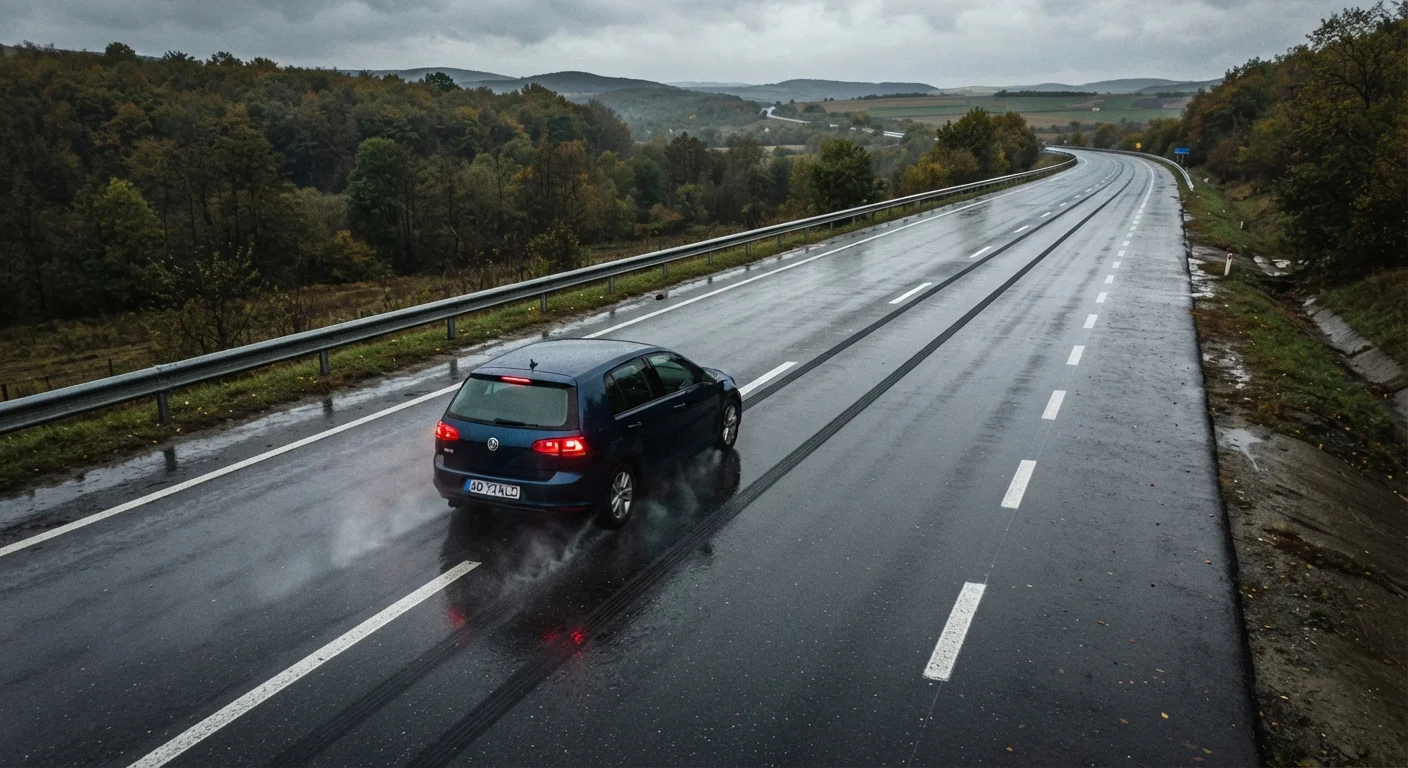
- Wet, icy, or uneven road surfaces dramatically extend the distance needed to stop.
- Fatigue, distraction, and impairment can add significant distance to the reaction phase alone.
- Maintaining a generous following distance is the practical application of stopping distance knowledge.
Stopping Distance
Stopping distance is the total distance a vehicle travels from the moment a driver perceives a hazard to the moment the vehicle comes to a complete stop. It combines two phases: the distance covered while the driver reacts, and the distance covered while the brakes are actually slowing the vehicle. Understanding this concept helps drivers make safer decisions about speed and following distance.
Stopping distance increases with the square of speed - doubling your speed roughly quadruples the braking distance required, not merely doubles it. This relationship follows from basic kinematic physics.
Two Phases, One Critical Number
Every stop your vehicle makes involves two distinct phases that together produce the total stopping distance. The first is reaction distance - the ground your vehicle covers from the moment your brain registers a hazard to the moment your foot depresses the brake pedal. The second is braking distance - the additional distance the vehicle travels while the brakes work to dissipate kinetic energy and bring the car to rest.
Neither phase is trivial. At 60 mph, a driver with a typical reaction time of 1.5 seconds travels approximately 132 feet before braking even begins. Add the braking phase, and the total stopping distance under ideal dry-road conditions can easily exceed 300 feet - roughly the length of a football field. Most drivers significantly underestimate this.
~300 ft
Total stopping distance at 60 mph on dry road
This general estimate includes both reaction distance and braking distance under normal alertness and dry pavement conditions.
4×
Increase in braking distance when speed doubles
Because kinetic energy scales with the square of velocity, doubling speed requires approximately four times the braking distance.
~50%
Increase in stopping distance on wet pavement
Reduced tire-to-road friction on wet surfaces is a widely cited factor in extended stopping distances in safety engineering references.
1.5 sec
Average driver reaction time
This figure reflects a typical alert, unimpaired driver; distraction or fatigue can extend reaction time substantially.
Why Speed Has an Outsized Effect
The physics here are counterintuitive for many drivers. Stopping distance does not scale proportionally with speed - it scales with the square of speed. This is because kinetic energy, the energy that must be eliminated for the vehicle to stop, is proportional to the square of velocity. Double your speed, and you roughly quadruple the braking distance required.
This mathematical relationship has profound real-world implications. A driver doing 40 mph in a 30 mph zone isn't just 10 mph faster - their braking distance is significantly longer than the driver traveling at the posted limit. Small speed differences compound quickly, which is why speed limits near schools, intersections, and pedestrian zones are set conservatively.
“Speed is the single most important factor in both the likelihood of a crash and its severity. The laws of physics are unforgiving - a small increase in speed produces a large increase in stopping distance and crash energy.”
— Road Safety Research Consensus, Summary of findings across traffic safety engineering literature
How Road Conditions Change the Equation
Braking distance assumes that tires can generate enough friction with the road surface to decelerate the vehicle. When that friction is reduced - by rain, ice, oil, loose gravel, or worn pavement - stopping distance extends significantly.
Wet pavement reduces available tire grip and can increase stopping distances by around 50% compared to dry conditions. Ice-covered roads can extend stopping distance by several times the dry-road baseline, depending on temperature and road surface type. These are not minor adjustments; they are life-safety margins that require proportional reductions in speed and increases in following distance.
Our guide to driving in rain, snow, and fog covers how to adapt your speed and spacing habits across challenging seasonal conditions.
Adjust Your Following Distance Before You Need It
Don't wait until conditions deteriorate to increase your following gap. If rain begins, traffic slows, or visibility drops, add buffer distance proactively - before an emergency stop is required. Building this habit means you're never caught reacting to poor conditions at an inadequate following distance.
The Human Factor: Reaction Time
Reaction distance is entirely a human variable, and it is more vulnerable than most drivers recognize. The 1.5-second average assumes a fully alert, undistracted driver who is actively scanning the road ahead. In reality, several factors can stretch that window considerably:
- Distraction - glancing at a phone or infotainment screen for just two seconds at 60 mph means 176 feet traveled without processing the road at all.
- Fatigue - drowsiness impairs cognitive processing speed in ways that parallel the effects of alcohol on reaction time.
- Impairment - alcohol, cannabis, prescription medications, and other substances all slow the brain's hazard-recognition response.
- Expectation - drivers are slower to react to unexpected hazards than anticipated ones, because the brain requires more time to process novel threats.
Understanding that reaction distance is controllable - through rest, attentiveness, and minimizing distractions - gives drivers a meaningful lever to pull before the brakes ever engage. For more on how following too closely compounds these risks, see why tailgating is more dangerous than most drivers realize.
Translating Physics Into Everyday Driving Habits
Knowing the science is only valuable when it changes behavior. The most direct application of stopping distance principles is maintaining an adequate following distance - a buffer that accounts for your reaction time, the road surface, and your vehicle's braking capability at your current speed.
A useful framework is to identify a fixed point on the road ahead and count the seconds between when the vehicle in front passes it and when your own vehicle reaches the same point. In dry conditions at moderate speeds, three seconds is a reasonable baseline. In wet or reduced-visibility conditions, four seconds or more is more appropriate. Popular guidelines such as the two-second rule represent a minimum, not a safety ceiling - a point explored in depth in our analysis of following distance myths.
These habits, grounded in physics rather than intuition, form the foundation of defensive driving - the proactive approach to crash prevention that experienced drivers consistently apply.