

Key Takeaways
- Compounding earns returns on both your original investment and all prior gains.
- Time is the single most important ingredient - starting earlier has an outsized impact.
- Even small, consistent contributions can grow substantially over decades.
- Investment fees compound too, meaning costs quietly erode long-term growth.
- Reinvesting dividends and interest automatically accelerates compounding.
Compounding
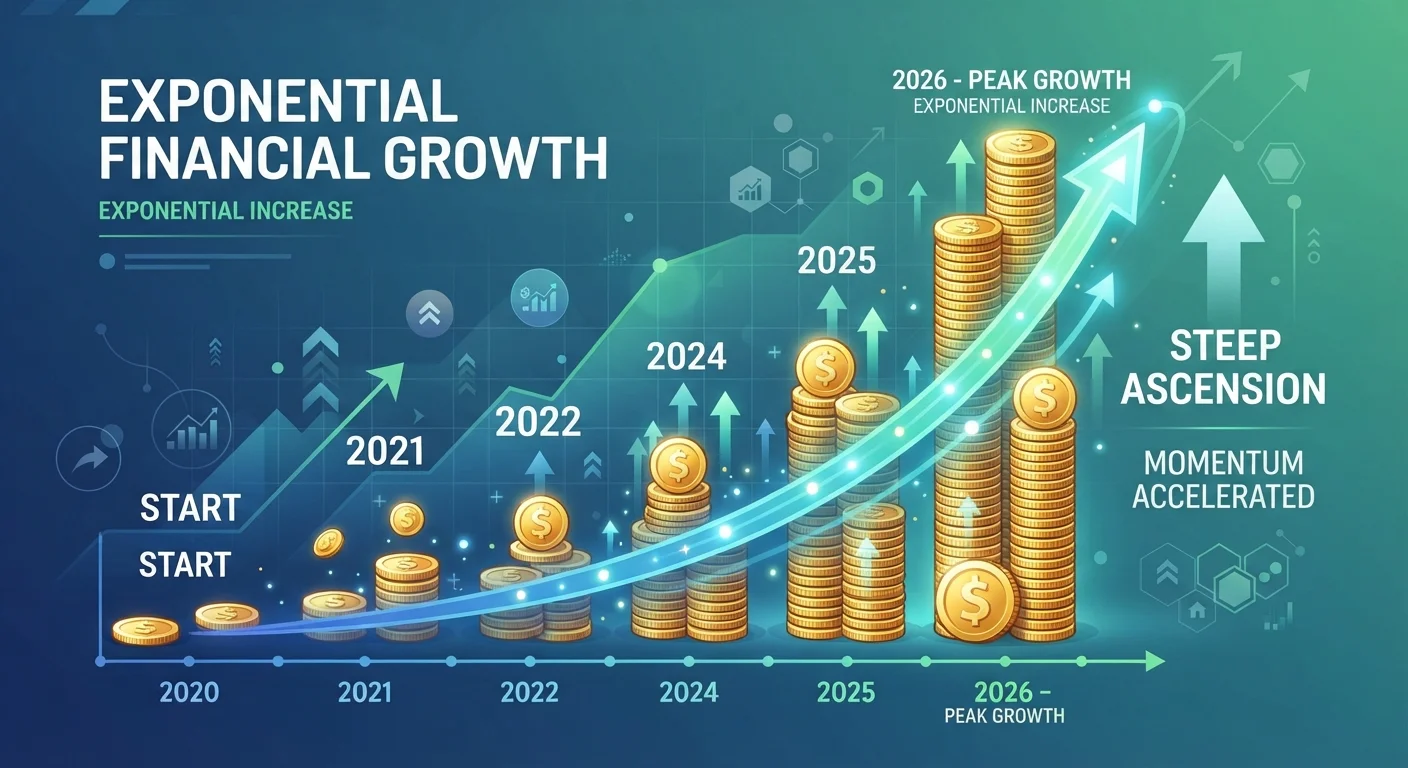
Compounding is the process by which the returns you earn on an investment begin generating their own returns. In other words, you earn growth not just on your original money, but also on all the growth that has already accumulated. Over long periods, this creates an accelerating cycle that can dramatically increase the value of an investment.
Mathematically, compound growth is expressed as A = P(1 + r/n)^(nt), where P is the principal, r is the annual interest rate, n is the number of compounding periods per year, and t is time in years.
How Compounding Actually Works
At its core, compounding is straightforward: your returns become part of the base that earns future returns. Consider a simple example. If you invest $1,000 and earn 7% in year one, you end the year with $1,070. In year two, that 7% applies to $1,070 - not just the original $1,000. Year after year, the base grows, and so does the dollar amount of each year's gain.
This is fundamentally different from simple interest, where returns are calculated only on the original principal. With simple interest, $1,000 at 7% always generates $70 per year. With compounding, that annual gain increases every single year.
The acceleration is gradual at first and dramatic later. This delayed surge is sometimes called the hockey stick effect - the curve looks nearly flat for years, then bends sharply upward. That shape is why investors often feel little is happening early on, even when the math is quietly working in their favor.
$1,000 → ~$7,600
Growth of $1,000 at 7% over 30 years
Illustrates how compounding multiplies an initial investment more than sevenfold over three decades at a historically plausible long-term return rate.
10 years
Approximate doubling time at 7% annual return
Based on the Rule of 72 (72 ÷ 7 ≈ 10.3), a widely cited shortcut for estimating how long it takes a compounding investment to double.
~$30,000+
Potential cost of a 1% fee over 30 years
On a $100,000 portfolio growing at 6% annually, a 1% annual fee can reduce final value by over $30,000 compared to a 0% fee scenario, illustrating compounding's double edge.
Why Time Is the Key Ingredient
No factor influences compounding more than time. The longer money stays invested, the more compounding cycles it goes through - and each cycle builds on a larger base than the last.
Consider two hypothetical investors: one starts investing at age 25 and contributes for 10 years, then stops. The other waits until 35 and contributes for 30 years. Assuming identical annual returns, the earlier starter can end up with more at retirement despite contributing for fewer years and putting in less total money. This isn't a trick - it's the math of exponential growth rewarding earlier start dates.
The practical implication is clear: beginning to invest sooner matters more than investing larger amounts later. A small amount invested today has more compounding runway than a larger amount invested a decade from now.
Automate to Stay Consistent
One of the simplest ways to benefit from compounding is to automate contributions to a retirement or investment account. Automation removes the temptation to skip months when markets feel uncertain - and consistency is precisely what compounding rewards over time. Even small recurring deposits can make a meaningful difference given a long enough horizon.
What Slows Compounding Down
Several factors can meaningfully reduce compounding's impact, and understanding them helps investors protect their long-term growth.
- Fees and expenses: Investment costs reduce the balance available to compound. As explained in our deep dive on investment fees, even a seemingly small annual expense ratio chips away at compounding's effect over decades.
- Withdrawing returns early: Taking out gains before they can compound eliminates the reinvestment cycle. Keeping returns invested - including reinvesting dividends - preserves the full power of the mechanism.
- Gaps in investing: Pausing contributions during market downturns interrupts the process. Strategies like dollar-cost averaging help investors stay consistent across market cycles.
- Inflation: Compounding grows nominal (face-value) wealth, but inflation erodes purchasing power. Real returns - returns after inflation - are what ultimately matter for long-term financial goals.
Putting Compounding to Work
Understanding compounding is most useful when translated into everyday habits. A few principles can help any investor harness this mechanism more effectively.
Start as early as possible. Even if initial contributions are modest, time is the variable that matters most. Waiting for the "right moment" or a larger paycheck often costs more in lost compounding time than the extra savings would gain.
It also helps to understand what you're investing in. Stocks, bonds, and funds each compound differently - equities tend to offer higher long-term growth potential but carry more risk. Choosing a mix aligned with your timeline and goals is a meaningful decision.
Finally, be aware that the same compounding math that builds wealth can work against you in debt. Compound interest in debt accelerates balances owed just as it accelerates balances saved.
“Compound interest is the eighth wonder of the world. He who understands it, earns it; he who doesn't, pays it.”
— Widely attributed (origin disputed), Aphorism commonly cited in financial education contexts
This article is for informational and educational purposes only and does not constitute personalized financial or investment advice. Consider consulting a licensed financial adviser before making decisions suited to your individual circumstances.