

Key Takeaways
- Ultra-processed foods are defined by industrial reformulation, not simply by having undergone some processing.
- The NOVA framework groups foods into four categories based on the degree of processing.
- Observational research links high ultra-processed food intake to several health outcomes, but cannot prove cause-and-effect.
- Nutrient composition, eating patterns, and socioeconomic factors all complicate the research picture.
- Reducing ultra-processed foods while emphasizing whole or minimally processed foods is a reasonable, broadly supported dietary direction.
Ultra-Processed Foods
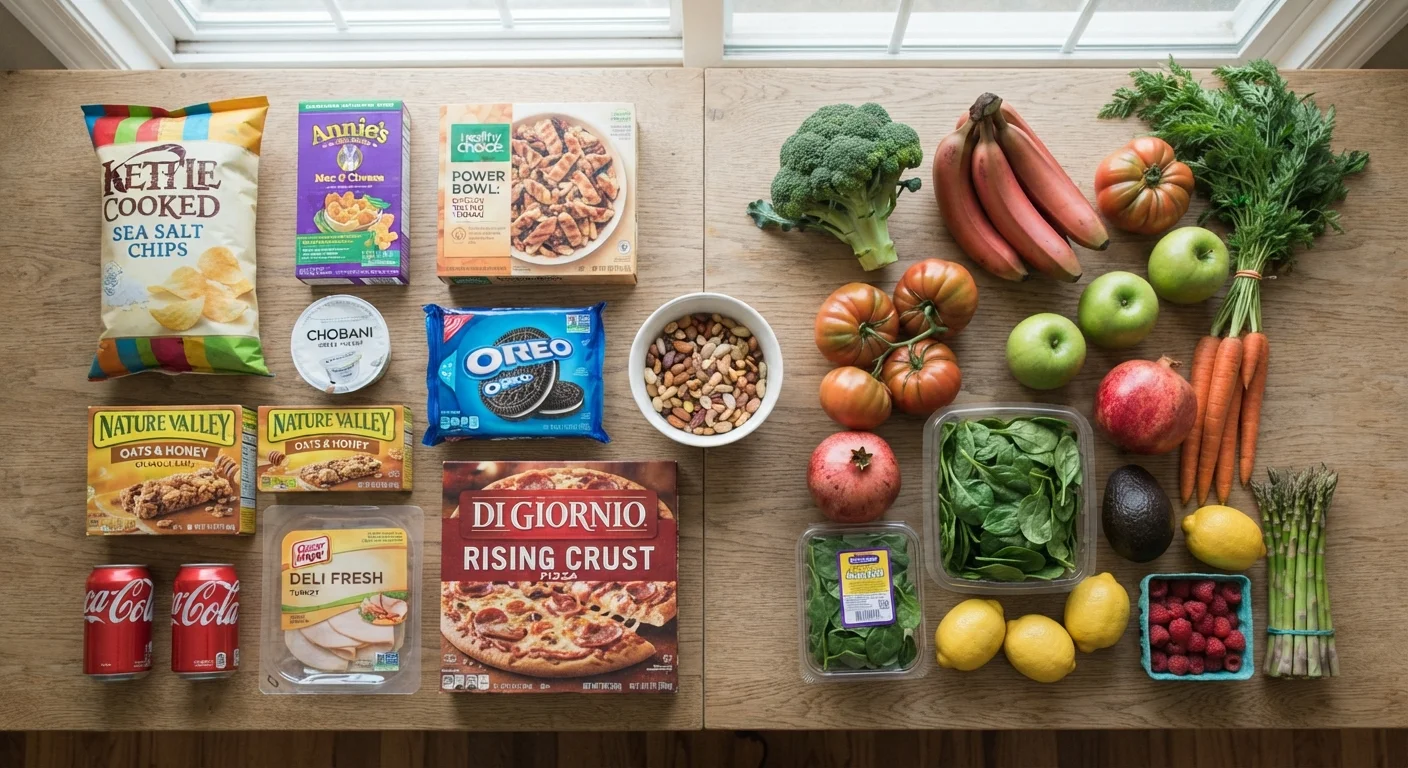
Ultra-processed foods are industrial formulations made primarily from substances extracted or derived from food - like refined starches, fats, sugars, and proteins - plus additives such as artificial flavors, colors, and preservatives. They typically contain little or no whole food. Examples include packaged snack cakes, flavored chips, reconstituted meat products, and many shelf-stable breakfast cereals. The key distinction is not just that they've been processed, but that they've been fundamentally reformulated away from anything resembling whole ingredients.
The term is formally defined by the NOVA classification system, a food grouping framework developed by researchers at the University of São Paulo that categorizes foods by the extent and purpose of industrial processing - not nutrient content alone.
What the NOVA Classification Actually Means
The phrase 'ultra-processed' gets used loosely in media headlines, which is part of why it confuses so many people. In nutrition research, however, it has a specific technical meaning rooted in the NOVA classification system - a framework developed at the University of São Paulo that groups all foods into four categories based on how much industrial transformation they've undergone.
NOVA's four groups, briefly:
- Group 1 - Unprocessed or minimally processed foods: Fresh vegetables, plain meat, eggs, plain milk, dried beans.
- Group 2 - Processed culinary ingredients: Oils, flours, sugars, and salt used to cook Group 1 foods.
- Group 3 - Processed foods: Products made by adding salt, sugar, or oil to Group 1 foods - canned vegetables, simple cheeses, cured meats.
- Group 4 - Ultra-processed foods: Industrial formulations using extracted food substances plus additives not typically found in home kitchens.
The critical point: NOVA does not classify foods by how many calories or how much fat they contain. A plain full-fat yogurt is Group 1; a low-fat flavored yogurt with stabilizers and artificial flavoring may be Group 4. The nutrient label alone doesn't tell the whole story. For a complementary look at how processing changes specific food components, see our article on what happens to grains during refining.
What the Research Has Found - and How Strongly
A substantial body of observational research - studies tracking large populations over time - has associated diets high in ultra-processed foods with increased risk of several health outcomes: obesity, type 2 diabetes, cardiovascular disease, depression, and certain cancers appear in the literature. These associations are consistent enough across multiple countries and populations to be taken seriously by public health researchers.
57%
Share of US daily calories from ultra-processed foods
A 2016 analysis published in BMJ Open estimated that ultra-processed foods account for approximately 57% of energy intake in the average American diet.
10%+
Higher all-cause mortality association
A large French cohort study (NutriNet-Santé) found that a 10-percentage-point increase in ultra-processed food consumption was associated with a greater than 10% increase in all-cause mortality risk - though the relationship was observational.
500 kcal/day
Extra calories consumed on ultra-processed diet
In the 2019 Cell Metabolism randomized trial, participants assigned to an ultra-processed diet ate roughly 500 more calories per day on average compared to those on an unprocessed diet.
However, observational data has a fundamental limitation: it can identify patterns, not causes. People who eat more ultra-processed foods often have other dietary and lifestyle differences - lower fruit and vegetable intake, less physical activity, lower household incomes - that independently affect health. Researchers attempt to adjust for these confounders statistically, but they cannot fully eliminate them.
A notable 2019 randomized controlled trial published in Cell Metabolism assigned participants to either an ultra-processed or unprocessed diet for two weeks and found that those on the ultra-processed diet consumed significantly more calories and gained weight. While informative, a two-week trial with a small sample is limited in what it can tell us about long-term chronic disease risk.
“The science on ultra-processed foods is compelling enough to act on, but honest enough to acknowledge we don't yet fully understand the mechanisms. The consistent finding across dozens of studies is that populations eating more of these foods tend to fare worse - but teasing apart why is genuinely hard.”
— Marion Nestle, Professor Emerita of Nutrition, Food Studies, and Public Health, New York University
The honest summary: the weight of current evidence supports a meaningful association between high ultra-processed food intake and poorer health outcomes. Whether processing itself is the driver - rather than correlated factors like low nutrient density or high calorie density - remains an active area of scientific debate. For more on why nutrition research so often yields conflicting headlines, see where nutrition science gets genuinely complicated.
Where the Debate Still Stands
Critics of the NOVA framework argue that classifying foods by processing level rather than nutrient composition creates some counterintuitive results. For example, an artificially sweetened beverage and a nutrient-dense plant-based meat alternative may both land in Group 4, even though their health implications differ considerably. Some nutrition scientists prefer to analyze specific nutrients - sodium, saturated fat, added sugar, fiber - rather than the processing category as a whole.
Proponents counter that nutrient profiling misses something real: that the matrix of a food - how ingredients are assembled and what additives are present - affects digestion, satiety, and metabolic response in ways that a simple nutrient label doesn't capture. Research into food additives like emulsifiers and artificial sweeteners is ongoing and not yet definitive.
A Simple Ingredient-List Check
When evaluating a packaged food, scan the ingredient list for substances you wouldn't find in a home kitchen - terms like 'modified starch,' 'soy protein isolate,' 'carrageenan,' or any multi-word artificial flavor or color. The longer and more unfamiliar the list, the more likely the product is highly processed. This isn't a perfect system, but it's a practical starting point for everyday shopping.
There's also a practical equity dimension that often goes undiscussed. Ultra-processed foods are frequently cheaper, more shelf-stable, and more accessible than fresh whole foods - especially in lower-income communities and food deserts. Public health recommendations to simply 'eat less processed food' can overlook genuine structural barriers. Any honest assessment of the evidence needs to account for the full context in which food choices are made.
Understanding the spectrum from whole to ultra-processed is a useful foundation: our explainer on what the whole foods vs. processed foods distinction actually means lays out that continuum clearly.
Practical Takeaways for Everyday Eating
Despite the ongoing scientific debate, some practical guidance holds up well across the evidence:
- Dietary patterns matter more than individual foods. A mostly whole-food diet with occasional ultra-processed items is consistently associated with better outcomes than a diet dominated by industrial formulations.
- The ingredient list is more informative than the nutrition facts panel for identifying ultra-processed products. Ingredients you wouldn't find in a home kitchen - like carrageenan, maltodextrin, or artificial flavor complexes - are signals of high processing.
- Small, sustainable shifts outperform elimination strategies. Swapping one or two ultra-processed staples for less-processed alternatives is more realistic and durable than an all-or-nothing approach.
For those interested in where supplements fit when dietary gaps are hard to fill, our piece on nutrition from food vs. supplements explores what the evidence supports there as well.
This article is intended for general informational and educational purposes only and does not constitute medical or dietary advice. Consult a qualified healthcare professional for guidance specific to your health needs.