

Key Takeaways
- Refining removes the bran and germ, stripping away most fiber, B vitamins, and minerals.
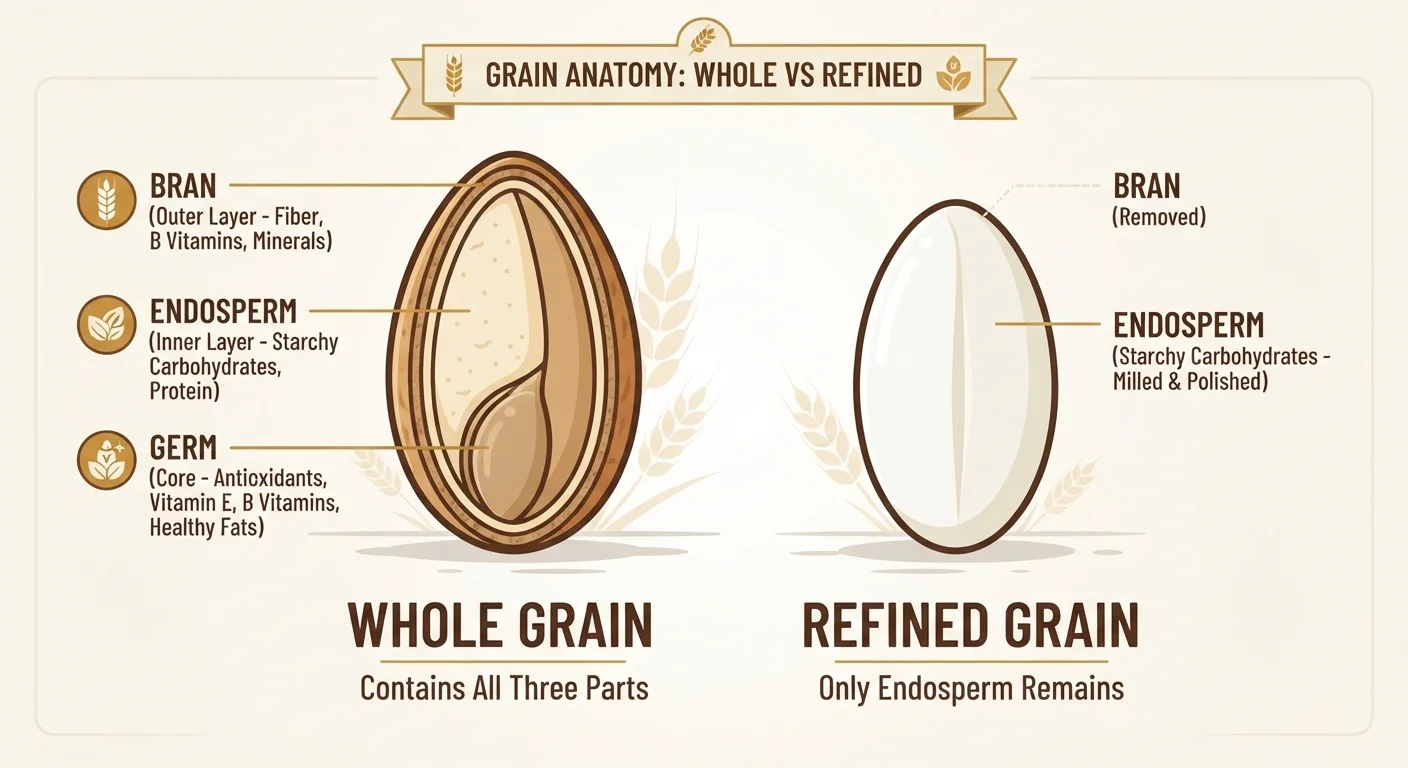
- Whole grains retain all three kernel layers: bran, germ, and endosperm.
- Enrichment adds back some nutrients lost in refining, but not all - fiber is rarely restored.
- Switching even some refined grains to whole grains is a meaningful dietary improvement.
- Reading labels carefully is essential, as 'wheat bread' does not automatically mean whole grain.
Option A
Whole Grains
The intact, nutritionally complete kernel.
Best for: Everyday eating where fiber, vitamins, and minerals are a priority.
Option B
Refined Grains
The processed, longer-lasting starchy core.
Best for: Situations where texture, shelf life, or digestive tolerance take precedence.
If you want to maximize fiber and nutrient density in your daily diet
Whole Grains
Whole grains deliver the full nutritional package of the kernel - fiber, B vitamins, vitamin E, iron, and magnesium - that refining systematically removes.
If you need a longer shelf life or a finer texture for baking
Refined Grains
Removing the oil-rich germ extends shelf stability, and a finer flour produces the lighter crumb structure many baked goods require.
If you have certain digestive sensitivities to high-fiber foods
Refined Grains
Lower fiber content in refined grains can be easier on the gut for some people managing specific digestive conditions - though a healthcare provider should guide individual choices.
If you want a practical middle ground without overhauling your diet
Whole Grains
Small substitutions - swapping white rice for brown, or choosing oatmeal over a refined cereal - can meaningfully shift your overall intake without requiring a complete dietary change.
What a Grain Kernel Is Actually Made Of
Every grain - wheat, rice, oats, corn - starts as a kernel with three distinct layers. Understanding those layers explains exactly what refining does and why it matters nutritionally.
- Bran: The tough outer shell. Rich in dietary fiber, B vitamins (thiamine, niacin, riboflavin), and minerals such as magnesium and iron. It also contains antioxidants.
- Germ: The embryo of the seed, which would sprout into a new plant. Packed with healthy fats, vitamin E, B vitamins, and phytochemicals.
- Endosperm: The largest layer, providing starchy carbohydrates and some protein. This is primarily what refined grains consist of after processing.
A whole grain keeps all three layers intact in their natural proportions. A refined grain has had the bran and germ milled away, leaving mainly the endosperm. The result is a smoother texture and longer shelf life - but at a nutritional cost.
For more on how processing levels affect food broadly, see the distinction between whole and processed foods.
What the Refining Process Actually Removes
Milling is efficient. It is also thorough. When grain is refined, the bran and germ are mechanically separated from the endosperm and typically sold off as animal feed or specialty products - not returned to the flour you buy.
| Criterion | Whole Grains | Refined Grains |
|---|---|---|
| Kernel layers retained | Bran, germ, and endosperm | Endosperm only |
| Dietary fiber | High | Low (mostly removed) |
| B vitamins | Naturally present | Mostly removed; some added back via enrichment |
| Vitamin E | Present (from germ) | Largely absent |
| Minerals (iron, magnesium, zinc) | Higher levels | Reduced; iron partially restored in enriched products |
| Shelf life | Shorter (oils in germ can go rancid) | Longer |
| Texture | Denser, chewier | Lighter, finer |
| Glucose absorption speed | Generally slower (fiber slows digestion) | Generally faster |
The practical losses are significant. According to nutritional analyses, refining wheat flour can remove roughly 75% of its fiber, along with meaningful shares of iron, zinc, magnesium, and several B vitamins. Vitamin E, found almost exclusively in the germ, is largely eliminated.
Some of that lost ground is recovered through enrichment - a process where manufacturers add back iron and certain B vitamins (thiamine, riboflavin, niacin, and folic acid) after milling. Enrichment is required by law for many refined grain products sold in the US. However, fiber is almost never added back through enrichment, and not every micronutrient that was removed is replaced.
~75%
Fiber lost during wheat refining
Nutritional analyses of whole versus refined wheat flour consistently show the large majority of fiber is removed when the bran is milled away.
25%
Of US adults meet whole grain recommendations
Dietary Guidelines data indicate most Americans fall well short of the recommended amount of whole grains in their daily diet.
3 oz
Daily whole grain target for most adults
The Dietary Guidelines for Americans recommend that at least half of all grains consumed each day be whole grains, equating to roughly 3 oz-equivalents for a 2,000-calorie diet.
This matters because fiber does more than aid digestion. It slows glucose absorption, supports gut bacteria, and contributes to satiety. Enrichment restores some isolated nutrients - it does not restore the structural and functional properties of an intact bran layer.
Reading Labels: Spotting the Difference at the Store
Marketing language on grain products is frequently misleading. Terms like multigrain, stone-ground, made with whole wheat, or wheat bread do not guarantee a product is primarily whole grain.
The most reliable signal is the ingredient list. A genuine whole grain product lists a whole grain as its first ingredient - for example, "whole wheat flour," "whole oat flour," or "brown rice." If the first ingredient simply says "wheat flour" or "enriched flour," the product is refined, regardless of what the front of the package implies.
Reading an ingredient list carefully gives you a clearer picture of what a product actually contains beyond its marketing claims. Similarly, the Nutrition Facts label can help: a higher fiber count per serving is a reasonable proxy for a more intact grain. Learn how to read a Nutrition Facts label without getting confused to put that number in context.
Enriched Does Not Mean Equivalent
When you see "enriched flour" on a label, it means specific nutrients were added back after milling - typically iron and four B vitamins. This is a positive step, but enrichment does not restore fiber or the full range of phytochemicals, minerals, and antioxidants found in the intact bran and germ. An enriched refined grain and a whole grain are not nutritional equals.
Whole grains and refined grains also sit along a broader spectrum. Ultra-refined products - like many snack crackers and packaged pastries - layer additional processing on top of refined flour. For a broader picture of what heavy processing adds to food, the research covered in ultra-processed foods is worth reviewing.
Practical Ways to Shift Your Grain Intake
A complete dietary overhaul is rarely necessary or sustainable. Small, consistent substitutions tend to stick better and still deliver real nutritional benefit.
- Swap white rice for brown or wild rice. Brown rice retains its bran layer and offers more fiber and magnesium per serving.
- Choose rolled oats over instant flavored packets. Plain rolled oats are a whole grain; many flavored instant varieties add sugar and have lower fiber content.
- Look for whole grain pasta. Whole wheat pasta has a nuttier flavor and more fiber. Mixing it with regular pasta in the same dish is one way to ease into the change.
- Try different whole grains. Farro, barley, quinoa (technically a seed, but often grouped here), and bulgur offer variety and different nutrient profiles.
Context matters too. Someone who eats mostly vegetables, legumes, and lean proteins and occasionally eats white rice is in a very different nutritional position than someone whose diet relies heavily on refined grain products throughout the day. Total dietary pattern, not any single food, shapes long-term health outcomes.
This article is for general informational and educational purposes only. It is not a substitute for personalized dietary advice from a registered dietitian or qualified healthcare professional.