

| Report data sources | DMV records, insurance claims, auctions, repair shops, rental agencies |
| Key identifier used | 17-character Vehicle Identification Number (VIN) |
| Title brand types | Salvage, rebuilt, flood, lemon law buyback, junk |
| Odometer check | Flags rollback or inconsistent mileage readings |
| Ownership history | Number of prior owners and states where registered |
| Accident records | Includes reported collisions, airbag deployments, and damage severity |
What a Vehicle History Report Contains
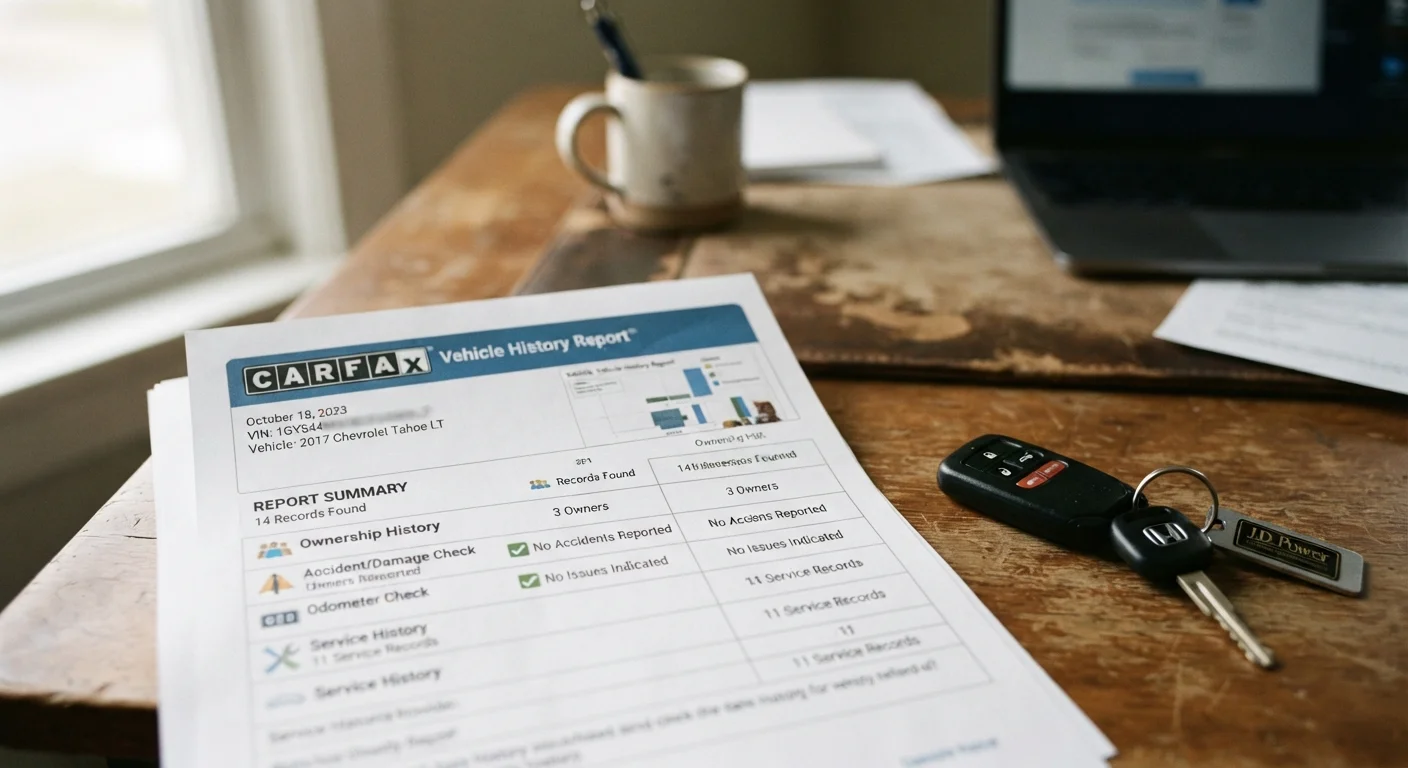
A vehicle history report is a compiled record of key events tied to a specific used vehicle, pulled together using its 17-character VIN. Think of it as the car's official paper trail - sourced from state DMV databases, insurance companies, salvage auctions, auto repair networks, rental agencies, and fleet operators.
| Report data sources | DMV records, insurance claims, auctions, repair shops, rental agencies |
| Key identifier used | 17-character Vehicle Identification Number (VIN) |
| Title brand types | Salvage, rebuilt, flood, lemon law buyback, junk |
| Odometer check | Flags rollback or inconsistent mileage readings |
| Ownership history | Number of prior owners and states where registered |
| Accident records | Includes reported collisions, airbag deployments, and damage severity |
Most reports are organized into several core sections:
- Title history: Shows every time the title changed hands and flags any branded titles - salvage, rebuilt, flood-damaged, or lemon law buyback.
- Accident and damage records: Lists reported collisions, including estimated damage severity and whether airbags deployed.
- Odometer readings: Compares mileage recorded at different points to catch potential rollbacks or inconsistencies.
- Service and maintenance records: Entries from shops that report to the data network, such as oil changes, recalls completed, or emissions tests.
- Ownership count and location: How many owners the vehicle has had and which states it was registered in.
- Use type: Whether the vehicle was used as a rental, fleet vehicle, police car, or taxi.
For a broader look at the used-car buying process, see our walkthrough of used-car inspection checks.
Red Flags Worth Taking Seriously
Not every entry in a report is alarming, but certain findings deserve close attention before you proceed with a purchase.
Reports Have Limits
A vehicle history report only includes events that were officially reported to insurers, DMVs, or repair shops that submit data to the reporting service. Unreported accidents, private-party repairs, and cash transactions may never appear. Always pair a history report with a professional pre-purchase inspection for the most complete picture.
- Salvage or rebuilt title: A salvage title means an insurer deemed the vehicle a total loss at some point. A rebuilt title means it was repaired and reinspected, but structural integrity, safety systems, and resale value may still be compromised.
- Flood damage: Water intrusion - especially into electrical systems - can cause long-term reliability problems that surface months after purchase.
- Odometer rollback: Mismatched mileage readings across different recorded dates are a serious warning sign of potential fraud.
- Multiple owners in a short period: Frequent ownership changes can indicate recurring mechanical problems that prompted each seller to move on quickly.
- Reported as a rental or fleet vehicle: These vehicles often have higher-than-average wear from multiple drivers; this isn't automatically disqualifying, but it warrants extra scrutiny.
- Open safety recalls: Cross-reference with the NHTSA database to confirm any outstanding recalls have been completed.
A clean history report is reassuring, but it doesn't replace hands-on evaluation. Our pre-purchase inspection guide explains what a qualified mechanic will examine that a report simply cannot capture. You may also want to review what certified pre-owned programs actually guarantee to understand how those vehicles are vetted differently.
A vehicle history report is one essential layer of due diligence - not the only one. Pair it with a test drive, a professional inspection, and a clear-eyed comparison of new versus used trade-offs to make a decision you feel confident about.